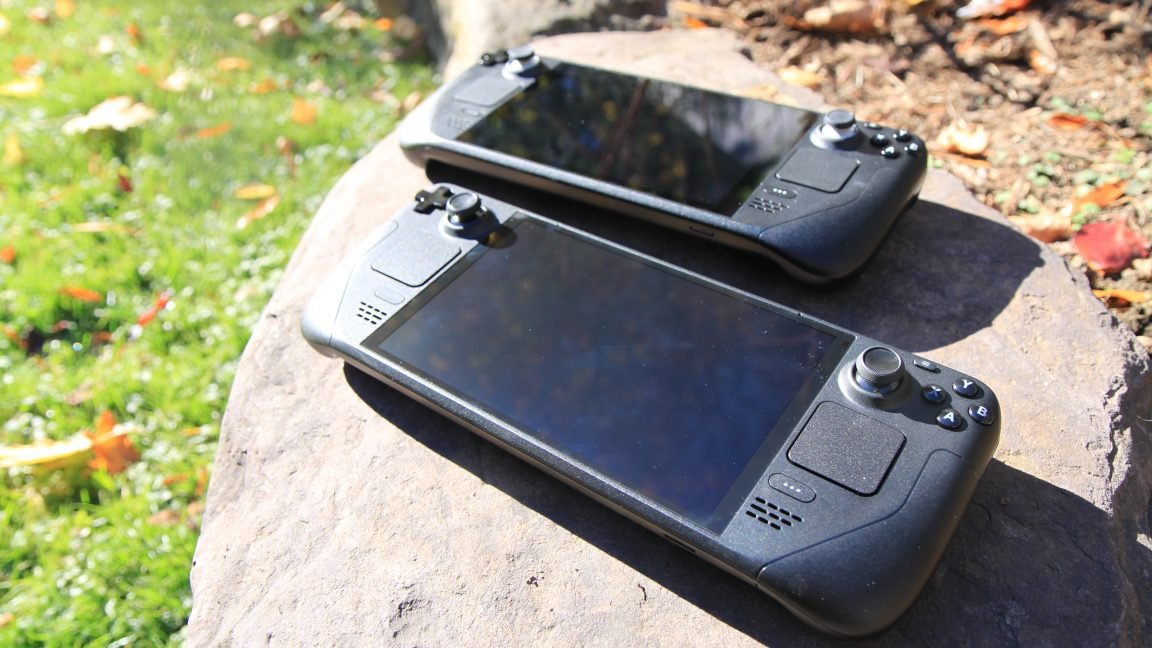
Since its 2022 launch, the Steam Deck has consistently been at or near the top of the company’s “top selling products by revenue” charts, with brief dips outside of the top 10 treated as newsworthy events. But sales of the popular handheld gaming PC have apparently been on a steep decline since the system relaunched at a higher price in May.
Linux-focused gaming site Boiling Steam breaks down the historical data, showing how the Deck’s chart position has fallen from fifth place immediately after orders resumed in late May down to 14th place for two weeks in early July (the hardware sits at 12th place in the current edition of those charts).
That’s in sharp contrast to 2025, when the Steam Deck never dropped below seventh place on the bestseller charts and was only rarely outside the Top 5. Then Valve warned of “intermittent shortages” for the Steam Deck starting in February, leading to weeks of lower chart positions before the Deck became completely unavailable until May.
Boiling Steam does some back-of-the-envelope math to try to translate these revenue-based chart positions into estimated unit sales ranges for the Steam Deck, based on assumptions about average sale price across hardware models (both before and after the price hike) and estimated weekly revenues for the surrounding games on the charts. That rough model suggests Steam Deck sales may have fallen by approximately 80 percent from a 2025 baseline of about 11,000 to 18,000 units per week to a current estimate of just 1,400 to 3,000 per week. While there’s a lot of wiggle room in those estimates, anything close to those numbers would reflect a huge slowdown in sales for a handheld that sold an estimated 4 million units in its first three years.
Supply and demand
Boiling Steam attributes this marked sales dip to a price increase that has “completely shut down demand for the Steam Deck.” And it’s likely that the Steam Deck’s historical $400 to $649 price range was much more attractive to consumers than the current $789 to $949 range brought on by RAM and storage shortages. At current prices, consumers might start considering more powerful handheld gaming PCs in the same price range from competing hardware lines like ROG’s Ally, Lenovo’s Legion Go, or MSI’s Claw.
But the relative dip in Steam Deck sales could also reflect the shortages in Steam Deck supply that Valve still warns are impacting availability in some regions “intermittently.” While some stock trackers have shown consistent availability for the Steam Deck since late May, the hardware was briefly unavailable in North America shortly after relaunching at its new prices, suggesting Valve can’t always satisfy the current market demand.
Regardless of the reason, it seems clear that Valve is currently selling many fewer Steam Deck units than it did even six months ago. In normal times, this might be a good sign that Valve should get moving on finalizing and releasing the long-awaited Steam Deck 2. But given how component pricing is looking for the immediate future, we shudder to think what Valve would have to charge to make a profit on a more powerful handheld today.