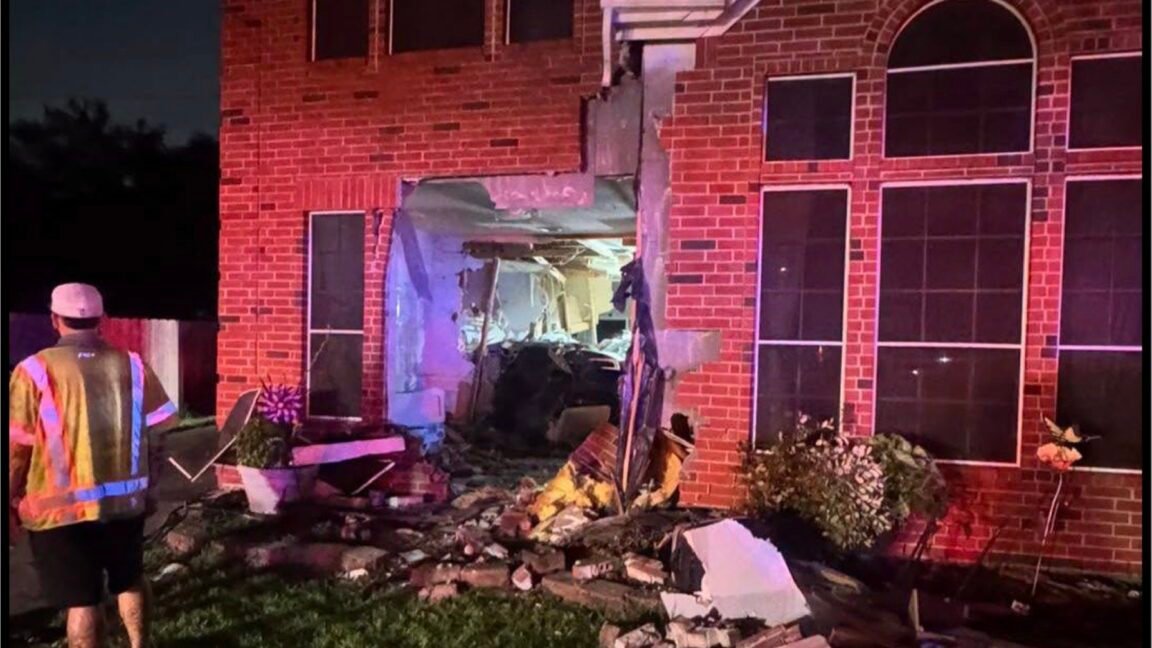
On Wednesday, the National Transportation Safety Board (NTSB) released preliminary findings verifying Elon Musk’s and Tesla’s claims that a driver involved in a fatal Texas crash that killed a grandmother overrode Full Self Driving in the moments ahead of impact.
Last month, 44-year-old Michael Butler told police that the autopilot feature was engaged at the time of the crash. On X, Musk disputed the claim, writing that Butler must have overridden the feature because “FSD drives slowly through neighborhood streets, and this was a high-speed crash!” Moving to back Musk’s claim, Tesla’s vice president of AI software, Ashok Elluswamy, said that internal data showed “the driver manually overrode self-driving by pressing the accelerator all the way to 100 percent of the accel pedal in this residential area.”
NTSB’s preliminary report, which does not yet determine what caused the crash, confirmed Tesla’s claims. Their probe found that FSD was engaged at the time of the crash, but electronic data showed “the driver manually overrode FSD (Supervised) by pressing the accelerator pedal to 100 percent.”
According to a local ABC News report, Texas cops searched Butler’s phone with his permission and found that he was working as a DoorDash driver when the crash occurred. The phone data showed that Butler had no issues with the Tesla making multiple prior delivery stops, but Butler allegedly told police he “passed out” and didn’t remember leaving the highway or turning onto the residential streets.
It seems that Butler may have wanted more reliability out of the autopilot feature, with Google searches on his phone showing queries like “Tesla FSD not aggressive enough 2026,” “Tesla not aggressive enough,” and “Tesla FSD too timid,” ABC News reported.
If the Tesla had successfully navigated that course that Butler set before allegedly losing consciousness, the car would have turned left before smashing into the family home where 76-year-old Martha Avila lost her life. But ABC News reported that in the six seconds before the crash, the Tesla instead exceeded 70 mph speeds and continued straight after the pedal was pressed “all the way down.”
The NTSB said that “security camera footage showed the car’s path of travel as it continued straight through the intersection, departed the roadway, and struck the residence.”
Butler has been charged with manslaughter and jailed, with a bond set at $150,000, ABC News reported.
Alongside Tesla, he also faces a lawsuit where Avila’s surviving family has alleged that both he and Tesla were negligent and may be to blame for the crash.
Although cops initially found no evidence of a mechanical malfunction, the family has alleged that Butler’s car may have been defective. For example, a Tesla defect known as “Sudden Unintended Acceleration” can occur when “components of the vehicle require additional power” and the draw on the battery causes “significant spikes in the system,” their lawsuit explained. If that happened to Butler’s car, the inverter may “incorrectly interpret that the accelerator pedal has been pressed” and rapidly advance to dangerous speeds.
NTSB confirmed that “all aspects of the crash remain under investigation while the NTSB determines the probable cause, with the intent of issuing safety recommendations to prevent similar crashes.”
Additionally, the National Highway Traffic Safety Administration has opened a special investigation.