US President Donald Trump’s whimsical and profoundly ill-advised war against Iran has shredded the US reputation for probity. Trump committed a huge strategic blunder. The global consensus views the current crisis as an artificial emergency, and US allies are now suffering for Trump’s mistakes, both economically and potentially militarily, for example by the unilateral redeployment of PAC-3 and THAAD missile defense systems from East Asian allies to the Middle Eastern theater.
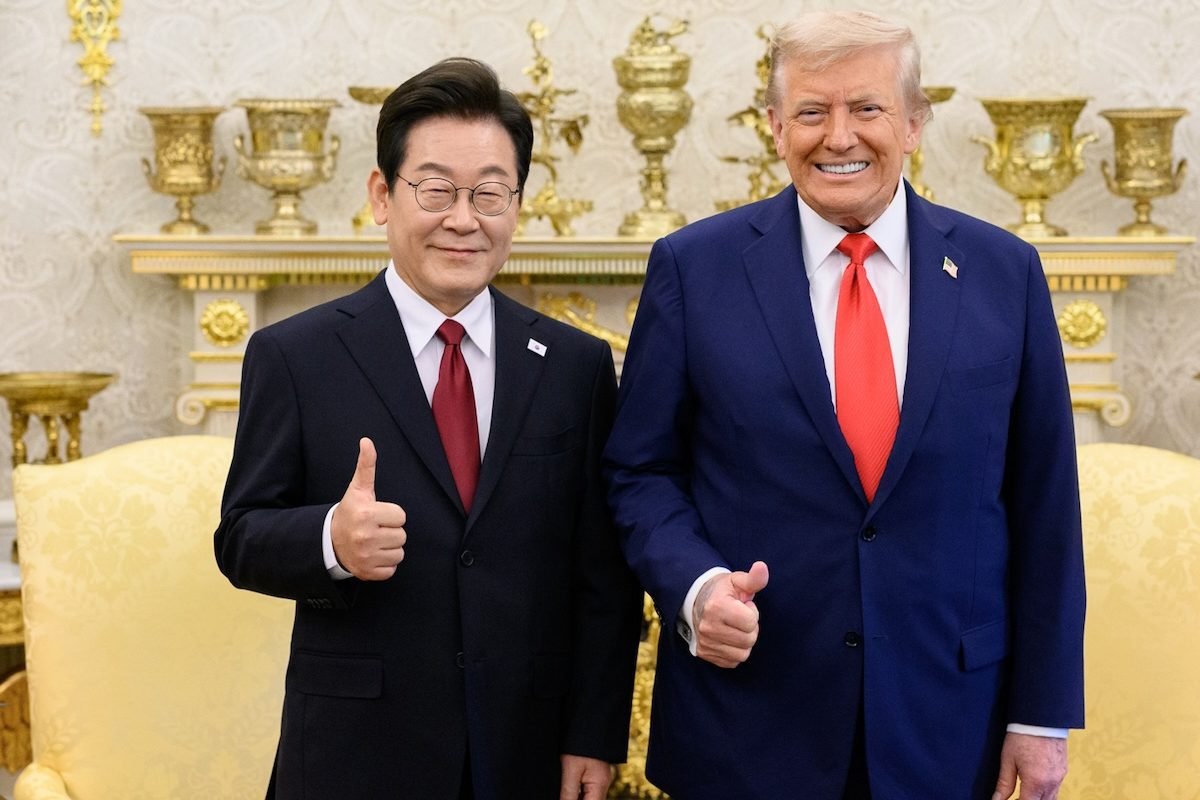
So what is the impact of the US-Iran War, specifically on the South Korea-US Alliance? Amid the international disorder generated over the past nine months by Trump’s military interventions in Venezuela and Iran, South Korean President Lee Jae Myung has pursued a strategy of “Pragmatic Diplomacy Centered on National Interest.”
Prioritizing national interest is a universal goal for any sovereign state, but this author initially doubted whether such a pragmatic approach could effectively counter the current US National Security Strategy and National Defense Strategy – which are distinctively unilateral and coercive, aggressively demanding increased burden-sharing from allies.
Upon deeper analysis, however, the pragmatic diplomacy of the Lee Jae Myung administration has proven to be a highly substantive, practical, and effective national security strategy for protecting South Korea’s interests against President Trump’s erratic behavior, for several reasons:
First, with a US administration that unilaterally takes unpredictable military actions, driven by the principles of America First and “Make America Great Again,” President Lee’s pragmatic diplomacy offers helpful flexibility. In contrast, a rigidly principled, conventional response would be of little use when the US routinely ignores its own strategic doctrines and international law in favor of President Trump’s personal whims.
Second, historically, whenever the US released a new National Security or National Defense Strategy, its allies would rush to publish their own corresponding security and defense blueprints, to align their roles with the US During the current Trump administration, however, very few allies have issued formal written responses, having concluded that proactively committing to specific principles and roles offers no strategic advantage.
Third, under previous US administrations, international law served as the ultimate shield for smaller nations resisting superpower coercion, but President Trump has repeatedly disregarded such niceties. US allies are therefore shifting toward flexible, case-by-case strategies tailored to make the best of Trump’s erratic behavior, rather than naively relying on international law as a fixed rule.
Accordingly, South Korea and other nations are focusing less on formal US strategic documents and more on monitoring where Trump’s personal attention is moving, adopting a “situation-to-situation response” framework.
This dynamic explains why President Trump’s call for allies to join a coalition against Iran’s blockade of the Strait of Hormuz was met with a lukewarm response, since US allies felt that Trump had manufactured the crisis himself. Encountering difficulties, Trump began aggressively bullying allies, including South Korea – one of the primary users of the strait – to deploy forces to help him out.
This coercive approach, was more appropriate for a primary school child than for an American president. Trump complained, for example, that the UK was not helping, then said that he did not need British help – and, anyway, UK forces were useless. Public opinion about Trump, as well as the US, has turned sharply negative in Trump’s second turn, this reversal being particularly strong in South Korea.
In fact, President Lee’s pragmatic diplomacy has secured a number of substantial concrete achievements, as detailed in this table:
| Key Achievement Area | Specific Outcome & Strategic Leverage |
| ROK–US Summits | Minimized the fallout of Trump’s tariff wars, leveraging commitments for large-scale South Korean investment in the US and its domestic shipbuilding base. |
| Nuclear Technology Support | Alleviated doubts regarding the US extended deterrence commitment by securing US support for South Korea’s civilian and naval nuclear technology, formalized in a Joint Fact Sheet released by the White House on November 13 last year. |
| Indigenous SSN Project | President Lee personally took charge of the ROK Navy’s independent nuclear-powered attack submarine (SSN) program. On May 26, he chaired the historic 1st Future Defense Development Committee at the Submarine Command in Jinhae. A US working-level inter-agency delegation visited Seoul on June 12 for a two-day kick-off meeting, agreeing to hammer out technical specifics in upcoming expert panels. |
| OPCON Transition Roadmap | Announced a concrete roadmap for the transition/recovery of Wartime Operational Control (OPCON) to the ROK Armed Forces. Operating under the reality that the terms of both administrations conclude in 2028, Seoul is actively pushing the Trump administration to establish the end of 2028 as “X-Year” for the final OPCON handover. |
We are now entering a transitional phase which requires a fundamental reinterpretation of the South Korea-US alliance. The role of United States Forces Korea (USFK) is changing, and a new division of labor between USFK and the Republic of Korea military is required. Trump has asserted that while the US will handle global confrontations with China and Russia, allies must increase their defense spending to counter regional military threats within their respective theaters, a concept he describes as a “decent peace.”
In support of a stronger role for its military, South Korea has emerged as the world’s fourth-largest defense exporter, very capable of mass-producing the heavy weaponry and hardware vital for modern and future warfare. Indeed, at the recent G7 meeting, President Trump explicitly asked President Lee, “Can South Korea urgently build 10 naval warships for the United States?” and President Lee responded, “In the spirit of our 70-year alliance, and with South Korea’s world-class defense industrial capacity, we are fully capable.”
On June 23, the New York Times published an op-ed arguing that even a global superpower like the United States cannot maintain its status without allies, and must therefore delegate roles and missions to them. This logic aligns nicely with President Lee’s policy of building a self-reliant defense and a strong military, which does not imply isolating the ROK military, it means evolving into a highly complementary military alliance with USFK.
The OPCON transition will boost the ROK military’s expertise in combined operations and significantly strengthen the mission capability of the ROK Joint Chiefs of Staff. While some critics point out that only a small minority of ROK generals have fully digested the combined operational plan, OPLAN 5015, this transitional window is precisely the time to pivot toward a South Korean-led combined operations framework.
Trump’s America First policy threatens to alter the traditional contours of the combined defense posture, as seen for example by the recent provocative comments of USFK Commander General Xavier Brunson about the Korean Peninsula being a “dagger” aimed at China. We must seize this opportunity: it is time for the ROK military to take the steering wheel and guide USFK forward.
Domestic security and military analysts have had a tendency to treat the ROK–US alliance as eternal and unshakeable. This needs to change. In the past, assignments to the ROK–US Combined Forces Command were often seen as marginal, and were sometimes filled by officers waiting out the time until retirement. The OPCON transition will require a drastic change in this mindset: only the best of the best will do for the core of our combined defense commands.
This will enable the ROK military to take the lead in upgrading our defensive posture against North Korea, moving from a legacy-based, conventional framework to build an advanced, future-warfare-ready capability. Our next generation of military leaders will guide USFK and design future operational doctrines, using OPCON recovery as a springboard to a genuinely strong military.
OPCON transfer has been discussed since 2007, but its execution has long suffered from political timidity. At the working level, staff worried more about their English language proficiency than about strategic command. Today, the English language capability of ROK service members ranks among the highest in the world.
What does the Trump administration, or any subsequent administration, really want from South Korea? Surely, they need a strong, self-reliant, and capable ally. It is time to trust the institutional capacity of the ROK military to back our pragmatic diplomacy with hard power, and time to get on and complete the OPCON transition.
Captain Sukjoon Yoon (ROK Navy, Ret.) is a Policy Advisory Committee Member, Ministry of National Defense, since last December and a visiting research fellow, Korea Institute for Military Affairs (KIMA).