The US push for a wartime industrial base is accelerating, but its real test is whether new weapons can be produced, delivered and sustained fast enough for a multi-front Indo-Pacific conflict.
This month, the Center for Strategic and International Studies (CSIS) released a report indicating that, although the US has made significant progress towards preparing its defense industrial base for wartime needs, important weaknesses in stockpiles and supply chains persist.
The report outlines how the US Department of Defense (DoD) has leveraged large-scale public and private capital to counter strategic adversaries like China. The US DoD expanded its vendor ecosystem by adding 5,000 new entrants in FY 2025 and driving nontraditional contract obligations past US$120 billion.
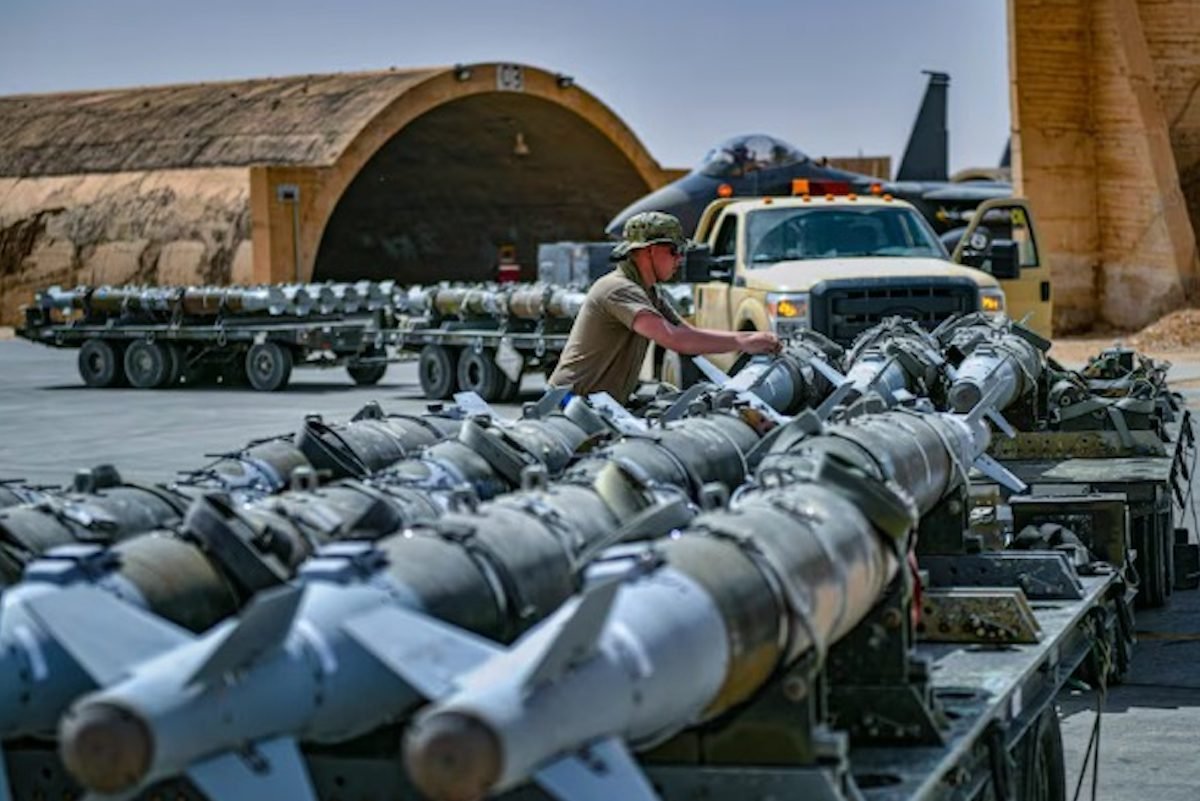
To replenish munitions depleted during the Iran War, the DoD secured historic multiyear agreements to boost interceptor production and shifted its strategy toward a “high-low mix,” aiming for low-cost munitions to comprise 70% of requested units by FY 2031.
Furthermore, the US committed $7.6 billion between 2025 and 2026 to build a secure “mine-to-magnet” rare earth supply chain outside Chinese control.
Despite these aggressive acquisition reforms and an estimated defense budget request of 4.6% of GDP for FY 2027, the report warns that institutionalizing true readiness will take years, as manufacturing lead times for vital weapons still stretch to over 3 years.
While the US is measuring industrial mobilization by money committed and capacity promised, the decisive test is whether it can outproduce China, move matériel across the Pacific, and replace losses faster than a real war consumes them.
However, it remains to be seen whether the projected production can meet the demands of high-intensity conflict on the Korean Peninsula, over Taiwan or across simultaneous theaters.
In a pre-emptive strike against North Korea, Nicholas Anderson and Daryl Press estimate in a 2025 Texas National Security Review (TNSR) article that a highly localized operation would rely on 24 long-range B-1 and B-52 bombers carrying 528 air-launched cruise missiles (ALCMs), as well as 120 sea-launched Tomahawk cruise missiles fired from naval vessels.
Furthermore, Anderson and Press add that US ground forces on the Korean Peninsula would contribute 48 M270A1 precision-guided Multiple Launch Rocket Systems (MLRS) to the immediate counterbattery campaign against North Korean artillery. That expenditure pales in comparison to the cost of a potential US-China conflict over Taiwan.
Seth Jones estimates in a May 2026 CSIS report that in the first seven days of a conflict, the US military would expend 3,000 to 5,000 baseline Joint Air-to-Surface Standoff Missile (JASSMs), 3,500 to 4,000 JASSM-Extended Range (JASSM-ER), and 400 to 1,000 Tomahawk cruise missiles, severely depleting or exhausting key US stockpiles almost immediately.
A simultaneous or near-simultaneous Korea–Taiwan conflict would split scarce US missiles, bombers and logistics, forcing support for one front at the expense of the other.
This raises the question of whether US munitions production can offset China’s industrial advantage and replace wartime losses quickly enough to alter the regional balance.
The Heritage Foundation’s January 2026 TIDALWAVE report compares the US and Chinese munitions systems, noting that while the US Indo-Pacific munitions system has significant structural fragility, the Chinese system is a massive, highly integrated enterprise optimized for high-intensity regional conflicts.
According to the TIDALWAVE report, the US model relies on finite stockpiles and could face an extreme “Triple Bind” supply failure within 25 to 120 days due to a two-year production lag, critical bottlenecks in rocket motors, and heavy reliance on imported Polish TNT.
In contrast, it says China’s state-owned conglomerates — like NORINCO — leverage automated, robotic “smart factories” that maintain resilient peacetime production with a 150% to 250% wartime surge capacity, allowing China to sustain prolonged combat depth.
However, the report points out that both nations share profound chokepoint vulnerabilities: the US is deeply dependent on Chinese rare earth minerals, while China’s highly centralized, rail-dependent distribution networks remain uniquely susceptible to targeted cyber warfare and advanced semiconductor export sanctions.
The comparison suggests that China holds the advantage in sustained regional munitions production, but both sides remain vulnerable to targeted disruption at critical industrial and logistical chokepoints.
Even if the US consolidates its supply chains and expands munitions production, those gains may not translate into combat power if vulnerable ports, transport networks, dispersed bases, storage sites and maintenance hubs cannot deliver and sustain the weapons under Chinese attack.
Highlighting the vulnerability of US facilities in the Pacific, Thomas Shugart III and Timothy Walton argue in a January 2025 Hudson Institute report that chronic underinvestment in Indo-Pacific combat logistics has left US forward bases unhardened and acutely vulnerable.
They warn that Chinese precision strikes could disable interdependent fuel lines, aboveground storage tanks and munitions stocks essential for sustained flight operations. Shugart and Walton add that these weaknesses would also hinder the dispersal of aircraft to alternative bases, particularly where prepositioned munitions, redundant fuel supplies and other passive defenses remain inadequate.
Kelly Grieco and her co-authors reach a similar conclusion in a December 2024 Stimson Center report, warning that Chinese missile attacks on forward-base runways could sever logistics and refueling links. They argue that prolonged runway closures could immobilize aerial tankers and restrict the operations of short-range fighters dependent on in-flight refueling.
Grieco and her co-authors also note that damaged airfields would impede deliveries of spare parts and munitions, while exposed fuel and weapons stocks could be depleted within days without reliable resupply routes.
US munitions expansion will have limited wartime value unless forward bases and logistics networks can survive attacks and keep aircraft fueled, armed and operational.
Beyond these logistical constraints, US contracts and investment announcements may overstate wartime capacity because much of the reported progress has yet to produce delivered weapons, qualified suppliers, skilled workers or sustained industrial output.
Mark Cancian and Chris Park argue in a May 2026 CSIS report that major funding increases and ambitious industrial framework agreements still leave a prolonged “window of vulnerability,” as billions in projected procurement have yet to materialize as battlefield-ready weapons.
Cancian and Park point out that while the DoD highlights aggressive contract actions, critical interceptors and missiles face severe manufacturing backlogs, requiring three or more years from appropriation to reach US stockpiles.
They stress that money alone cannot instantly resolve deep supply chain bottlenecks or expand actual factory output, and that maximum potential surge capacities remain theoretical projections rather than active, sustained industrial production.
The next phase of the US defense-industrial buildup will depend less on announcing capacity than on proving, through sustained production and contested-theater exercises, that weapons can be replenished and delivered faster than China can disrupt their flow.
Unless the US aligns factory expansion with hardened logistics, allied production and realistic multi-theater planning, new capacity may arrive too slowly to strengthen deterrence before the next regional crisis.