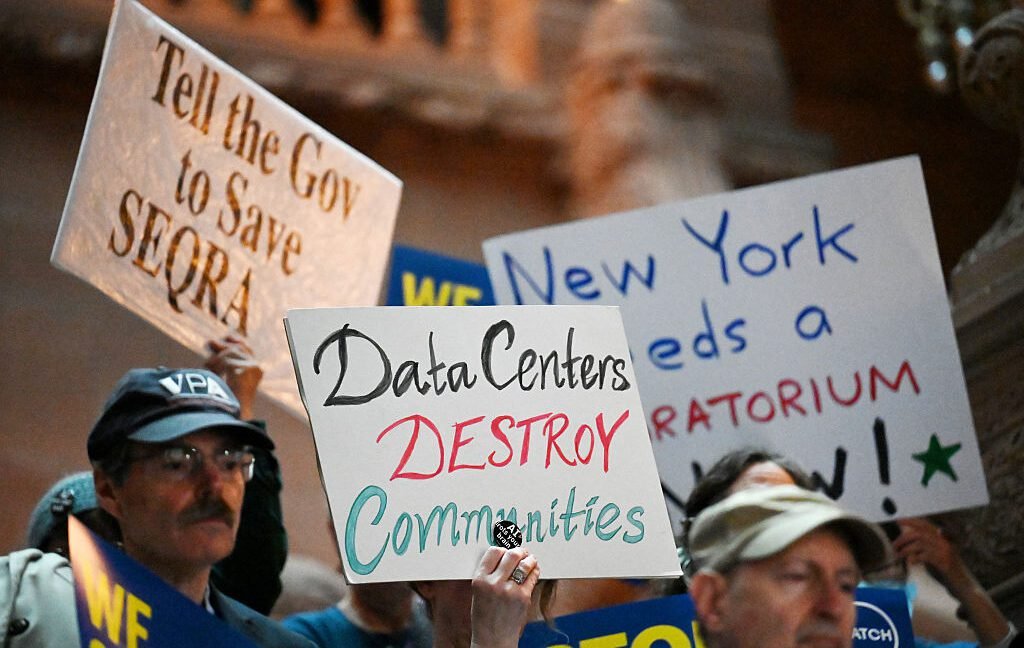
New York became the first state to pause all construction of massive new data centers after Democratic Governor Kathy Hochul announced a one-year moratorium on Tuesday, Reuters reported.
The state-wide ban applies to data centers using 50 megawatts or more, officials told Reuters, and it won’t be lifted until the state figures out what “consistent standards” for responsible data center development in New York should look like.
Across the US, calls to halt data center construction have multiplied, as Americans grow increasingly concerned about risks of pollution, rising energy costs, and diminishing water supplies. At the federal level, Bernie Sanders (I-Vt.) and Alexandria Ocasio-Cortez (D-N.Y.) have introduced legislation seeking a possible nationwide construction ban. But Republicans are seemingly unlikely to embrace that legislation, given Donald Trump’s claim that such moratoriums would threaten America’s lead in the AI race.
However, officials on both sides of the aisle are cautious that their views on data centers could get them voted out. At every level, pressure is increasing on elected officials to consider residents’ fears before signing contracts that fail to consider if data center construction will benefit the public. New York’s move comes after researchers last month found that more than $130 billion data center projects have been blocked or delayed by protests so far this year.
On Tuesday, Hochul directed “state officials to develop a Generic Environmental Impact Statement (GEIS) to ensure that new data centers coming online are being held to ‘consistent standards,’ as well as examine the potential environmental impacts of the construction and operation of data centers in the state,” Reuters reported.
New York has fewer data centers than hotspot states like Virginia and Texas that have drawn more projects, but it did have a long queue of data centers waiting for approval to connect to the state’s energy grid, Reuters noted. Some projects had sparked backlash, The Washington Post reported, and New York lawmakers had already passed a bill to impose a data center moratorium in response. Hochul has yet to receive the bill for signing, Reuters reported, but her office described the law as “complicated” and said it would take some “time to work through” once it does reach her desk.
In the meantime, Hochul said it was her “responsibility to take action and lead,” as “data center development threatens to hike up utility bills, deplete our natural resources, and create uncertainty for New Yorkers.”
“New York will lead the way in creating the strongest standards in the nation for data center development, ensuring that when companies succeed because of New York, New Yorkers succeed too,” Hochul said in a statement.
NY threatens to repeal tax giveaways
Possibly providing a blueprint for other state-wide bans, New York’s bold anti-AI stance was viewed as “a striking setback for artificial intelligence companies that politicians once courted for investment,” the Post reported. It comes after Maine’s governor vetoed a prior state-wide effort to temporarily ban construction out of concerns that Maine’s legislation didn’t exempt a favored project already underway.
Hochul is clearly taking a firmer stance against massive projects concerning New Yorkers. Although her office insists that she isn’t anti-AI, she believes that she must take steps to ensure responsible growth of the industry in New York, where electricity prices are among the highest in the US. On Tuesday, Hochul indicated that she also planned to repeal sales tax exemptions for data centers, which could influence other states that, prior to the AI backlash from constituents, leveraged the tax giveaways to lure investments from the AI industry.
In New York, Hochul has suggested that old incentives and voluntary commitments that AI firms previously relied on to strike deals with officials were no longer enough. States need more information to assess whether residents will be protected from potentially harmful projects.
Hochul had already moved to ensure that data centers don’t force residents to pay higher prices as energy demand in the area skyrockets. In February, Hochul announced a plan to ensure data centers pay their “fair share” for energy grid updates, which she said would set a “simple standard” to “ensure everyday New Yorkers do not subsidize this energy-intensive industry.”
“These industries must pay more; if they do not, they must supply their own energy,” Hochul’s office said in a press release.
The moratorium shows that New York is serious about mulling how to set higher standards for data center construction, but the greatest immediate impact of the moratorium may be the momentum it gives to the anti-AI movement by signaling that stopping all construction in a state is possible.