The Ukrainian military is steadily replacing dangerous frontline tasks with ground robots. In April, President Volodymyr Zelensky ordered the military to field at least 50,000 unmanned ground vehicles (UGVs) in 2026, calling them “the next big step” in saving soldiers’ lives.
Ihor Shmyryov, head of the UGV department at Ukraine’s defense innovation platform Brave1, expects Ukraine to exceed Zelensky’s target once direct brigade purchases are included. “In the first half of 2026, 25,000 UGVs will be contracted for deployment to the front,” he said. “That’s twice the number contracted during all of 2025.”
Ukraine’s UGV industry is booming. A study jointly conducted by the KSE Institute, Brave1 and Defense Builder found Ukraine’s UGV market grew 488% in 2025. In March, Andrii Biletsky, commander of Ukraine’s 3rd Army Corps, said UGVs could eventually replace up to one-third of soldiers along the front.
“The goal is to replace an infantryman on the front line with drones, as much as possible,” Shmyryov said. That means pairing aerial drones with UGVs.
Kyiv is already implementing that vision. In April alone, Shmyryov said Ukrainian UGVs carried out more than 10,000 missions, most delivering supplies to frontline positions. As the battlefield grows more dangerous, demand for machines that can replace soldiers keeps rising.
“Drones can make ground unlivable,” said Heiner Philipp, an engineer with Technology United for Ukraine. Ukrainian forces can now detect and strike Russian troops day and night, often suppressing positions before infantry move in. Increasingly, the first thing advancing across that ground is not a soldier, but a robot.
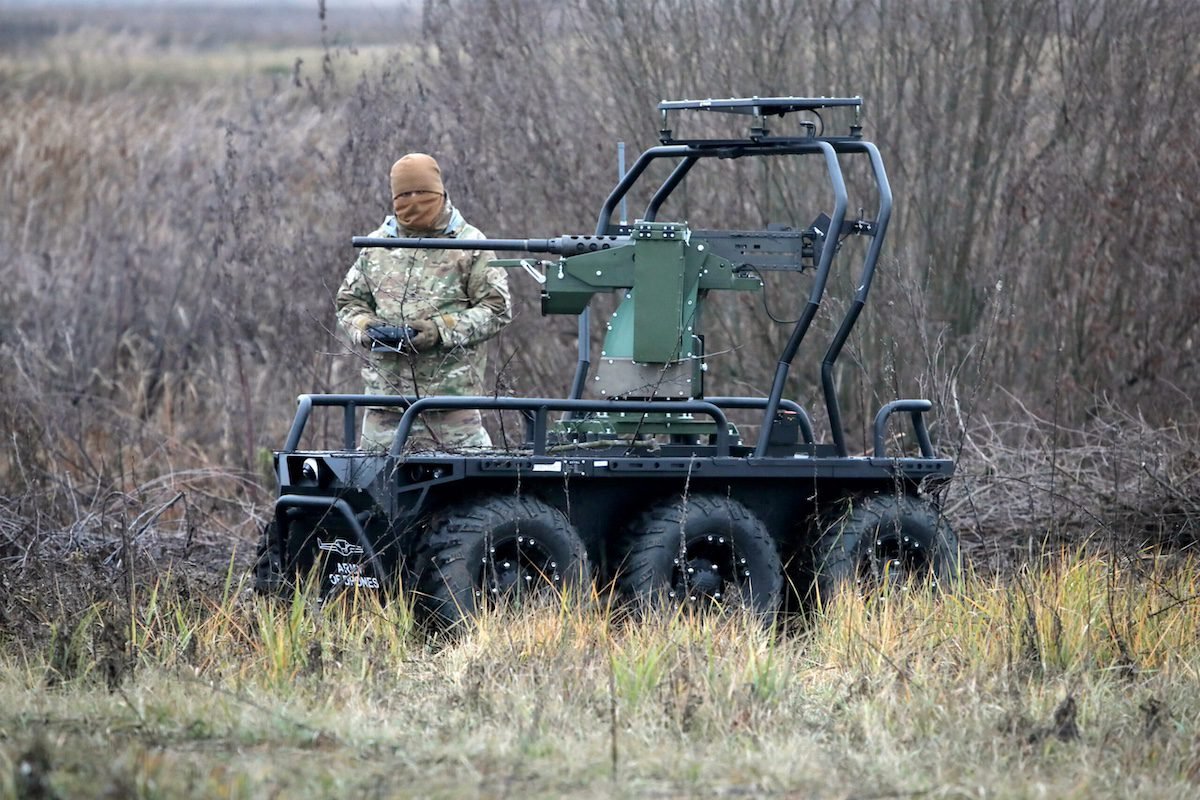
Pavel Shurmei of the Kastus Kalinoŭski Regiment said his unit initially experimented with machine-gun-equipped UGVs but now uses them mainly for logistics, where the systems have found their clearest battlefield role.
Another mission is countering Russia’s growing use of small infiltration groups, allowing armed UGVs to engage them without exposing more soldiers inside the drone kill zone.
“Primarily, it involves engaging enemy personnel and equipment using turrets. This is already operational on the front lines,” Shmyryov said. “Robots can perform patrols and hold positions.”
In February, Khartiia’s Lava regiment cleared a Russian strongpoint near Kupiansk using ground robots, kamikaze UGVs and strike drones without sending infantry into the objective.
Two months later, Ukraine’s Defense Ministry announced the formation of “drone assault units,” integrating aerial drones, ground robots and infantry into a single combined-arms system.
Ground robots are also taking on engineering tasks. Dima, a soldier with Ukraine’s 3rd Assault Brigade, told me his unit uses UGVs to deploy concertina wire and MZP barriers in front of defensive positions. “But it’s tough,” he said. “As soon as a robot rolls out to the frontline, all the enemy’s FPVs try to strike and destroy it.”
Developers are expanding what UGVs can do. Ratel Robotics began testing net launchers mounted on ground robots to intercept low-flying drones.
In June, the 3rd Army Corps unveiled an AI-enabled robotic air-defense system capable of autonomously detecting, tracking and engaging aerial targets, highlighting how rapidly UGVs are evolving into modular battlefield platforms.
A Brave1 representative told me AI-enabled UGVs are already being used on the front lines for missions ranging from fire support to air defense, including engaging Russian Shahed kamikaze drones.
Poor communications remain one of the biggest barriers to deploying ground robots at scale. Rather than relying on a single radio link between an operator and a robot, mesh networks allow drones, UGVs and ground stations to relay commands through one another, making robotic formations withstand jamming.
“Mesh networking is essentially a prerequisite for UGV employment at scale,” said Ryan O’Leary, a former commander of Ukraine’s Chosen Company volunteer unit.
Russia is pursuing many of the same concepts. Samuel Bendett, an adjunct senior fellow at the Center for a New American Security, said Russian forces are fielding UGVs for logistics, casualty evacuation and combat roles, including systems such as the Courier, Depesha and Impuls, alongside improvised robots built by frontline units.
But he believes Ukraine currently retains an advantage in deployment. “The overall Russian UGV number used at the front today is likely smaller than the Ukrainian one,” said Bendett, adding that communications limitations have constrained wider Russian use. Even so, he said, both militaries increasingly see that ground robots are becoming essential on a battlefield dominated by drones.
Ukrainian commanders are beginning to plan assaults around what robots can accomplish before soldiers move forward.
The commander of the NC13 strike UGV company in the 3rd Assault Brigade told the Ukrainian outlet Militarnyi in December that his unit has already conducted offensive operations using multiple armed robots simultaneously. The next step, he said, is making such assaults routine rather than exceptional.
More capable robots do not mean infantry is disappearing. “UGVs can support frontal assaults and degrade enemy forces,” said George Barros of the Institute for the Study of War.
“They are not a perfect substitute for infantry. At the end of the day there will always be a requirement for old-fashioned infantry to occupy and control terrain,” Barros said. He added that current systems remain vulnerable to FPV drones and mines, and armed UGVs must still be physically reloaded after expending their ammunition.
“Progress here depends as much on hardware as software,” said Deborah Fairlamb, founding partner of Ukraine-focused venture capital firm Green Flag Ventures. Advances in software and AI should make UGVs more capable as better hardware reaches the battlefield.
During casualty evacuations, several robots may be lost attempting to recover a wounded soldier before one succeeds. As Yuliia Trybushna of NUMO Robotics told me: “It’s better to lose four machines than one soldier.”
Ukraine plans to field more than 50,000 UGVs this year. But Trybushna estimates replacing most frontline positions would ultimately require roughly 150,000 to 200,000 annually.
Combat UGVs remain relatively uncommon not because they have failed, she said, but because the doctrine needed to employ them at scale is still being developed. Individual battlefield successes come first; standardized tactics follow.
Ground robots are unlikely to replace infantry soon. But they are steadily replacing many of the tasks soldiers once performed, offering an early glimpse of a battlefield where soldiers increasingly stay behind while machines go forward.
David Kirichenko is a freelance journalist and an associate research fellow at the Henry Jackson Society. His research focuses on autonomous systems, cyber warfare, irregular warfare, and military strategy. His analyses have been widely published in outlets such as the Atlantic Council, the Center for European Policy Analysis, the Irregular Warfare Center, Military Review and the Modern Warfare Institute, as well as in peer-reviewed journals. Follow him on X: @DVKirichenko.