At Vienna’s Berggasse 6, a single address holds the intersecting legacies of Theodor Herzl, the Holocaust, and the Israeli-Palestinian conflict
Some homes preserve history. Others become museums. At Berggasse 6 in Vienna, the past remains unusually present.
The building was constructed in the mid-1850s. Today, it brings together unlikely layers of religious and political history: It belongs to the Catholic Schottenstift Abbey, its ground floor houses a Palestinian-owned pizzeria, and from 1896 to 1898 it was home to Theodor Herzl, a founder of modern Zionism. Decades later, several Jews connected to the building were deported and murdered during the Holocaust, giving the address another, darker place in Jewish history.
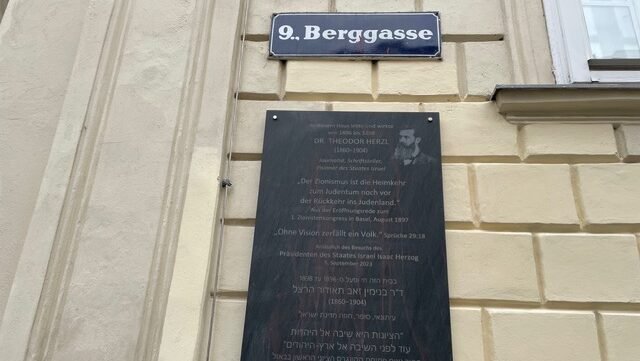
Today, little about the building indicates its importance in Jewish history, except for a plaque honoring Herzl, which was unveiled by Israeli President Isaac Herzog a month before the October 7 massacre. The sign has since been defaced with red markings.
The Room Where Zionism Took Shape
“The road from Palestine to Paris is beginning to pass through my room,” Herzl wrote in his diary on January 6, 1897. While Herzl lived there for only two years, from 1896 to 1898, his apartment in Vienna’s 9th District played a pivotal role in the creation of a Jewish state.
In a very real sense, his home was also the central office of the Zionist movement
“In a very real sense, his home was also the central office of the Zionist movement,” Dr. Daniel Polisar, executive vice president and co-founder of Shalem College in Jerusalem, told The Media Line. “But you could also say that from his home, he built the Jewish state. A large number of the most important meetings took place there. A lot of the most important work took place there. A lot of his writing took place there.”
Polisar, who served as the founding chairman of the National Council for the Commemoration of the Legacy of Theodor Herzl, described the period in which Herzl lived in the apartment building as “the peak of his activity.” From his home, Herzl founded the newspaper Die Welt and organized the First Zionist Congress in Basel in 1897, among other major initiatives. Later, he organized activities for the newly formed World Zionist Organization (WZO) from his home and held WZO’s executive meetings there.
Herzl also used his home as a diplomatic meeting place. In a Dec. 13, 1896, diary entry, he included a letter offering to receive Prussian Minister of War Julius von Verdy du Vernois at his home to make the case for a Jewish state. He also used the residence to seek support among Jewish figures. In diary entries from 1897, Herzl referred to meetings or expected meetings with Dr. Joseph Samuel Bloch, an Austrian parliamentarian and rabbi; Rabbi Sigmund Gelbhaus, a Galicia-born rabbi and Jewish scholar then active in Vienna; Sigmund Mayer, a Pressburg-born Viennese Jewish merchant, communal leader, and writer active in Jewish civic defense; and J. K. Poznanski of Łódź, a wealthy Russian Polish Jewish industrialist.
The Jews Who Never Reached Safety
Years after Herzl lived at Berggasse 6, the case for Jewish sovereignty became tragically clearer. At least three Jews were deported from the same apartment building and murdered during the Holocaust. Hugo and Irene Roden were deported on July 14, 1942, to Terezín, the ghetto and concentration camp in what is now the Czech Republic. Of the 1,009 people on their transport, 950 were killed, including Hugo. Irene was among a group of 59 who survived Terezín, but she was later deported to Auschwitz, where she was murdered. The death dates of Hugo and Irene Roden are not known.
Camilla Tandler was deported three days after the Rodens. She died at Auschwitz, and her date of death is also unknown.
Heinrich and Adele Kurtz, residents of Herzl’s building in 1919, sought permission in 1939 to immigrate to Mandatory Palestine. At the time, Jewish immigration there was controlled by the British authorities. The Kurtzes never reached safety. Heinrich Kurtz was transported to Treblinka in September 1942 from Terezín, where he was killed. Adele Kurtz died on Feb. 23, 1942, four months before her husband was deported from a different address in Vienna. Her cause of death is unknown.
The Building Today

Hakim Hadid, the owner of Pizzeria Valentino, in Vienna. (Courtesy)
Today, the closest most visitors can get to Herzl’s former apartment is Pizzeria Valentino, a restaurant on the ground floor of the same building.
The address carries a striking irony: Herzl’s work above the restaurant, nearly 130 years ago, helped shape the life of its current owner, Hakim Hadid, a Palestinian.
In the same building where Zionism moved from idea to organized political movement, Hadid keeps a framed photograph of Yasser Arafat, the longtime leader of the Palestine Liberation Organization and later president of the Palestinian Authority. Hadid said he had known Arafat since he was 12 years old, through an uncle who was close to the former leader.

Framed photo of Arafat in Hadid’s office. (Courtesy)
When asked how he felt about the building’s history, Hadid told The Media Line: “Not good.”
Born in Nablus, 67-year-old Hadid moved to Libya as an infant. He studied for his master’s degree at the Technical University of Vienna but dropped out after two years and has now been working at the pizzeria for 43 years, 18 of those as the sole proprietor.
Hadid says that many people, including Israelis, come to ask him about the building’s history. He said he just wants to be left alone because he sometimes “gets the sense that they want me out,” and the Israelis “have already taken my house [in the West Bank].” He said he did not understand why people made such a big deal about the building, since he had been there for about four decades longer than Herzl.
Back in Hadid’s office, taped near the printer, is a large picture of Israeli Prime Minister Benjamin Netanyahu cut from a newspaper article with the headline: “Haftbefehl gegen Netanjahu.” The English translation: “Arrest Warrant for Netanyahu.”

“Haftbefehl gegen Netanjahu.” The English translation: “Arrest Warrant for Netanyahu.” (Courtesy)
Despite Hadid’s family history, he thinks there can be peace in the region, with a Palestinian state beside a Jewish one. While he believes that Israel is an “illegal” state, he said one has to accept the reality that it is not going anywhere.
He framed coexistence not as affection, but as necessity.
“We cannot kill all the Israelis,” Hadid said.
Interview translation provided by Prabhu Guptara and Clemens Öllinger.