In early June, Ukrainian President Volodymyr Zelensky published an open letter to Vladimir Putin proposing a face-to-face meeting to end a war now in its fifth year. Putin’s reply was that talks were pointless unless Ukrainian forces first withdrew from Russian-occupied territory and Kyiv dropped its bid to join NATO.
It was a small exchange in a war full of much larger ones. But it said something about why five years of sanctions, diplomatic isolation and moral condemnation from the West haven’t moved Moscow any closer to the deal Western capitals actually want.
Ask most diplomats, and they’ll tell you that they simply haven’t been tough enough or clever enough. The more uncomfortable explanation is that they never really understood the country they were trying to pressure in the first place.
A vocabulary problem
For two decades, the standard Western vocabulary for Russia has settled on words like authoritarian, fascist and even totalitarian.
These terms, borrowed wholesale from the 20th century’s worst regimes, carry a built-in assumption: that the Russian state survives on coercion alone, that ordinary Russians are essentially a captive audience waiting to be freed and that discrediting one man would bring down the whole edifice.
It’s a comforting theory since it lets them explain Russian conduct without ever asking why tens of millions of Russians might actually consent to the arrangement. What it obscures is the uncoerced, genuinely popular foundation of the post-Soviet Russian state and of Putin’s government specifically, a foundation that has held up rather better over time than the coercive machinery Western commentary likes to discuss.
Much of the traditional Western literature on Russia leans on history and direct observation to explain what amounts to an eternal Russia, a civilization whose statehood, foreign policy and president get treated as a fresh enigma every time there’s a crisis, a riddle to be solved all over again.
The trouble is that this literature tends to collapse Russian national identity into imperial conquest, so that any Russian assertion of interest beyond its 1991 borders reads as an unreconstructed colonial reflex. But Russian history isn’t identical to the history of Russian conquest.
Underneath the shifting borders of Muscovy, the Romanov empire and the Soviet Union runs a current of Russian identity – linguistic, religious, cultural – that would have persisted no matter what shape the state around it happened to take.
An identity beyond Putin
Russian society has and is cultivating a national identity that would exist with or without Putin.
Most Russians have no illusions about how corrupt their political class is. Polling over the years has repeatedly shown large majorities holding their own leadership personally responsible for it and cynicism toward the elite runs deep, predating Putin by generations.
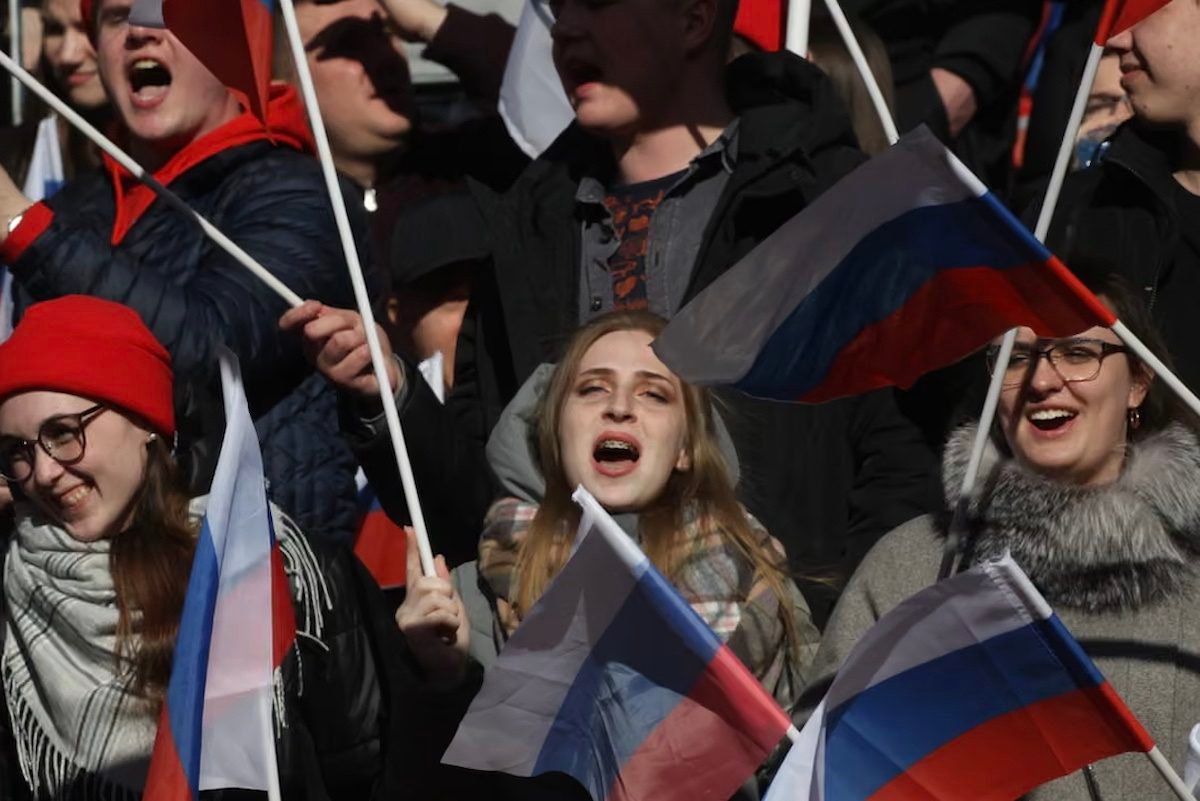
But the same people who mock their governors and distrust their oligarchs still see their country as fundamentally distinct from Western Europe and the United States: not a broken state waiting to be fixed through external intervention, but a different civilization on its own track.
They also know, better than most Western analysts give them credit for, what Putin has and hasn’t delivered.
While they appreciate stability, a fragile prosperity now under real strain, a rebuilt military and a handful of glittering, redone cities that serve as showcases more than as proof of any deeper modernization, ordinary Russians are also fully aware of stagnant provinces, a shrinking population and the technological dependence that sanctions have exposed.
They carry an unsentimental view of their government’s failures alongside a stubborn sense that Russia’s separateness from the West is worth defending. The West keeps expecting the first belief to erode the second. So far, it hasn’t.
Society’s grip on the state
The Western commentary on Russia tends to critique the state: its security services, its censors, the vertical of power running from the Kremlin down to the last regional governor.
What usually gets missed is the current running the other way: society’s grip on the state, as argued by scholars like Michael Kimmage and Timothy Frye. That’s the grip likely to matter more in the long run, not the Federal Security Service (FSB).
Russians are unusually good at seeing through official messaging. It’s a skill left over from seven decades of decoding Soviet propaganda, sharpened further by a partly marketized media landscape that taught people to read state messaging with suspicion long before “media literacy” became a Western obsession.
So, the government’s success at manufacturing obedience is a lot thinner than Putin would like to believe.
His own approval numbers tell the story. They hit a wartime high near 88% in early 2025, then slipped to roughly 79% by the spring of 2026, according to the Levada Center. That slide doesn’t track battlefield setbacks, which have been minor.
It reflects kitchen-table economics instead: a steep hike in the value-added tax, a documented pause in private investment that the Kremlin itself denies exists and incomes that increasingly don’t stretch to cover the basics.
This in no way looks like a population swallowing propaganda whole, but one doing its own math on what the war really costs, and adjusting its opinion of the man running it.
Why diplomacy fails
Diplomacy has failed to end the war for five years running. The 2022 Istanbul talks, the Anchorage summit and three rounds of trilateral negotiations in Abu Dhabi and Geneva in early 2026.
The reason is that the West’s main tool, economic sanctions, keeps confirming the very story that lets Russians tolerate the war in the first place: that Russia is a besieged civilization, and hardship is simply the cost of standing apart from a hostile West.
The sanctions do bite. Russia’s public finances are visibly strained, but so far, this pain has fed a story about national resilience instead of building real pressure toward compromise. If anything, each new round of sanctions seems to sharpen the public appetite for defiance more than it dulls it.
The West needs to acknowledge that Putin met Russian society halfway rather than simply imposing himself on it. This will ensure that Western pressure gets aimed narrower and focused rather than being spent on outrage that was never really a leverage to begin with.
Getting the diagnosis right
None of this is an excuse for what Russia has done in Ukraine. It’s an argument for getting the diagnosis right, not for going easy on the conclusion. The West’s mistake has been analytical, not moral.
It took its own vocabulary (fascist, totalitarian, dictator) and mistook it for a description of Russian reality, when really it was describing the West’s own outrage. Putin didn’t just capture Russian society. He met a good part of it halfway, and whatever identity emerged from that meeting will outlast him.
Western policy can keep waiting for a captive nation to rise up and be rescued, or it can start dealing with Russia’s reality. Right now, it’s doing the former, mistaking its own bad diagnosis for the Russian public’s failure to see something obvious.
Sajid Farid Shapoo is a highly decorated senior Indian security official (three-star general). He holds a PhD in security studies from Princeton University and writes regularly on geopolitics and international security issues. The views expressed are his own.