The breakdown of the ceasefire between the US and Iran was perhaps the least surprising news this week. The 14-point plan – AKA the memorandum of understanding (MoU) – signed by Donald Trump in Versailles at the end of the G7 summit on June 17 and by the Iranian president, Masoud Pezeshkian, the same day had always felt dangerously impermanent.
So the return to what analysts coyly refer to as “kinetic warfare” and journalists call “bang-bangs” seemed inevitable.
For Ben Soodavar, an expert in decision-making in war at King’s College London, the agreement was a “a ceasefire with a built-in detonator”, which has now “gone off”.
There was nothing in the agreement to resolve the underlying problems which had led to the war in the first place. The issue of Iran’s nuclear ambitions has not been resolved, Israel and Hezbollah continue to exchange strikes in southern Lebanon, and Iran has retained the ability to close the Strait of Hormuz and cause economic chaos whenever it chooses. This week it chose to do just that.
Read more: Iran ceasefire was always going to break – here’s why
Trump, meanwhile, was attending the Nato summit in Ankara, surrounded by allied leaders who need the strait to be open as badly as anyone. Quite apart from losing face at the collapse of his much-vaunted deal, the incident will have provided a reminder, if Trump needed one, that America’s Nato allies declined to come to his rescue when he asked early in the conflict.
That’s not to say that all the pressure is on the US president. Iran’s leadership are also believed to be deeply divided over the deal, with the vice-chairman of the Iranian parliament’s National Security Commission, Mahmoud Nabavian, for example, warning in June that the deal would turn Iran into a “colony of the United States”.
Farhang Morady, of the University of Westminster, a long-time Iran-watcher, believes that hardline factions of both the clerical establishment and the powerful Islamic Revolutionary Guard Corps (IRGC) remain resolutely opposed to doing a deal on Iran’s nuclear programme.
These hardliners may have been persuaded to fall into line with the Obama administration over the 2015 joint comprehensive plan of action (JCPOA). But Morhady notes that powerful conservative factions conspired to block Iran’s compliance with international money-laundering conventions, meaning that much of the promised economic benefit of the deal to Iran never materialised. The same players have been behind the failure of talks in more recent years.
There are signs that the balance of power might be slowly shifting, Morhady writes. It will be a key power struggle to watch.
Read more: Iran’s ‘hardliners’: who they are, what they believe and why they matter
But most of the images coming out of Iran this week have been of the estimated ten million people who attended the funeral of the former supreme leader, Ayatollah Ali Khamenei, who was killed on the opening day of the conflict. The event was carefully choreographed to project an image of defiance and unity, designed to bolster and the legitimacy of the Islamic Republic.
Tehran will have hoped that the war launched by the US and Israel just weeks after that savage crackdown have served to unite the country. But Marzieh Kouhi-Esfahani, an expert in Iranian politics and foreign policy, believes there have been indications this week of schisms at the top of Iranian politics.
She sees the abrupt departure from the funeral procession of Hassan Khomeini, the grandson of Iran’s first supreme leader, Ruhollah Khomeini, and the conspicuous absence of former presidents Hassan Rouhani and Mohammad Khatami, as an indication of deep divisions. As are the continuing attacks, including from plenty of mourners this week, on Pezeshkian and his foreign minister Abbas Araghchi over the ceasefire deal.
Read more: How Iran used Ali Khamenei’s funeral as a political and diplomatic tool
Putin under pressure?
To Russia, where the success of Ukrainian strikes on Russia’s energy infrastructure both in Russia itself but particularly on the occupied Crimean peninsula, are reported to be changing the public mood about the war. Fuel shortages, rising prices and talk of a recession are adding to the pressure on the Russian president, Vladimir Putin.
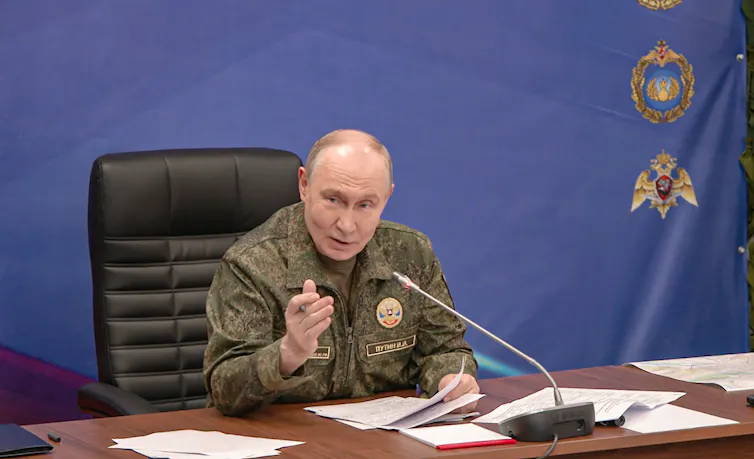
There have even been questions about Putin’s ability to survive if things don’t improve dramatically, and soon. But Alexander Titov, who has visited St Petersburg each year since the war began in 2022 doesn’t believe the Russian president is in any real jeopardy at present.
Such has been Putin’s capture, over nearly three decades, of Russia’s state institutions, its media and big business that his position remains pretty much unassailable, Titov believes. And Russia’s ability to launch massive strikes against Ukrainian cities and their civilian populations can be in no doubt after the savage bombardments of the past week.
Read more: Ukraine war is not going well for Russia – how dangerous is this for Vladimir Putin?
All that said, there are fears that the Ukraine war may be recreating the conditions in Russia that gave rise to the period of lawlessness which followed the collapse of the Soviet Union in 1991.
Then it was Russian veterans returning from Afghanistan to find economic and social turmoil who fuelled a dramatic rise in organised crimes. Now it is veterans of the Ukraine war, including large numbers of convicts who were pardoned in return for enlisting.
Adrianna Marin, who studies criminal gangs and has seen similar phenomena in post-conflict societies such as Colombia, Sierra Leone, Cambodia and Bosnia-Herzegovina, believes that even if just a small percentage of the veterans coming home to unemployment and a lack of state support turn to crime, then their skill sets acquired from their military training could make them formidable recruits to Russian crime groups.
Read more: Ukraine war sparks fears of an organised crime resurgence in Russia
Fifa farce
Much has been written in recent weeks about the enormous soft-power potential attached to hosting the football World Cup – the biggest sporting event on the planet.
But the US president squandered all goodwill this week when it was revealed that he had intervened to put pressure on Fifa, which runs the global game, to bend the rules to allow USA’s star striker to play in Monday’s match against Belgium. Folarin Balogun had been sent off in his team’s previous game against Bosnia and Herzegovina, which carries a mandatory one-match suspension.
But after lobbying from the White House, including a phone call from Trump to Fifa president Gianni Infantino, that suspension was itself suspended, and Balogun was cleared to play.
For Josh Bland, who researches football culture at the University of Cambridge, part of the great appeal of the beautiful game is that, on the pitch certainly, everyone plays by the same rules. In one fell swoop the US president threw that into jeopardy.
For the record, the USA were soundly beaten by Belgium, four goals to one.
Read more: World Cup’s credibility in question after Fifa volte face following call from Donald Trump