Families in Gaza describe fear, scarcity, and uncertainty while Israeli analyst Jonathan Conricus says Hamas’ refusal to disarm remains central to the crisis
In Gaza, uncertainty over negotiations and postwar arrangements is deepening the strain of daily life. As shortages spread across water, fuel, health care, and basic services, people inside Gaza and beyond say the current framework is not addressing the deeper crisis on the ground.
Political analyst Iyad Jouda describes a growing sense that the political process is preserving the status quo rather than changing it. “I believe the actual agreements were not what they should have been. There were headlines that the Peace Council wanted to promote and convince us were real, but in reality, the coordination being carried out with the Israeli prime minister reflects an agreement on procedures that maintain the current situation in Gaza.”

Political analyst Iyad Jouda, in the Gaza Strip. (Screenshot: The Media Line)
For him, the gap between promises and reality is central. “Israel is not abiding by its commitments, and the Peace Council is not acting according to a real plan that would lead to the end of the occupation in Gaza,” he tells The Media Line. “If we return to the basis on which the Peace Council was formed, it was supposed to lead to the end of the occupation in Gaza, Israeli withdrawal, and then the unification of the West Bank and Gaza Strip.”
He warns that what is taking shape now may entrench separation rather than unity. “What is happening now appears to be a set of arrangements that reproduce the current reality and move toward ‘Gaza One’ and ‘Gaza Two.’ In my opinion, this is a real separatist plan.”
The answer, he says, must begin with Palestinian unity and broader regional action. “What is required from Palestinians, first of all, is to move beyond division, reach a unified position, and agree on a strategic plan to confront the occupation at the international and political levels,” he says, adding that there must be a Palestinian-Arab plan to face what may come next because, in his view, Benjamin Netanyahu does not want this region to be calm and does not want to implement the commitments he has made. “This situation requires stronger and more effective Palestinian-Palestinian and Palestinian-Arab action,” he argues.
Jonathan Conricus, a senior fellow at the Foundation for Defense of Democracies and a former international spokesman for the Israel Defense Forces, told The Media Line that the humanitarian suffering in Gaza is real, but said Hamas bears responsibility for prolonging the crisis by refusing to comply with the agreement.

Jonathan Conricus, a senior fellow at the Foundation for Defense of Democracies and a former international spokesman for the Israel Defense Forces, speaks to The Media Line. (Screenshot: The Media Line)
As a human being, I can understand and imagine how the situation on the other side of the border is in Gaza, and I’m sure it’s a horrible, unsustainable situation
“As a human being, I can understand and imagine how the situation on the other side of the border is in Gaza, and I’m sure it’s a horrible, unsustainable situation,” Conricus said. “Not because how Israel wants it, but because Hamas continues to, A, violate the agreement, B, not lay down their weapons, and C, to oppress the people who live there because they want to remain in power.”
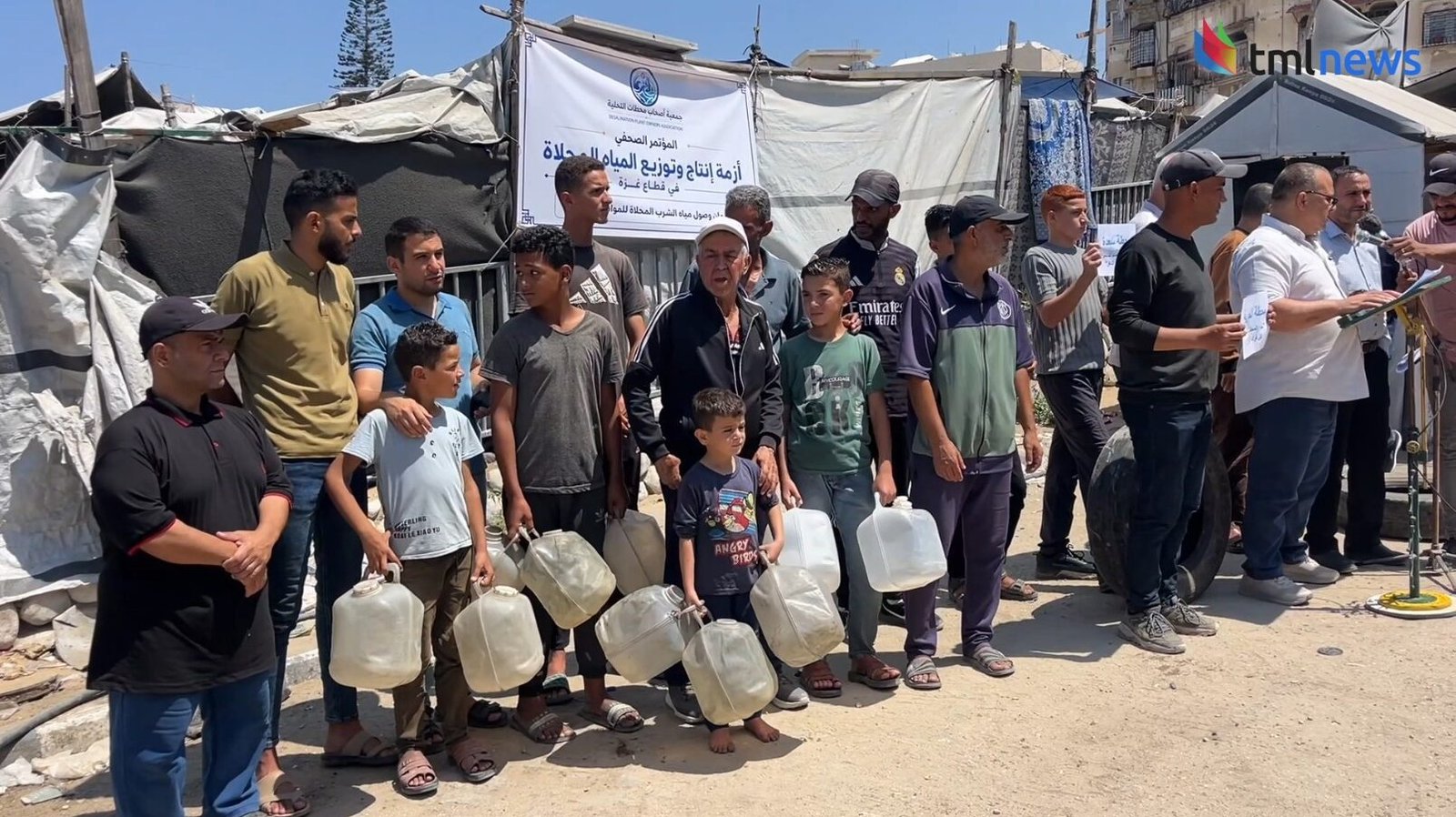
Beyond politics, one of the most immediate pressures is water. A., who works at a desalination plant, says the system is under growing strain as fuel shortages hit production and distribution at the same time. “One of the most important challenges is the lack of fuel for the production facilities, including desalination plants and water facilities in Gaza.”
He says the problem extends far beyond the plants themselves. “There is also difficulty transporting fuel to different areas in Gaza because of the lack of tires and fuel. All these challenges directly affect the quality and continuity of water services. They also limit the ability to implement a comprehensive plan to provide safe water.”

Gaza resident A., a water desalination plant employee. (Screenshot: The Media Line)
The pressure is especially severe in summer, when demand rises, and conditions in displacement camps worsen. “Given that we are in the middle of summer, and according to estimates, the need for water has doubled. This creates a health threat for citizens if there is a shortage of water, especially in displacement camps,” he says.
A. says the consequences could soon become even more severe, with the lack of water and basic necessities directly affecting people’s lives, warning that if fuel and basic supplies remain unavailable, plants could shut down completely by the end of next month and claiming that some desalination plants have already shut down. “This will lead to a drinking water crisis and a shortage of basic services for citizens who depend on these plants,” he says.
For now, there are only temporary solutions. I can reduce production, close some lines, open others, stop producing 400 units and produce 200 or 100 instead. But the real fear is that we will reach zero production.
Khaled Odeh, the owner of the water desalination station, says water operators are now managing decline rather than solving the problem. “For now, there are only temporary solutions. I can reduce production, close some lines, open others, stop producing 400 units, and produce 200 or 100 instead. But the real fear is that we will reach zero production.”
That, he tells The Media Line, is now the central concern. “We hope we do not reach that stage. For desalinated water in particular, this is the most dangerous phase since the beginning of the war.”

Khaled Odeh, the owner of the water desalination station in the Gaza Strip. (Screenshot: The Media Line)
Earlier in the war, he says, there were still materials available to keep things going. That is no longer the case. “Those were used, consumed, and completely depleted … We bought some spare parts at very high prices, but that period is over. Now we have reached the point where zero production may become unavoidable if supplies do not enter the market.”
For residents in Gaza, the water crisis is already personal as access to clean water remains severely limited. Another resident, B., puts it in simple terms: “I would say many people have become sick because of this water. It moves from one container to another, from one barrel to another, from one tap to another. Of course it becomes polluted for people.”
Saaed Al-Aklouk, an environmental and water sciences expert, tells The Media Line the scale of the collapse is visible in the amount of water available each day. “Before the war, the amount of water available to a Palestinian citizen was estimated at around 84 or 85 liters per day. Now, this amount has been reduced to about 5 liters per day, because most of the water sources that supplied people have been damaged or drained.”

Environmental and water sciences expert Saaed Al-Aklouk. (Screenshot: The Media Line)
As formal systems break down, he says, people are turning to unsafe alternatives such as private wells and other “irregular sources,” a trend that has polluted the water and affected public health and the sanitation system.
He says the problem begins with the aquifer itself and deepens as sanitation systems collapse. “There are two main reasons for this. The first is that the water from the aquifer already had problems. More than 97% of this aquifer was not suitable for drinking from a chemical standpoint. The second reason is that pollution levels in the aquifer have increased,” he explains.
That has led to dangerous new patterns of water use in the streets. Al-Aklouk says that because of “the destruction of hundreds of kilometers of water networks,” people have started looking for alternatives. The private wells often draw directly from the aquifer through damaged or unsafe systems. These same sources may also be used by others for washing and personal hygiene, raising serious concerns about disease transmission and the potential spread of epidemics among the population.
Conricus said he could not verify the specific water figures cited by Palestinian experts and residents, but accepted that Gaza is facing a severe humanitarian crisis. He also said Israel continues to provide supplies needed to keep parts of the system functioning.
“I mean, I can’t verify those numbers, whether it’s 5 or 20 or 30 or 50 liters per day, but I can; it makes sense, and I agree that there’s a severe situation, a severe humanitarian situation in Gaza,” he said. “Israel continues to provide electricity to the Gaza Strip. Israel provides fuel to run desalination and electric generation. Israel provides mineral water in bottles in copious amounts every day.”
The water crisis is unfolding alongside a medical emergency.
Jihad Badawi points to a loved one waiting for treatment outside Gaza. “This is my nephew. He is supposed to travel to Egypt. His wife is waiting for him on the bus so he can go to Egypt for treatment abroad. Do you see the state we are in?”
The case, he tells The Media Line, is urgent. “This young man has a colostomy opening. He has a serious abdominal condition. He has colon failure.”

Gaza resident Jihad Badawi. (Screenshot: The Media Line)
His appeal is direct. “We are calling on the Egyptian authorities to open the crossing of Rafah, because people are suffering.”
Ziad Al-Shaer, one of the wounded, describes what survival looks like after injury. “I was injured on my left side, and the injury is visible. I had surgery three months after the injury, but until now, I still need another operation.”

Gaza resident Ziad Al-Shaer. (Screenshot: The Media Line)
He tells The Media Line the injury has left him unable to support his family. “I came here to speak about the situation of the wounded. The situation is very difficult. I cannot work, I cannot move properly, and I cannot do anything. I live to support my family, and that is the problem.”
His comments return to a reality of pain, dependence, and waiting. “The situation is very difficult. It is not easy. I cannot stand or move normally. … I am asking for help. I ask the Egyptian committee and the Ministry of Health to help me.”
Conricus said scrutiny over medical and humanitarian access should not focus only on Israel, arguing that Egypt’s control of Rafah has also shaped Gaza’s isolation.
“I really would focus the whole issue here on the other neighbor, the Arab neighbor of the Gaza Strip, which is Egypt, which has a very, very cruel, cold-hearted policy towards the Gaza Strip,” he said. “They closed the Rafah border, and they have made absolutely sure that none shall pass, not going to receive any Arabs coming out of the Gaza Strip into Egypt, whether it’s medical, family issues, or other humanitarian issues. They’re simply not having it.”
In displacement areas, residents describe a different but connected crisis: danger, isolation, and the absence of aid. Wisam Arhim, a resident living near the Yellow Line, tells The Media Line that even humanitarian aid organizations are reluctant to enter. “Every time we ask an institution to come and see the camp, they tell us this is a dangerous area. But how are we supposed to live? We are living here.”

Wisam Arhim, a resident living near the Yellow Line in the Gaza Strip. (Screenshot: The Media Line)
He says families remain exposed while those who might help stay away. “There are around 100 to 150 families here. That means around 500 to 600 people. There is shooting every day. If you had come an hour and a half ago, there would have been shooting.”
Conricus said such conditions reflect a broader limbo caused by Hamas’ continued rule and refusal to disarm.
“As long as Hamas is in power, and as long as they’re in power, unfortunately, this horrible reality that we have today of this limbo situation, where it’s neither this nor that, and as usual, the people who suffer are the ones who are on the ground and who are not represented, don’t have political rights, and live under Hamas oppression,” he said. “They’re the ones who are facing the consequences, not the Hamas-affiliated families, not the seniors of the Hamas organization.”
Gaza resident Amina describes what insecurity feels like after dark. “They will shoot me. It is forbidden to go out at night.”

Gaza resident Amina. (Screenshot: The Media Line)
Fear, she tells The Media Line, shapes their lives. “At night, there is a lot of fear and violence. There is violence against us and against our brothers. Even young children are affected. We want to live in peace.”
Conricus said Israel’s long-term goal is quiet on both sides of the border, but said that depends on Hamas being disarmed and Gazans choosing another political path.
“I think that the bottom line, what Israel wants, Israel generally speaking, is for Israelis to live peacefully on our side of the international recognized border, and for Gazans to live on their side peacefully with the prospects of prosperity,” he said. “But that really relies on Hamas being disarmed and of Gazans choosing a different path for the future.”
Some residents still hold on to negotiations as their only remaining hope. A Gaza resident identified as C. tells The Media Line, “We have been in this war for four years. We are sitting in the streets. Even if we were killed, we would still be sitting in the streets.”

Gaza resident C. (Screenshot: The Media Line)
Still, the hope of return remains. “God willing, the negotiations will succeed and we will return to our homes. We hope for the best. We will return to our homes.”
Another Gaza resident, identified as E., connects that hope to freedom of movement and access to treatment. “All people around the world live in dignity,” he tells The Media Line. “They travel from their airports and leave their countries. But our people are locked in.”
For him, the crossings are part of the same struggle for dignity and survival. “We cannot even go to Egypt to treat my sick two-year-old daughter. We want them to change the situation at the crossing. We want them to open the crossings, so people can receive treatment, eat, drink, and live without humiliation.”
He ends with an appeal to all sides involved in negotiations. “We hope the negotiators in Cairo—whether from the authority in Ramallah, from Hamas, or from any authority—will end this situation. Enough is enough.”
They say the negotiators are in Egypt. I see them eating koshary, that is all. They are just relaxing.
Others express no faith at all that talks will bring change. Gaza resident D. dismisses the process, saying, “They say the negotiators are in Egypt. I see them eating koshary, that is all. They are just relaxing.”

Gaza resident D. (Screenshot: The Media Line)
He says years of dealing with Egypt and repeated rounds of diplomacy have brought no result. “We have been dealing with Egypt for three years, every other day. They have protected Egypt more than they have protected Gaza. In the end, there is no result. They speak about a second phase, but after the war we will enter the fourth year, and there is still no solution.”
His frustration extends to Palestinian leaders and international actors alike. “All they want is to take matters out of our hands. Trump wants to turn Gaza into a tourist destination. Hamas Political Bureau Chairman Khalil al-Hayya also wants to benefit from the same story. There is no solution. People are just going along with the situation.”
Across these accounts, politics is never separate from survival. Residents describe mistrust, scarcity, illness, displacement, blocked movement, and fear, while Conricus frames the crisis as inseparable from Hamas’ continued control and refusal to disarm. For those living inside Gaza, the argument over responsibility has not changed the most basic demands: safety, care, water, movement, and the chance to go home.