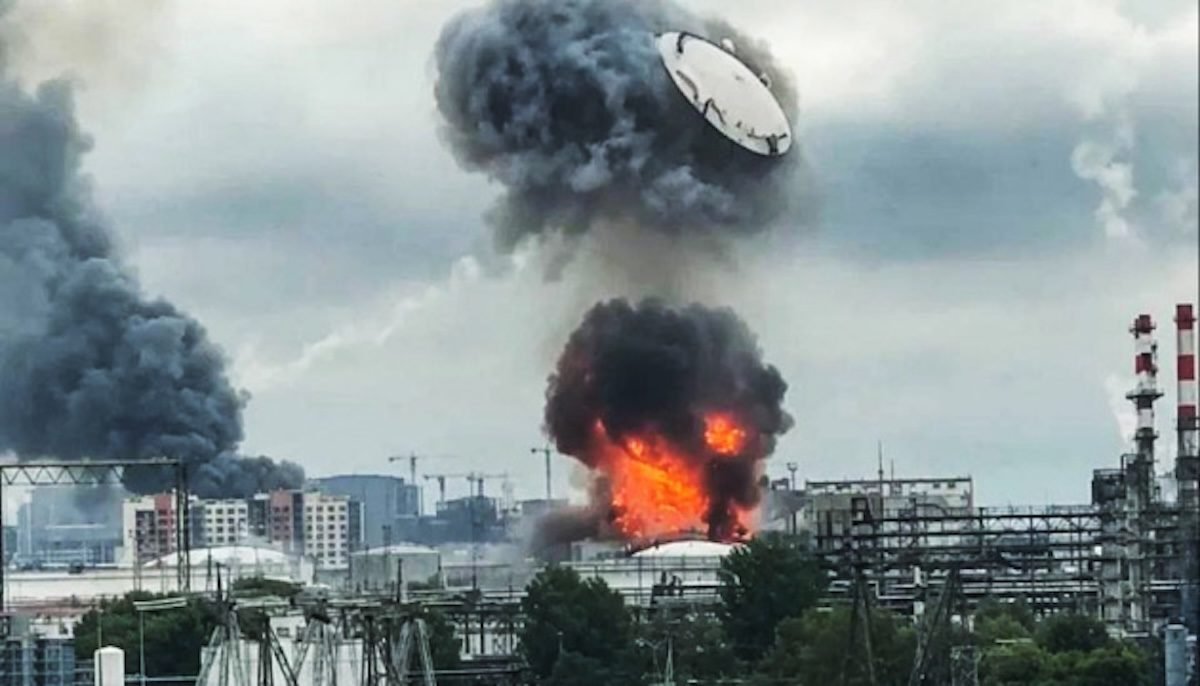
The long-range/mid-range Ukrainian strike campaign is continuing to grow, ominously for Russia.
Some Ukrainian analysis just released about the damage to Russian oil production for June, if true, shows that if a Russian counter is not in the works the Russian war economy will hit a financial crisis sooner rather than later.
People have been stating that at some point Russia will counter, but the question for Putin is pressing: It needs to happen soon.
In some ways people have overstressed the speed of the adaptation cycle in this war, and the Ukrainians are hoping this is one.
Can Russia counter?
Last week was one of the most extreme comparisons of the long-range war. The Russians continued to attack Ukrainian civilian targets, launching a mass attack on Kyiv (Wednesday-Thursday night) that heavily damaged a number of apartment buildings and left 30 people dead and many more wounded. At least 28 ballistic missiles were fired at Kyiv alone—a record number.

It confirms that the Russians’ primary option to try and counter the Ukrainian long-range attack on them is to increase civilian strikes. They are using more and more ballistic missiles on non-strategic targets.
The Russians understand that Ukraine has very few Patriot missiles left and therefore that they have a higher chance of getting their missiles through right now than before. And the Ukrainians confirm this by pleading with their European partners to help them get their hands on any Patriots that they can.
Unless partners do step up, there will be more nights like Wednesday night.
As there will be more Ukrainian strikes that the Russians seem unable to counter. Indeed, the pressing need for the Russians to counter is arguably greater than Ukraine’s, as the Ukrainians are ramping up their long-range strike campaign and it is causing serious strategic damage. Last week we saw at least four major Ukrainian attacks on Russian oil facilities. These are the ones for which there is some evidence.
- Overnight 27–28 June — Slavyansk-na-Kubani refinery (Krasnodar Krai) and Yaroslavl refinery. Ukraine President Zelensky announced strikes on two refineries. Krasnodar governor Kondratyev confirmed a fire at the refinery from drone debris, with one person killed. It processes close to 4 million metric tons of crude annually and is a key source of export products (fuel oil, naphtha, marine fuel) through Black Sea ports. The Yaroslavl strike (~700 km from the border) had no direct Russian confirmation, though the regional governor reported road closures due to a Ukrainian drone attack that morning. Ukraine’s MoD later said four storage tanks (35,000 m³) were destroyed at Slavyansk and nine more damaged, plus a crude distillation unit. Note, these were the strikes that forced Putin to make his first public acknowledgment of a fuel “deficit.”
- Overnight 30 June – 1 July — Ufa refinery complex (Bashkortostan), second strike within a week. Zelensky confirmed; ~1,300 km from the front line, Ukraine hit one of Russia’s largest refining hubs and a major lubricants producer.
- Overnight 1–2 July — Lukoil-Nizhegorodorgsintez, Kstovo (Nizhny Novgorod). A major attack. Ukraine’s General Staff stated that its forces struck one of Russia’s largest refineries east of Moscow, starting a fire; the plant is Russia’s fourth-largest refinery, its second-largest gasoline producer, and Lukoil’s biggest, and reportedly suspended operations again after the strike.
- Overnight 3–4 July — St. Petersburg oil terminal and Vysotsk port.Unusually, both confirmed from the Russian side: Governor Beglov said the city’s oil terminal was struck in a “large-scale” drone attack, and Leningrad region governor Drozdenko said a drone struck the Vysotsk port area on the Baltic.
These attacks show that as June turns into July, Ukraine is accelerating its attacks on Russia’s oil infrastructure. In June, Ukraine claimed to have attacked 11 different refineries and many other ancillary oil targets. This is on top of 18 combined refinery and fuel facility attacks in May.
The upshot of all of this can be seen in the lines for scarce petrol that are now all over Russia. The Ukrainians claim to have shut down more than 42% of Russia’s oil output, while other analysts say the figure could be closer to one third. In some ways, the difference is not that important. The overall trend is in one direction – more Ukrainian attacks at greater range, more hits on vital facilities – and that begins a compounding spiral of decreases in Russian oil revenue.
The question now is whether Russia can come up with a counter. It has been stated for months that at some point Russia will come up with something to lessen the effectiveness of Ukrainian attacks. In other words, that the adaptation cycle will switch in Russia’s favor.
However this might misread the actual adaptation cycle in this war. In one way it has been incredibly fast, particularly when it comes to small, short-range drones. These are almost constantly being adapted, and at different times it was said that each new system had only a few months, sometimes only weeks, of operational viability before it would be countered by some enemy development.
However that has not been the case for long-range strike and air interception. These adaptation cycles have taken considerably longer. The Ukrainians have been reliant on Patriots for their most advanced interception needs for years. Only now are there serious efforts to come up with a European, non-US replacement (and that will still take a while).
Likewise when it comes to long-range strike, adaptation has been quite a long process. Ukraine started thinking about the campaign we are seeing back in 2023, and it has taken almost three years to reach this state. Individual systems support this notion of a longer-adaptation cycle. The Ukrainians Flamingo FP-5 cruise missile was first announced to the world almost 11 months ago, and only now does it seem to be operating with some effectiveness.
So, top-line adaptation in both long-range strike and interception has been a much slower process. And this should very much worry the Russians. There is no sign that they have either a new more effective interception systems coming on line or the ability to greatly increase anti-air production. What we do know is that even densely protected areas, such as Moscow, are not invulnerable.
And the need for a Russian counter to the Ukrainian long-range strike campaign is immediate. If somewhere between 33% and 43% of Russian oil production is already off-line, and Ukrainian strikes on oil targets can keep increasing, there will be an oil crisis.
I do, however, wonder when people, in stressing the quick adaptation cycles in this war for some systems, are missing the much longer cycle for others. There have been a number of glib assumptions throughout this war that have shaped public perceptions. This might be another.
Do not assume a Russian counter is actually coming unless there is evidence. Right now it is hard to see it.
India shows the true fraudulence of US sanctions
China and India have always provided the best tests for the strength (or not) of US oil sanctions on Russia. These two states together buy far more oil from Russia than any other two and they are both considered strategic partners of Russia in different ways.
The Chinese, the largest purchaser of Russian oil, have never paid much attention to Trump’s sanctions. In January 2026, before the latest Iran war changed global demand, Chinese purchases of Russian oil spiked.
The Chinese have calculated that Trump is too afraid of them and too enamored of Putin to actually take any legitimate step to enforce sanctions against their companies. And they are right. In 2025, Trump regularly admitted that he had no real leverage over the Chinese.
India showed a little contrast, at first. When the sanctions were first announced in the second half of 2025, the Indians went ahead and continued to buy Russian oil at a very high pace – at first accelerating purchases once the sanctions were announced. In early 2026, the Indians hedged and reduced some Russian purchases, to see what the US would do.
Trump’s war with Iran put a quick end to the Indian hedge, and the Indians quickly started buying up all the oil they could once the American bombing started. Of course, with that war now in ceasefire, and US sanctions supposedly reactivated on June 17, we might expect to see a return of Indian hedging. But that would be wrong. The Indian figures for all of June are out, and they show record purchases throughout the month.
Indeed, here is a chart of Indian purchases of Russian oil from September 2025 to June 2026, based on the Kpler figures where I can get them and estimates from other articles where possible.

Now the Indians are “gorging” on Russian oil in the words of one report. Indeed there has been a massive expansion of Indian purchases from Russia from May, when all US sanctions had been relaxed. Here are a number of the headline points from Reuters.

The Indian government has also come out and said that from now on, India will continue to buy Russian oil regardless of the status of any US sanctions. It is the kind of move that is getting little coverage, but deserves more.
The US is so weak, and other major states are calculating that Trump will never actually do anything to harm Putin. They are flouting US sanctions now and will do so in the future.
Moreover, it shows how the loud voices that were proclaiming that Trump would really hit Russia hard – and that pointed repeatedly to the very weak US sanctions against Lukoil and Rosneft – now have nothing left to fall back on. Trump has basically created a free-for-all situation for the purchasers of Russian oil.
Which is why in the end it is the Ukrainian long-range campaign mentioned above, and the Russian ability to counter that, which will determine the economic fate of Putin’s war machine. The US has been, overall, a massive help to Putin’s war machine in 2026. Trump’s war with Iran generated by May an extra $15 billion for Russia. It has forestalled a crisis, for now. At the same time it destroyed any worries that states might have that US sanctions were meant to be taken seriously.
What Trump giveth in the end will be up to Ukraine to taketh away.
Two reports worth reading
There has been some very interesting new research on the state of the war economically and militarily released in the last few days. In both cases these reports touch on issues I have mentioned today and in earlier updates. Both are also free and fully downloadable, so you can read them in their entirety at your leisure.
The first is a report from the Kiel Institut, entitled: Endgame: The State of the Russian Economy.

In this report the authors (a very distinguished group) break down the economic crunch that Russia is facing, with revenues not meeting the voracious demands of the Russian war economy.
In a nutshell, the authors conclude that the present state of the Russian war economy is “not sustainable.” Russia is basically living hand-to-mouth with all of its buffers spent (Putin has thrown away the entirety of Russia’s once large sovereign wealth fund) and can only fund the war through energy sales. This means that Ukraine’s partners in Europe have an opportunity to destroy Russia’s present strategic plan. Here is how it starts:
Russia’s current macro stance is not sustainable. High interest rates are stifling the economy, while loose fiscal policy and quasi-fiscal operations are propping up the defense sector. The Q1 2026 budget deficit exceeded the full-year target in just three months. The choice now is between fiscal consolidation or monetary accommodation resulting in even higher inflation. Going forward, export revenues from the sale of raw materials remain the decisive variable for the economic outlook: With fiscal buffers spent, Russia’s war capacity is more than ever directly coupled to hydrocarbon export income.
The second report was released by Seth Jones and Riley McCabe of the Center for Strategic and International Studies and is entitled: Russian Blood and Treasure: The Ballooning Costs of Putin’s War. Just for full disclosure, I am a research associate of CSIS.

This is the latest in a regular series on Russian losses in the war. The picture that they paint here, using data, is one of ballooning Russian losses of soldiers and a Russian loss of territory over the last few months. They deliberately try to move beyond the anecdotal evidence that too many analysts have been using to describe the state of the war and calculate where things stand. They even try to put the Russian “advances” of the last year and a half into historical context such as with this chart.

Their view is that the Russian method of conducting the war is breathtakingly expensive for what it achieves. Their conclusion, like that of the Kiel Report, is that this moment actually is an opportunity for Ukraine’s real partners to take advantage of Russia’s failures.
Phillips P. O’Brien is a professor of strategic studies at the University of St. Andrew. This weekend update article is republished with permission from Phillips’s Newsletter, where you can read more about grand strategy and war history.