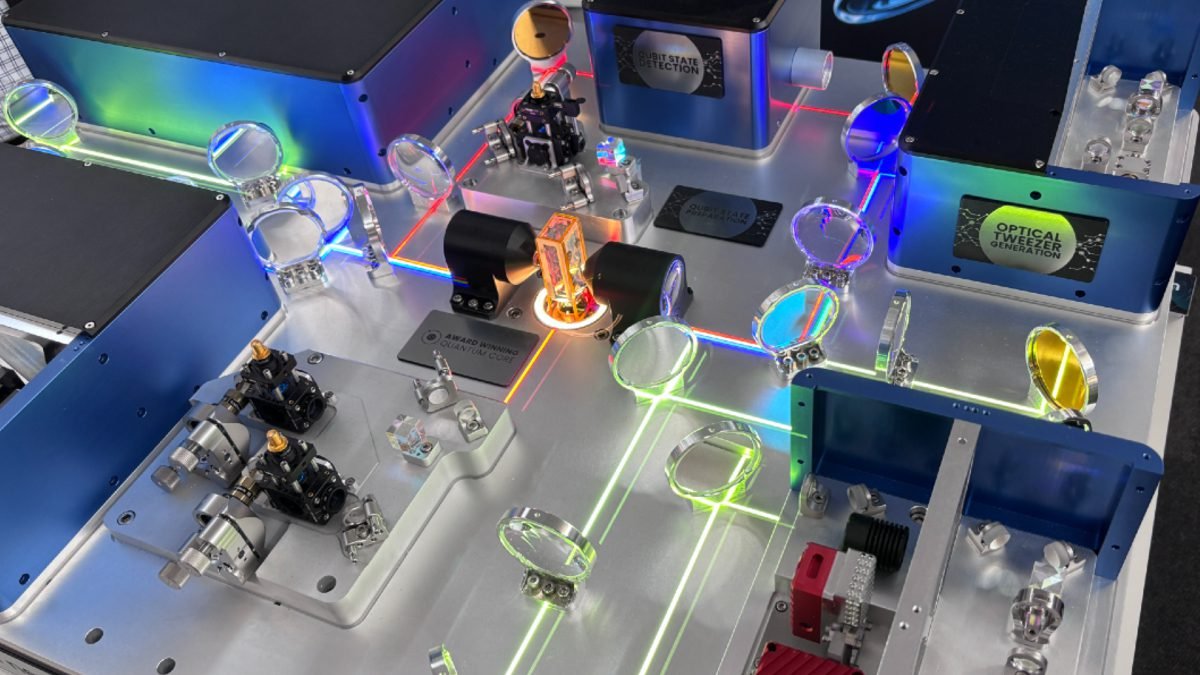
As the United States and China escalate their rivalry over quantum technology, companies across the sector are already repositioning to navigate the geopolitical storm, from building domestic manufacturing bases to carving out independent units for non-Western markets.
In the lab physicists race to achieve entanglement, the phenomenon in which particles become inextricably linked regardless of distance. In the boardroom, quantum firms are doing everything they can to avoid being drawn into an entanglement of a different kind, one between Washington and Beijing.
This week, US President Donald Trump signed an executive order directing federal agencies to strengthen domestic quantum supply chains and manufacturing capabilities, update the national quantum strategy and expand counterintelligence protections for quantum technologies.
The order frames competing nations, including adversarial countries, as a direct threat to American quantum leadership.
Against that backdrop, the strategies of quantum firms vary sharply by geography. US-based companies are focusing on local customers and supply chains, while UK and European players see an opening to serve allies and non-allied nations alike.
Taiwanese firms, caught between two superpowers, are racing to build sovereign quantum capabilities before tightening export controls close that window.
Executives from Quantum Computing Inc (QCI), Infleqtion and ORCA Computing, alongside a board advisor from Foxconn, spoke to Asia Times on the sidelines of the Commercializing Quantum Global 2026 conference in London, organized by Economist Enterprise, sharing how they are navigating the intensifying US-China quantum race.
“In order to mitigate the risk imposed by geopolitics, we have been working on establishing our manufacturing capabilities in the US. Right now, we are not subject to export control restrictions, but that could change. When there are restrictions, we just have to follow the rules,” Yuping Huang, chairman and chief executive of QCI, a publicly listed US quantum photonics company, told Asia Times in an interview.
“Quantum technology is open. We should use the open approach to studying and commercializing quantum. The quantum industry can benefit from reduced interference from geopolitical factors,” he said.
QCI is expanding a thin-film lithium niobate foundry in Tempe, Arizona, to produce active and passive photonic chips, part of a deliberately domestic manufacturing footprint spanning multiple US states. When asked whether the company planned to set up a separate overseas unit to serve non-Western markets, Huang said the company had not yet given that approach any thought.
Huang graduated from the University of Science and Technology of China (USTC) in 2004 and received his PhD in quantum physics from Michigan State University. He founded QPhoton, a quantum photonics innovation firm, in 2020, before merging it with QCI in June 2022. He is the single largest shareholder in QCI and a US citizen.
Ryan Hanley, UK chief technology officer at Infleqtion, a US-based neutral atom quantum technology company, said the firm works exclusively with allied nations given their shared values on national security and infrastructure development. He said Infleqtion is well positioned within the AUKUS framework of Australia, the UK and the US.
He said China has one of the biggest state investments in quantum technology globally and can develop technology rapidly due to its concentrated focus, but Infleqtion’s response is alignment with allied nations rather than engagement with both sides of the rivalry.
He added that the company has structured its UK and US operations independently, allowing products developed in the UK to be offered to a broader range of markets than those covered by US export controls.
“That is a conscious business decision to do things separately, such that we can serve different parts of the market because of that export control,” he said.

US tightens the screws
During the Biden administration, Washington moved to choke off China’s access to quantum technology, introducing export controls on quantum computers, critical components and related software in September 2024, followed by a ban on most US investments in China’s quantum sector that took effect in January 2025.
In March 2025, the Trump administration added about 80 companies to its export blacklist, more than 50 of which were Chinese, including six subsidiaries of Inspur Group accused of acquiring US technologies to develop AI and quantum technologies for the Chinese military.
On May 21 this year, the Trump administration announced US$2 billion in federal incentives under the CHIPS and Science Act for nine quantum companies, including US$1 billion for IBM to build a quantum-grade superconducting wafer foundry and US$375 million for GlobalFoundries to establish a domestic quantum foundry.
Ann Dunkin, a distinguished professor at Georgia Institute of Technology and former chief information officer at the US Department of Energy, said at the London conference that the US faces a structural weakness in the quantum race that goes beyond funding.
“The US is very good at innovation, but not scaling things, and so we need to get in early to scale, or China will outpace us,” she said. “China is very good at scaling things, and you have seen industries where we have lost that battle.”
“We want to be in a position where if there are going to be a handful of global foundries, we want the West to have that handful, or at least some of that handful. From a geopolitical standpoint, we run the risk otherwise of the same problem we have right now in many technologies, where we are dependent upon China for high-tech goods,” she said.
In July 2024, the US and nine allied nations established the Quantum Development Group (QDG) to coordinate quantum technology policies and promote resilient supply chains. The group expanded to 13 members at its fourth meeting in Tokyo last September. At its fifth meeting in London in late March 2026, members committed to deeper cooperation on research security, supply chain resilience and quantum standards development.
QDG membership includes Australia, Canada, Denmark, Finland, France, Germany, Japan, Korea, the Netherlands, Sweden, Switzerland, the UK and the US.
Manjari Chandran-Ramesh, a partner at Amadeus Capital, a global deep-tech investor, said she hoped the geopolitical rivalry would prove to be background noise rather than a fundamental barrier, pointing to the QDG as evidence that multilateral quantum cooperation remains viable.
“European companies are in a position where we can benefit from the fact that the US and China are having a quantum race, because we have good clusters all across Europe and in the UK, and we can provide for a number of qubit modalities,” she said. A qubit, or quantum bit, is the fundamental unit of information in quantum computing.
She added Europe’s existing foundry ecosystems around imec in Belgium, CEA-Leti in France and VTT in Finland give it the flexibility to serve a broader range of quantum hardware developers across multiple qubit technologies.
“The US has tended to favor more US companies in their investments and increasingly has more of a US focus,” Richard Murray, co-founder and chief executive of ORCA Computing, a London-based photonic quantum computing company, told Asia Times.
“The UK’s approach is better because it’s much more open,” he said. “The UK’s target is to attract globally leading quantum companies to build their systems in the UK, as well as supporting UK companies.”
He said ORCA sees itself as competitive with leading global quantum companies in that open marketplace.
ORCA’s existing customers span allied nations across Europe, North America and Asia, including the UK Ministry of Defense, the National Quantum Computing Center, Poland’s Poznan Supercomputing and Networking Center and Montana State University in the US.
In its latest commercial milestone, ORCA deployed its PT-2 system at a major Japanese enterprise through a partnership with the trading house Toyota Tsusho, which it described as the world’s first commercial installation of a quantum computer. The PT-2, a photonic quantum computer housed in standard 19-inch server racks requiring no specialized cooling, was deployed in under one week within a live enterprise environment.
Taiwan walks alone
While the US has export controls, Beijing is building its own quantum ecosystem through heavy investment in academic research and commercialization.
Guo Guoping, a professor at USTC and secretary-general of the quantum computing committee of the Chinese Computer Federation, said last year that the US and the Netherlands have tightened export controls on quantum chips and semiconductor equipment, making indigenous development across the full technology chain a strategic necessity.
Taiwan finds itself in a particularly difficult position, excluded from China’s quantum ecosystem by political reality and absent from the QDG’s allied-nation framework, leaving it to navigate the quantum race largely on its own.

Ching-Ray Chang, a board member at Hon Hai Precision Industry, known as Foxconn, and director of the quantum information center at Chung Yuan Christian University in Taiwan, said the geopolitical environment for quantum technology is fundamentally different from that of the era when Taiwan built its semiconductor industry.
“Fifty years ago, when Taiwan started to make semiconductors, there was no classification at all. Everybody shared the knowledge with each other. But right now, even though you can pay money, sometimes you cannot get any technology transfer,” he said.
“Every country is trying to build its own quantum technology because this is some kind of sovereignty issue. You need to develop and control many things yourself; you cannot rely on others. Not only the patents, but also the production,” he said.
Chang said Taiwan was late to develop quantum technology because all its talent, capital and resources remained tied up in the semiconductor industry, but the government and major companies, including Foxconn, have already begun investing in quantum.
He said Foxconn remains at an early stage compared with global peers but it plans to launch a quantum computer prototype as early as next year.
Read: US, China escalate quantum race with rival investment drives
Follow Jeff Pao on X at @jeffpao3