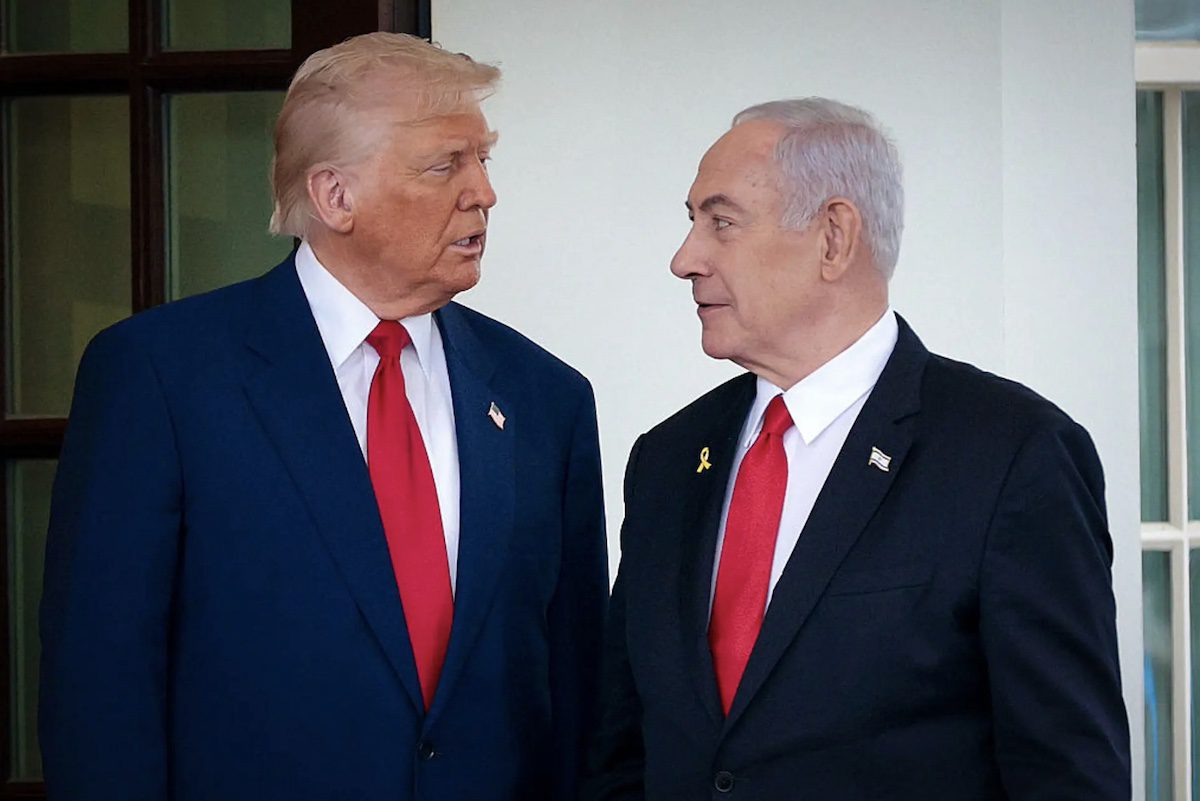
There is a ritual quality to the reassurances that flow from Washington to Jerusalem after every crisis, every ceasefire, every awkward telephone call between an American president and an Israeli prime minister.
“The bond is unshakeable.” “Our commitment to Israel’s security is ironclad.” These phrases have been repeated so many times, by so many administrations, that they have acquired the character of liturgy — comforting, familiar and only loosely tethered to the actual conduct of policy.
Israel’s strategic class would do well to examine that gap more honestly than it usually does.
Since 1948, Israel has found itself in a recurring position: militarily formidable, diplomatically dependent, and navigating the yawning gap between what it feels it needs to survive and what its indispensable ally is prepared to permit. That gap has never fully closed.
The question worth asking — and which Israeli leaders are rarely willing to ask aloud — is whether structural trends in American politics and grand strategy are widening it further.
Historical pattern
Begin with the record. In October 1973, with Israeli armor having encircled Egypt’s Third Army and the Israeli government poised to deliver a decisive military blow, the Nixon administration did something that would become a recurring feature of American statecraft: it saved the enemy from total defeat and called the result a diplomatic triumph.
Henry Kissinger brokered a ceasefire that rescued Egyptian leader Anwar Sadat’s battered forces, handed Washington the role of indispensable regional mediator and gave Israel the lesson it has had to relearn ever since: when American and Israeli objectives diverge, it is Israel that is asked to defer.
The airlift that resupplied Israeli forces during that war, Operation Nickel Grass, was real and consequential — and it also created a dependency. You cannot accept the ammunition and then reject the terms that come with it.
This is not a criticism of American statecraft so much as a description of how great-power patronage has always worked. Athens had its client states. Rome had its client kings. Washington has its allies, and allies serve the patron’s interests, not the other way around.
Shifting American priorities
What has changed is the strategic environment in which that patronage is offered. America’s pivot toward great-power competition with China requires concentrating resources and attention on the Indo-Pacific, not on endless Middle Eastern entanglements.
This is not an ideological position; it is a fiscal and strategic reality that transcends administrations. The Pentagon’s planning documents, regardless of who occupies the Oval Office, point east — to the Taiwan Strait, to the South China Sea, to the arc of competition with Beijing. The Middle East, once the consuming obsession of American foreign policy, has become a distraction from the main event.
Israel’s utility as a strategic partner is increasingly questioned not by anti-Israel voices, but by hardheaded realists who note that American interests in the region — energy security, counterterrorism, great power competition — can often be better served through relationships with Arab states that don’t carry the same political baggage.
This argument will gain force as the years pass, regardless of which party holds power in Washington.
Domestic fault line
Then there is the domestic dimension, which is perhaps the most consequential of all. American support for Israel has rested for decades on a bipartisan consensus that has now visibly fractured.
American public opinion, particularly among younger voters and minorities, has grown increasingly skeptical of blank-check support for any foreign nation, including Israel. Demography is destiny in democratic politics, and the demographic cohorts most skeptical of unconditional support for Israel are the ones inheriting the future of both major parties.
The US provides Israel with regular security aid, currently at an annual rate of $3.8 billion under a memorandum of understanding that expires in 2028. The renegotiation of that agreement will take place in a domestic political environment quite different from the one in which it was originally crafted.
The $3.8 billion annual military aid package, while currently politically untouchable in Washington, represents exactly the kind of foreign spending that an America First-oriented public questions.
None of this means that America is about to abandon Israel. The relationship is too embedded in institutional, cultural, and political structures for any sudden rupture. The US remains Israel’s closest ally, and its support is a central pillar of Israel’s national security, providing access to advanced weapon systems, intelligence sharing, defense technology cooperation, and crucial diplomatic cover at the UN Security Council.
But “will not abandon” is not the same as “can be counted upon unconditionally.” Israel’s leaders need to understand the difference — and to plan accordingly. The lesson of every past crisis is that Washington will support Israel up to the point where doing so conflicts with American interests more broadly defined.
At that point, the phone calls from the Secretary of State become more insistent, the resupply shipments acquire new conditions, and the “ironclad commitment” reveals its actual tensile strength.
The conclusion Jerusalem avoids
What should a clear-eyed Israeli strategist conclude from all of this? Not that the alliance is worthless — it is enormously valuable.
But its value is contingent, transactional and subject to revision by forces that Jerusalem cannot control: American electoral politics, shifting generational attitudes, great-power competition, and the ever-present temptation for Washington to play the role of regional mediator at Israel’s expense.
The morning after every ceasefire is, for Jerusalem, always a morning of reckoning. What was achieved, what was left undone, and what price will be paid, years hence, for the terms that Washington imposed — these are the questions that endure.
Israel’s long-term security cannot rest on the assumption that any American administration will always prioritize Israeli needs over American calculations. The historical record, read without sentiment, does not support that assumption. The uncomfortable answer to the question of whether Israel can count on America in the long run is this: yes, as a partner — but never as a guarantor.
The distinction matters enormously, and the sooner Israeli strategic thinking internalizes it, the more seriously Jerusalem will take the imperative of cultivating alternatives: regional relationships, strategic self-sufficiency and a diplomacy less dependent on a single patron whose own priorities are, inevitably, its own.
This article was originally published on Leon Hadar’s Global Zeitgeist and is republished with kind permission. Become a subscriber here.