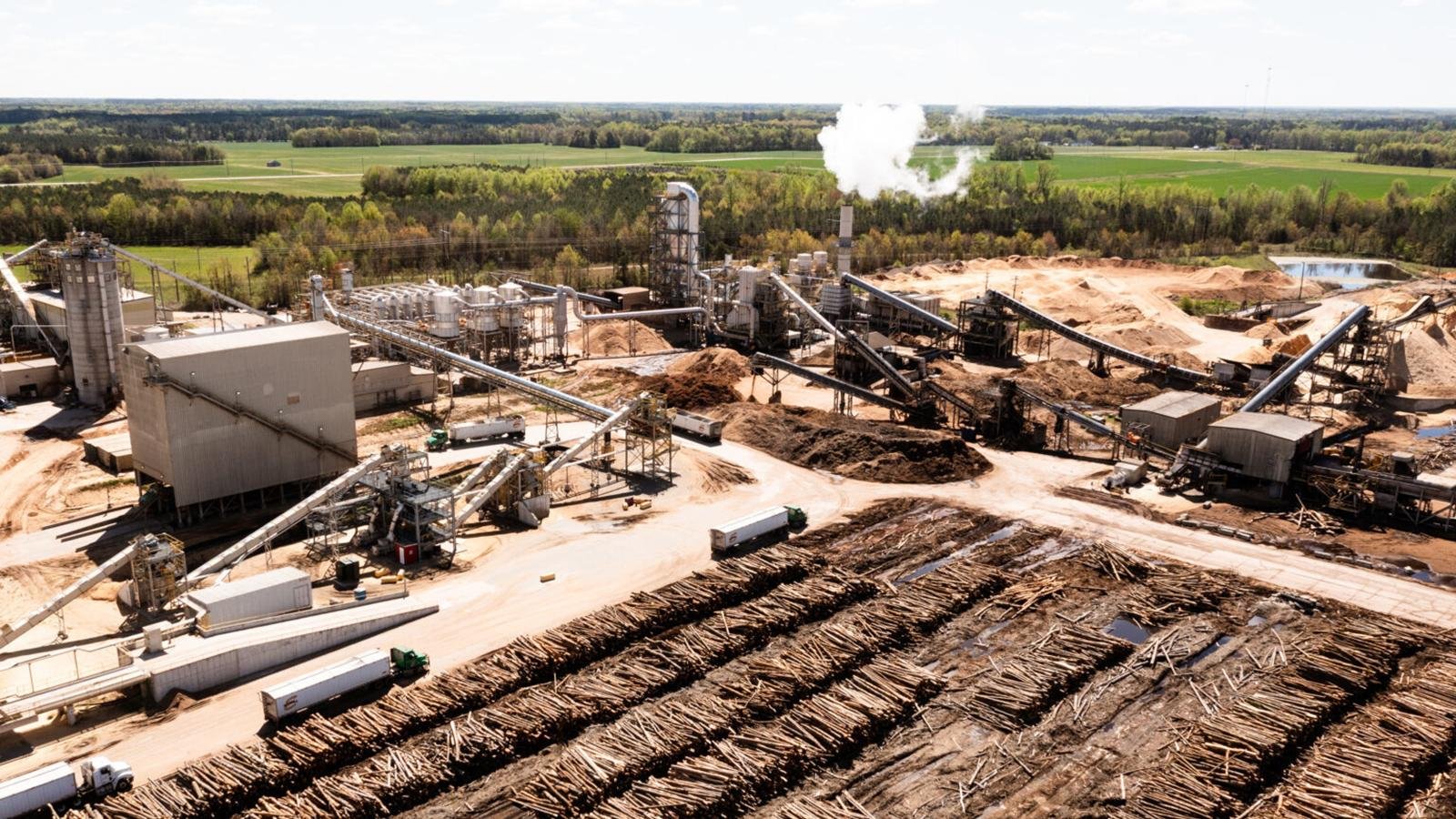
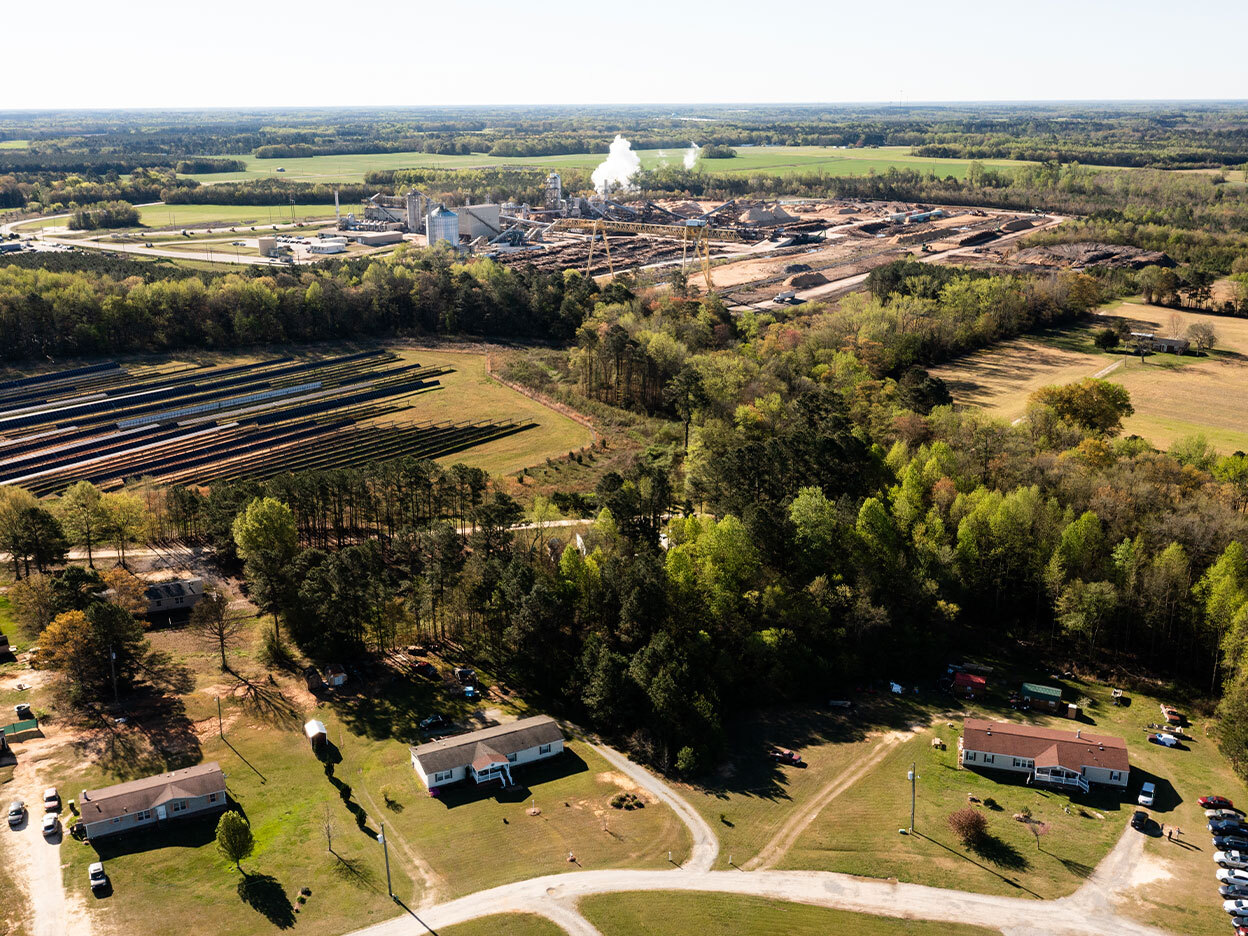
After the world’s largest producer of wood pellets built what it called a state-of-the-art biomass facility near Ruby Bell’s home in Faison, North Carolina, she started organizing. Bell told her residents about the potential impacts, and tried to prevent the company from adding to the area’s environmental burden. It has been an uphill climb.
The retired educator recalls the day that the reality of the effects set in. She had spent the afternoon talking to residents about their experiences living near the new wood pellet facility. By the time she got home, Bell says she was sniffling, her nose was running, and her eyes were burning. “I thought ‘what in the world is going on?’ Then it dawned on me: I sat outside for 20 minutes talking to a resident. There was all this dust and my pants were covered from sitting in a chair,” she recalls. “If it’s like this after 20 minutes, I can only imagine what it’s like for those people living there.”
Seeing experiences like Bell’s — ordinary residents pushed into the role of frontline advocates — helped draw Sherri White-Williamson deeper into environmental justice work, changing the course of her life. After decades working for federal agencies in Washington, D.C., White-Williamson wanted to return to North Carolina and confront industrial pollution. Believing she could make a bigger impact as a lawyer, she enrolled at Vermont Law School at the age of 63. After graduating, White-Williamson founded the Environmental Justice Community Action Network (EJCAN), a grassroots organization dedicated to empowering rural communities to defend their environment and health.
 estimates that Enviva facilities in North Carolina alone consume about 50,000 acres of forest each year, leading to flooding and deforestation.
After the trees are felled, they are hauled to a processing plant, where they are chipped, dried, and pressed into small pellets. Enviva claims that its impact on forestland is minimal because it only uses wood that is unsuitable for other purposes, such as tree limbs and leftover wood from timber harvests. Environmental groups like Dogwood Alliance and the Southern Environmental Law Center have documented evidence to the contrary, capturing images of clear-cut logging and mature downed trees bundled in neat rows along the perimeter of barren dirt fields to supply the pellet mills.
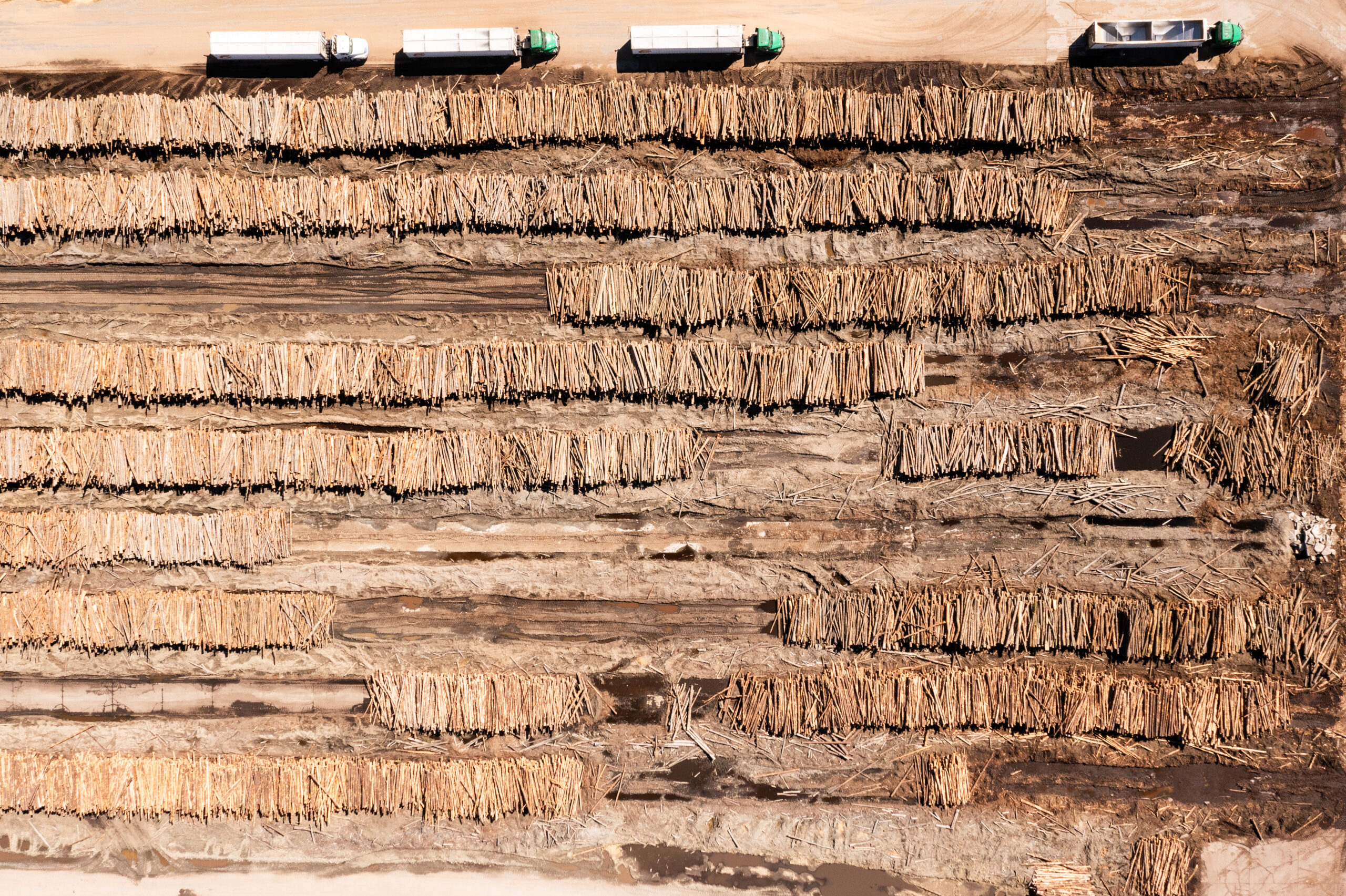
White-Williamson points out that none of this energy is produced for US consumption. “The pellets are going overseas, and the trees are getting cut down over here,” she says, pointing out that these forests would otherwise be storing carbon.
A growing body of research shows that burning wood pellets emit even more carbon than burning coal. Although trees are a renewable resource, researchers at the Massachusetts Institute of Technology calculated that in some instances, it would take more than a century for young trees to absorb as much excess CO2 as the forests they replace.
The social and environmental consequences extend far beyond carbon. Recent data found that Enviva’s wood-pellet facilities are 50% more likely to be located in vulnerable communities already besieged by polluting industries and environmental injustices. Oversight has often failed to keep pace with these impacts. Although the facility had received several citations for emitting too many toxins, in 2019 the Department of Environmental Quality granted Enviva’s request to expand its production capacity over community objections.
“The story is always the same,” says White-Williamson. “The community that doesn’t have the power or the access to power, or politicians or decision makers is always getting the short end of the stick.”
This raises considerable health risks for the people living nearby, says Danielle Purifoy, a professor of geography and environment at the UNC Gillings School of Public Health. The pellet manufacturing process releases a toxic combination of particulate matter, carbon monoxide, nitrogen oxide, and volatile organic compounds (VOCs).
 report showed that air pollution, dust, noise, and traffic have a measurable impact on quality-of-life.
“The results of this survey confirm what we have known for years: Biomass wood pellet plants do incredible amounts of harm to nearby communities, which are more often than not communities of color, or lower-wealth communities,” said SELC staff attorney Jasmine Washington. “When they were asked, they shared very openly about their frustrations at the daily impact from this pellet mill.”
Eager to talk about their experiences after having their concerns ignored for years, respondents complained of the constant plant and traffic noise, needing to wash their cars almost daily, and no longer feeling comfortable sitting on their porches. Some said they were even forced to wear masks indoors.
“Folks are speaking up more because they now understand that there is a direct link between what they or their family is experiencing, and what’s going on around them,” says White- Williamson. The survey findings underscore the importance of EJCAN’s work helping communities document harm, and building collective power to advocate for protections.
The Environmental Justice Community Action Network (EJCAN) is a North Carolina–based nonprofit that works to advance environmental justice in rural communities, particularly in Sampson County. The organization supports residents facing pollution and other environmental harms by providing scientific research, water and air monitoring, education, and advocacy. EJCAN also helps communities access legal and technical resources, empowering them to hold polluters accountable and push for cleaner air, water, and soil.