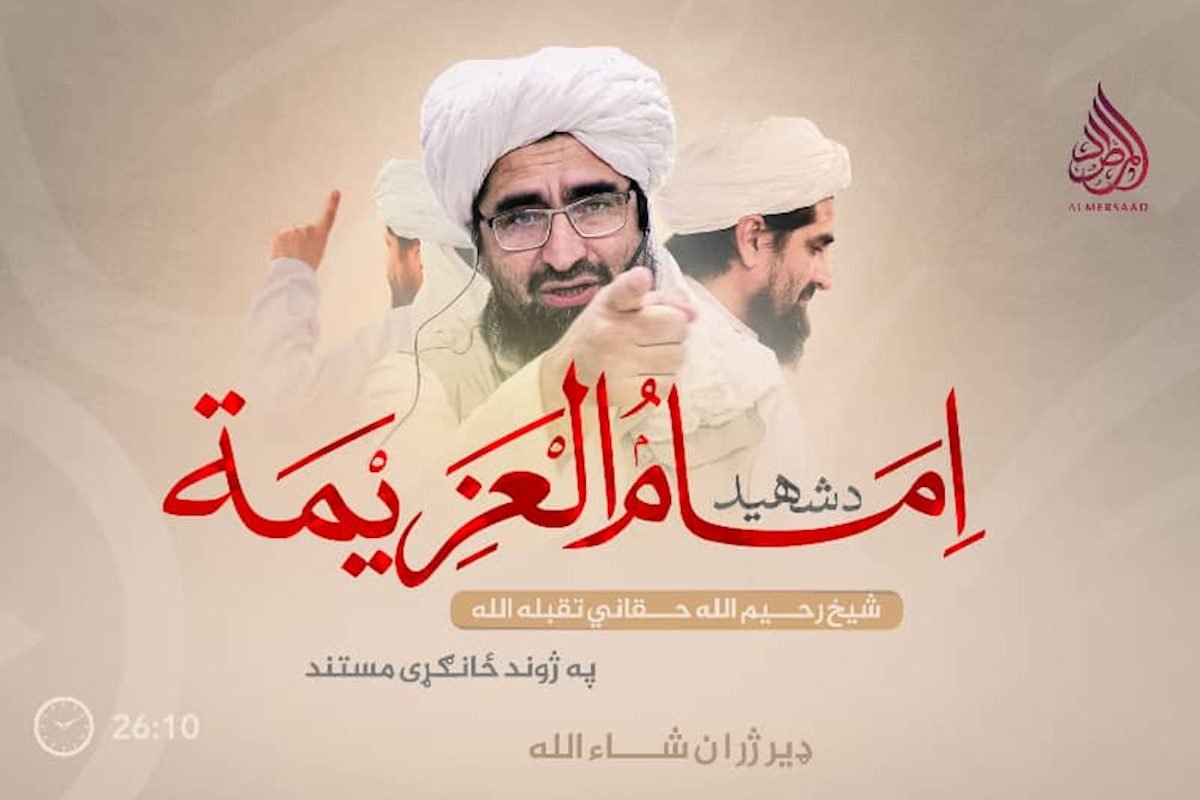
For much of the last two decades, the Taliban fought its war with rifles, roadside bombs and guerrilla ambushes. Today, one of its most important battlefields lies not in the mountains of Afghanistan but in the information domain.
The Islamic Emirate of Afghanistan (IEA) increasingly recognizes that modern conflicts are shaped not only by military power but also by narratives, legitimacy and perception management.
The emergence of English-language platforms such as Al-Mirsad illustrates how the Taliban’s communication apparatus has evolved from insurgent propaganda into a sophisticated strategic communications system aimed at influencing international audiences and defending the movement’s political legitimacy.
This outlet’s evolution has attracted growing attention among regional analysts. In May 2026, The Durand Dispatch – Strategic Messaging published a 17-page study by Joey Moran examining Al-Mirsad, which is sometimes transliterated from the Arabic as Al-Mersaad.
Based on an analysis of 137 articles published between January 2025 and March 2026, the study argues that Al-Mirsad, which means the “watchtower” or “observatory”, functions less as an independent media outlet and more as an instrument of statecraft.
Its messaging revolves around three objectives: delegitimizing Islamic State Khorasan Province (ISKP), repositioning Pakistan as Afghanistan’s principal external adversary and projecting the Islamic Emirate as a sovereign state operating within an emerging multipolar order.
Taken together, these themes suggest that the Taliban have modernized their communications strategy without fundamentally altering their ideological foundations. What has changed is not the movement’s worldview but the sophistication with which it is communicated.
Delegitimizing ISKP
Al-Mirsad’s most consistent narrative focus is the delegitimization of ISKP. References to ISIS, Daesh, Khawarij and Fitnah appear throughout its English-language output, reflecting a sustained effort to challenge the group’s religious and political legitimacy.
This is more than a counterterrorism narrative. By repeatedly labeling ISKP as “Khawarij,” Al-Mirsad seeks to place the organization outside accepted Islamic authority. Similar terminology has also appeared in narratives concerning Tehreek-e-Taliban Pakistan (TTP), suggesting that such labels function as political instruments as much as religious classifications.
Alongside this religious framing is the portrayal of ISKP as a foreign project. Al-Mirsad frequently depicts the group as the product of external intelligence manipulation, financed and supported by actors seeking to destabilize Afghanistan. Pakistan’s intelligence services are often presented as facilitators of this agenda.
Whether such claims convince international audiences is less important than their strategic function. They reinforce the Taliban’s image as both the defender of Afghanistan and the principal force confronting extremism. At the same time, they undermine attempts to justify military pressure on Afghanistan under a counterterrorism pretext.
Notably, many of these narratives appeared before major Pakistan-Afghanistan tensions escalated in 2026, suggesting prior narrative preparation rather than reactive messaging.
What also distinguishes Al-Mirsad from traditional jihadist media is its audience. ISKP media products primarily target recruitment and ideological mobilization. Al-Mirsad increasingly addresses diplomats, analysts and policymakers. Its objective is not recruitment but legitimacy.
Pakistan as the new adversary
One of the most significant shifts in Taliban communications is the gradual replacement of the United States by Pakistan as the principal external antagonist.
For years, Taliban narratives revolved around resistance to foreign occupation. Following the US withdrawal, Pakistan increasingly assumed the role of external adversary. Growing tensions over cross-border militancy, border management and security incidents have provided fertile ground for this transition.
Within Al-Mirsad’s messaging, Pakistan is portrayed through several overlapping lenses: a sponsor of instability, a state seeking to conceal domestic failures through external confrontation and a declining regional power struggling to retain influence over Afghanistan.
In some narratives, Pakistan is depicted as facilitating ISKP and exporting its internal contradictions across the border.
During military escalations in October 2025 and February 2026, Al-Mirsad consistently framed Pakistani strikes as violations of Afghan sovereignty. Coverage emphasized civilian casualties and the suffering of women, children and refugees, reinforcing a narrative of Afghan victimhood and sovereign self-defense.
Equally revealing is what Al-Mirsad chooses not to discuss. Despite remaining central to Afghanistan-Pakistan tensions, Fitna al Khawarij (FAK), an official state designation used by Pakistan to describe the TTP and its affiliates appeared in only four of the 137 articles examined.
When discussion became unavoidable, it was often reframed as Pakistan’s domestic problem or presented in ways that minimized Afghan responsibility. This suggests that strategic omission has become as important as strategic messaging.
The contrast with Pakistan’s communications approach is also notable. Islamabad generally advances its position through official statements and diplomatic engagement. Al-Mirsad operates through a broader narrative framework that blends religion, sovereignty, history and geopolitics to shape how international audiences interpret Afghanistan-Pakistan tensions.
Manufacturing legitimacy
The third pillar of Al-Mirsad’s messaging strategy is legitimacy.
Although the Islamic Emirate remains without broad international recognition, its communications increasingly portray Afghanistan as a normal and accepted member of the international community. Russian engagement, expanding ties with China and India’s gradual reopening of channels with Kabul are regularly highlighted as evidence of growing acceptance.
Each diplomatic meeting, trade agreement or regional engagement is presented as proof that Afghanistan’s rulers are becoming an unavoidable political reality. The emphasis is less on formal recognition and more on practical engagement.
This narrative aligns with broader geopolitical trends. As competition among major powers intensifies and a more multipolar Eurasian order emerges, the Islamic Emirate seeks to position itself as a pragmatic regional actor capable of engaging diverse partners irrespective of Western preferences.
At the same time, issues that continue to obstruct formal recognition receive considerably less attention. Restrictions on women, concerns regarding inclusive governance, ICC arrest warrants and allegations of links with transnational extremist organizations rarely occupy the same prominence as stories emphasizing diplomatic progress. Al-Mirsad systematically amplifies signs of de facto recognition while downplaying obstacles to formal acceptance.
Perhaps the most revealing aspect of this strategy is its management of contradiction. The Taliban continue to reject democracy as incompatible with Islamic governance while simultaneously seeking legitimacy from an international system largely built upon democratic norms.
Al-Mirsad frequently invokes Koranic authority, Rashidun precedents and the legacy of Mullah Omar to reinforce ideological continuity even as it seeks international acceptance.
Similarly, narratives emphasizing Afghan sovereignty often coexist with broader appeals to pan-Islamic solidarity. Rather than resolving such contradictions, Al-Mirsad manages them through selective messaging tailored to different audiences.
The language of jihad, mujahideen and martyrdom also remains visible throughout its content. In this sense, the Taliban’s communications modernization has not been accompanied by ideological moderation. The movement has changed how it communicates, but not what it believes.
New information battlefield
Al-Mirsad is at the heart of the evolution of Taliban statecraft.
Unlike the Taliban of the 1990s, which relied largely on information control and unsophisticated propaganda, today’s rulers increasingly compete in the global marketplace of narratives. Information operations now complement diplomacy, governance and security policy. Media has become an instrument of statecraft.
The broader lesson extends beyond Afghanistan. Future regional crises are likely to be shaped not only by military developments but also by competing efforts to define sovereignty, victimhood, counterterrorism and political legitimacy before international audiences. In that contest, narrative advantage may prove as consequential as battlefield success.
Al-Mirsad demonstrates how a movement once associated primarily with insurgency has adapted to the realities of twenty-first-century geopolitical competition. The struggle for influence is no longer confined to borders or battlefields. Increasingly, it is fought in the information space – where narratives shape perceptions of legitimacy and, ultimately, regional outcomes.
Saima Afzal is a researcher specializing in South Asian security, counterterrorism, and broader geopolitical dynamics across the Middle East, Afghanistan and the Indo-Pacific. She is currently a research scholar at Justus Liebig University, Germany.