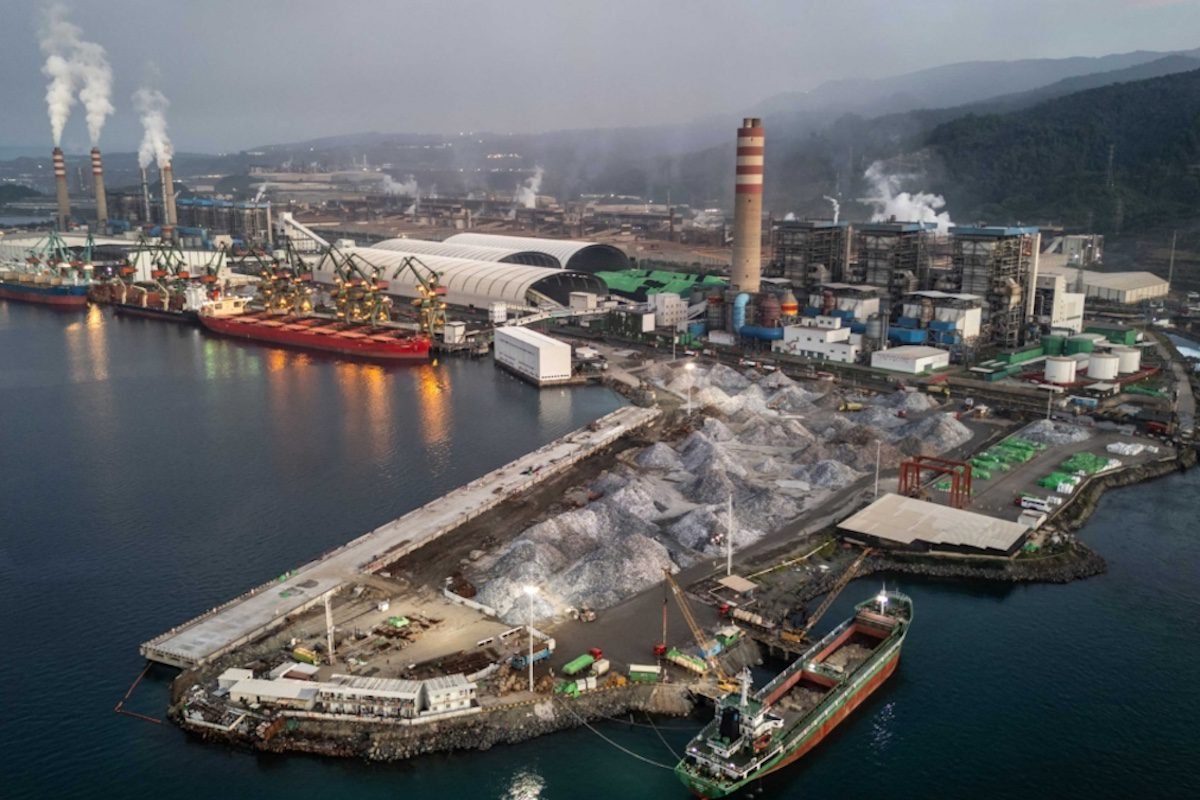

Halmahera, the largest island in Indonesia’s North Maluku province, is unlikely to be familiar to most readers outside Southeast Asia. Yet this forested island, located between Sulawesi and New Guinea, has become one of the most important places in the global energy transition.
Home to some of Indonesia’s largest nickel deposits and the world’s largest nickel mine, Halmahera now sits at the center of rapidly expanding supply chains that support electric-vehicle and battery manufacturing.
Over the past decade, billions of dollars in investment have flowed into the island, much of it linked to large-scale industrial projects backed by Chinese capital.
The China-led transformation has been dramatic, giving rise to bountiful new economic opportunities. Industrial activity has expanded rapidly. Infrastructure has improved in areas that had long struggled to attract public or private investment. Many of these changes have brought real benefits to local communities.
Earlier this year, Indonesia Weda Bay Industrial Park (IWIP), owned by three Chinese companies, and Weda Bay Nickel, majority owned by China’s Tsingshan Holding Group, began construction of a water treatment facility to provide clean water to villages in Central Halmahera, marking a tangible improvement in villagers’ daily lives.
To be sure, these contributions deserve recognition. But the growing role of corporations in community life raises an important question: What happens when foreign companies become more visible and effective than the government for delivering public services?
This is not a criticism of any particular Chinese or other foreign company operating in Indonesia. Nor is it an argument against foreign investment in public infrastructure. Rather, it is a warning about a pattern that has appeared repeatedly in resource-rich regions around the world.
A major industry arrives. Investment flows in faster than the government’s capacity to expand. Companies begin supporting infrastructure, education programs, health initiatives and community services.
Initially, these efforts are welcome because they address real needs. Over time, however, a subtle shift can occur. Communities begin looking to corporations rather than public institutions for solutions to public problems. When that happens, the balance between private influence and public responsibility begins to change.
Halmahera risks becoming what might be called a “company island”: a place where a single industrial ecosystem becomes so influential that it shapes not only employment and economic growth, but also the provision of services and the direction of development itself.
A strong state should welcome responsible private investment while remaining visibly present in people’s lives. Roads, water systems, schools and healthcare should not depend on the continued success of a particular industry or the goodwill of a particular company. Public services should remain public responsibilities.
This distinction matters because corporations and governments play fundamentally different roles in society. Corporate leaders may act in good faith, but their primary responsibility is to their businesses.
Governments carry a different obligation. They are responsible for the long-term welfare of all citizens, including those who do not directly benefit from industrial growth. As Halmahera’s role in the global energy transition grows, this distinction will become increasingly significant.
The island is often discussed today in terms of nickel, batteries and industrial parks. Yet Halmahera is more than a strategic asset in a global supply chain. It is home to hundreds of thousands of people, diverse Indigenous and customary communities, rich marine ecosystems and livelihoods that extend far beyond mining.
Its future should not be defined solely by the needs of the global battery industry.
Saving Halmahera does not mean rejecting investment. It does not mean opposing industrial development. The island’s residents deserve economic opportunities, better infrastructure and rising living standards.
But development should strengthen public institutions, not substitute for them.
The measure of success in Halmahera should not be how many tons of nickel leave its shores each year. It should be whether local communities feel that their future is being shaped by accountable public institutions capable of serving the public interest.
The world’s energy transition will require places like Halmahera. The question is whether that transition will leave behind stronger societies or merely stronger corporations.
For Halmahera, the answer depends on whether the government remains at the center of development. An island can welcome foreign investment without surrendering its future. It can benefit from corporate involvement without becoming dependent on it.
That is the balance Halmahera must preserve if it is to avoid becoming a company island.
Muhammad Zulfikar Rakhmat is director of the China-Indonesia Desk at the Jakarta-based Center of Economic and Law Studies (CELIOS) independent research institute. Yeta Purnama is a researcher at CELIOS.