BANGKOK – India’s military is expanding across the Andaman Sea into Southeast Asia with the construction of a multi-billion-dollar air and sea base on remote Great Nicobar Island, New Delhi’s furthest reach toward the Strait of Malacca, where rival China ships more than 70% of its imported oil.
“The Great Nicobar Island Project, which is of strategic, defense and national importance, transforms the region into a major hub of maritime and air connectivity in the Indian Ocean region,” India’s Prime Minister Narendra Modi proudly shared on his social media in September.
New Delhi and its allies, potentially including Washington, could benefit in that watery zone if a serious conflict erupts with China after the massive project is completed on the isolated and previously neglected island.
Construction has already begun. An initial phase allowing air and sea operations may be ready within a few years.
Great Nicobar is India’s southernmost island, 3,000 kilometers southeast of New Delhi, in the 800-kilometer-long tropical Nicobar archipelago.
“When completed, the Great Nicobar project would allow India to monitor activities near the Strait of Malacca, a key trade corridor for China,” the Hong Kong-based South China Morning Post reported on May 22.
“Amid the Hormuz blockade, supporters of the Indian project — including some of the country’s military veterans — argue it would enable New Delhi to ‘control’ or disrupt Chinese supply chains and worsen its ‘Malacca dilemma,’” the paper said.
China Global South Projects, a foreign-run analysis website, agreed and said on May 21: “Chinese analysts warn India’s Nicobar push threatens Beijing’s ‘Malacca Lifeline.’”
“Chinese analysts see the project as a sign that New Delhi is trying to turn Great Nicobar into an economic and military outpost near one of China’s most important maritime lifelines, giving India greater ability to monitor the Malacca Strait and project influence across the region.
“India is increasingly seen as a maritime rival that could shape China’s access to the Indian Ocean and Southeast Asian sea lanes, and potentially gain leverage near one of Beijing’s most important economic lifelines,” it reported.
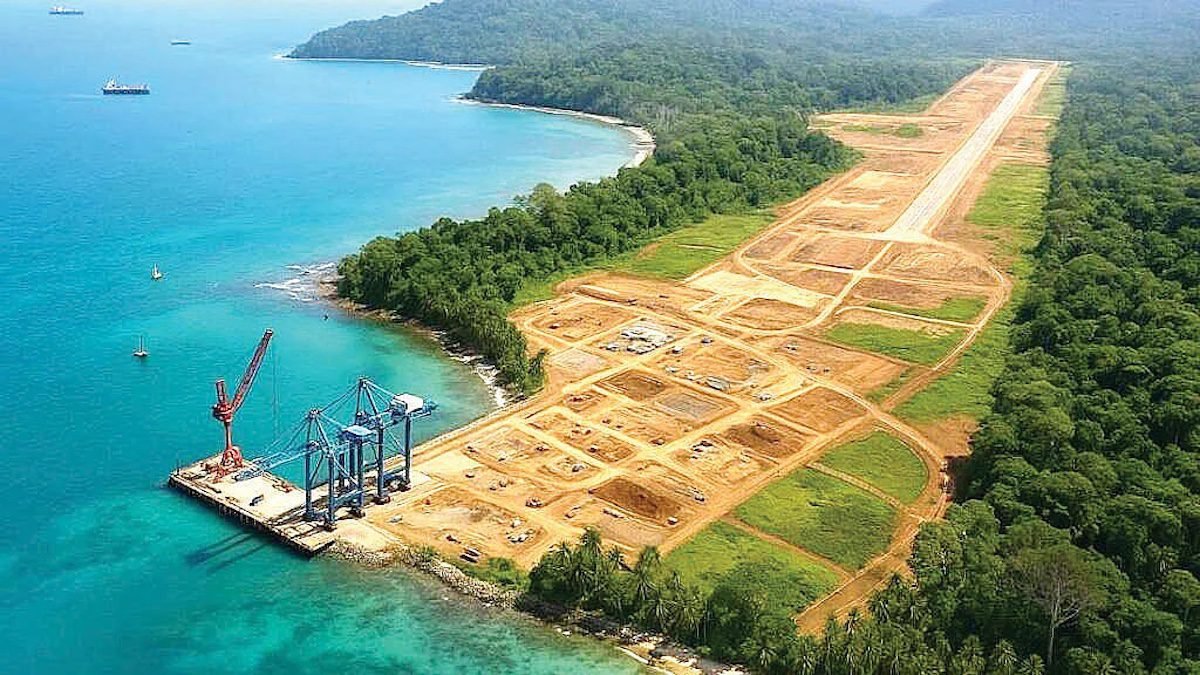
When India completes construction of the Greenfield International Airport to handle fighter jets and commercial planes, it will replace the tiny airport at Campbell Bay, the small east coast capital of Great Nicobar Island.
Installation of advanced radar capability at Campbell Bay’s existing Indian Naval Air Station Baaz (“Hawk” in Hindi) would give New Delhi increased surveillance over the western mouth of the equatorial Strait of Malacca, which is also used by the US Seventh Fleet.
Great Nicobar Island is only 175 kilometers northwest of Indonesia’s large Sumatra Island, which forms the western mouth of the Malacca Strait, near west Malaysia, Singapore and southwest Thailand.
The strait, which opens onto the Andaman Sea and the wider Indian Ocean, has come under increased focus after the Iran war and Strait of Hormuz blockade made narrow shipping routes vulnerable chokeholds on a fluid chessboard.
India is also building a huge deepwater seaport at the island’s southern Galathea Bay, which opens onto the Andaman Sea, where an estimated 70% of Chinese oil imports pass from the Middle East into the Strait of Malacca for onward passage to China’s east coast.
Galathea Bay’s International Container Transshipment Terminal is planned to become the nation’s biggest port, potentially dwarfing India’s west coast facilities at Mumbai (Bombay).
“It may be competing to become the container handling hub in the entire Indo-Pacific region,” said Kumar Joshi, Great Nicobar Island’s lieutenant governor.
Similar to international port facilities in Singapore, Malaysia and Sri Lanka, it would be used to transship and reroute cargo by allowing large vessels to load or unload smaller ships that ply routes to nearby ports across Southeast Asia.
India’s own transshipments would be less expensive if it did not have to pay fees and taxes at those three foreign ports when its vessels move cargo to and from other ships. Along with the Andaman Islands further north, Great Nicobar Island “is emerging as India’s gateway to Southeast Asia and the global Blue Economy,” Joshi said in October.
Construction is being carried out in phases, with an initial opening planned for 2028 and expansion continuing over the next 20 years. New Delhi also expects to make money from providing refueling, repair, warehousing and other commercial activities for international vessels transiting the Strait of Malacca and the nearby Andaman Sea.
Tourism would also benefit from a boost when international travelers begin arriving by air or on cruise ships in Great Nicobar.
A new power plant on the island is in the works to supply energy for the massive project, which would include a new town larger than the capital, populated by importing more than half a million Indians from the mainland to operate the facilities. Enthusiasts insist the island could become the next Hong Kong by mid-century.
Many of the island’s 1,200 residents, however, hunt and gather their food in the rainforest, including about 300 Shompen tribespeople who are among the most isolated and uncontacted on Earth.
“We, as scholars with expertise on the crime of genocide, are writing to express our utmost concern that the indigenous Shompen people of India’s Great Nicobar Island will face genocide if the plan to turn their island into the ‘Hong Kong of India’ goes ahead,” Survival International, a British campaign group for indigenous people, said in a petition to New Delhi.
“The Shompen people have lived for hundreds, if not thousands, of years in harmony with the rich natural world of Great Nicobar Island, largely without contact with outsiders,” the petition said.
It was signed by 39 prominent American, British, and other genocide and Holocaust scholars.
Environmentalists, meanwhile, warn of possible toxic chemical pollution, disrupted ecosystems, threats to endangered land and sea creatures from spills and shipping, and other havoc from the expanded military installations.
Worried geologists reportedly documented the possibility of an underwater earthquake triggering a tsunami that could inundate the island.
Great Nicobar Island is only about 910 square kilometers and almost totally covered in thick, relatively unexplored forests, graced by elegant lagoons and fish-rich coral reefs.
Hoping to quell complaints about the estimated $9 billion cost and potential environmental risks, Prime Minister Modi said the project is “a prime example of economy and ecology complementing each other” after optimistic Union Minister Bhupender Yadav briefed him in September.
The “project has great significance not only for economic development of the island and surrounding areas of the strategic location, but also for defense and national security,” India’s environmental court, known as the National Green Tribunal, determined in 2023 favoring its development.
“The area is located in China’s ‘String of Pearls’ strategy, which is sought to be countered by Indian authorities under India’s ‘Act East’ policy,” the court said.
The String of Pearls describes China’s expanding number of foreign seaports, which are already established in Sri Lanka, Pakistan, East Africa and elsewhere — making New Delhi, Washington and others concerned.
India’s Act East policy refers to New Delhi’s recent efforts to strengthen commercial, military, and diplomatic relations with prosperous Southeast Asia rather than prioritizing ties with its bordering neighbors in financially strapped South Asia.
Richard S. Ehrlich is a Bangkok-based American foreign correspondent reporting from Asia since 1978, and winner of Columbia University’s Foreign Correspondents’ Award. Excerpts from his two new nonfiction books, “Rituals. Killers. Wars. & Sex. — Tibet, India, Nepal, Laos, Vietnam, Afghanistan, Sri Lanka & New York” and “Apocalyptic Tribes, Smugglers & Freaks” are available here.