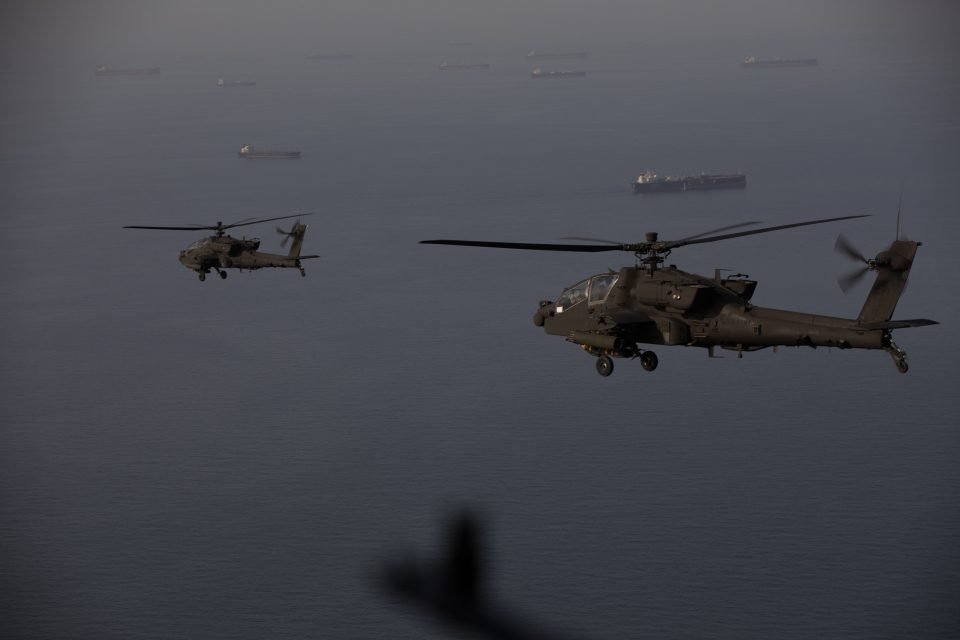
A US Army helicopter gunship was apparently struck by an Iranian Shahed drone before going down near the Strait of Hormuz—but it’s unclear whether the one-way attack drone was deliberately aimed or achieved more of a lucky accidental strike.
Axios correspondent Barak Ravid first reported an unnamed US government official’s comments that an Iranian drone had hit the US Army AH-64 Apache helicopter before the latter went down on June 8. The New York Times later confirmed that reporting through more anonymous US officials, including one official who said US military investigators were still evaluating whether the Iranian drone strike on the helicopter was intentional or accidental.
Iran has fired thousands of such Shahed drones against a wide range of military and civilian targets in the Gulf region since February 28, 2026, when the United States and Israel began the war by jointly attacking Iran with a barrage of bombs and missiles. But Shahed drones have mainly struck stationary targets such as Amazon data centers and energy facilities, sometimes hitting slow-moving commercial ships in the Strait of Hormuz.
The basic models of Iranian Shahed drones rely on GPS satellite guidance and preprogrammed coordinates to strike stationary targets from long range and are not usually designed to track and strike moving targets, said Mark Cancian, a senior adviser with the Center for Strategic and International Studies, a think tank based in Washington, DC, in an interview with The New York Times. But he suggested that Iran may have received newer Russian-modified Shahed drones that can be remotely operated to strike targets in motion.
Whatever the case, the result is that an Iranian drone that usually costs about $35,000 managed to take down a US Army helicopter with a price tag of $25 million. The only silver lining for the US military was its successful rescue of both helicopter crew members from the water due to the unprecedented use of a drone boat.
The growing tally of US military aircraft losses
This represents the first US Army Apache helicopter to go down during the conflict—and apparently the first such helicopter to be taken out by a drone. The United Arab Emirates and Israel had been using their own US-supplied Apache helicopters to hunt and shoot down Iranian Shahed drones.
But Iran had previously succeeded in shooting down an F-15E Strike Eagle fighter jet and an A-10 Thunderbolt ground-attack aircraft on April 5 and April 6, respectively, using ground-launched missiles. All crew members were rescued, though the US military had to mount a risky combat search-and-rescue operation to retrieve the F-15 fighter jet’s weapon systems officer from the Zagros Mountains in Iran.
Iran has also shot down dozens of US MQ-9 Reaper drones used for surveillance that can each cost more than $30 million. Other US military aircraft have sustained damage during combat operations over Iran or while sitting on the ground at air bases targeted by Iranian missile and drone attacks, according to a tally compiled by the Congressional Research Service on May 13. Furthermore, six aircrew died after their KC-135 Stratotanker aerial refueling aircraft crashed on March 12 following a collision with another tanker aircraft.
The US military was initially tight-lipped about how the Army Apache helicopter went down. But, in a social media post on June 9, President Donald Trump became the first to publicly blame Iran for shooting down the Apache helicopter, while also warning that “the United States must, of necessity, respond to this attack.”
US Central Command, the US military combat command responsible for Middle East operations, followed up by launching what its press release described as “self-defense strikes against Iran, June 9, at the Commander in Chief’s direction in response to yesterday’s downing of a US Army Apache helicopter.”
The latest flashpoint
Trump was initially inclined to shrug off the Apache helicopter’s downing after the pilots were rescued, according to The Wall Street Journal. But the president apparently changed his mind during a White House briefing when both Defense Secretary Pete Hegseth and Chairman of the Joint Chiefs of Staff Gen. Dan Caine “recommended military action” and shared more details about the Iranian Shahed drone striking the US helicopter.
The strikes from US fighter jets targeted Iranian air defense, ground control stations, and surveillance radar sites near the Strait of Hormuz, according to the US Central Command press release. But Iran’s state broadcaster claimed the US military strikes also damaged water tanks and cut off the water supply for at least 20,000 people in Hormozgan province.
Iran also retaliated by launching yet another round of Iranian missile and drone attacks against Gulf countries such as Bahrain and Kuwait, along with Jordan, according to The New York Times. The Islamic Revolutionary Guard Corps, an Iranian paramilitary force, said it had targeted US bases in the region, including the US Fifth Fleet base in Bahrain, while claiming to shoot down yet another US MQ-9 Reaper drone.
The latest tit-for-tat strikes threaten to completely shatter any lingering illusion of a ceasefire between the United States and Iran that supposedly began on April 8. The ceasefire period has been punctuated by intermittent fighting and dueling blockades in and around the Strait of Hormuz, the vital shipping lane choked off by the conflict.