President Xi Jinping has, over the years, drastically cut short his foreign travels. More like Chairman Mao, he prefers to host world leaders in Beijing.
His foreign visits that averaged about 14 trips a year during 2013–19 fell to one during the pandemic year 2020, to zero for 2021, and were partially revived to five or six trips a year during 2022-2025.
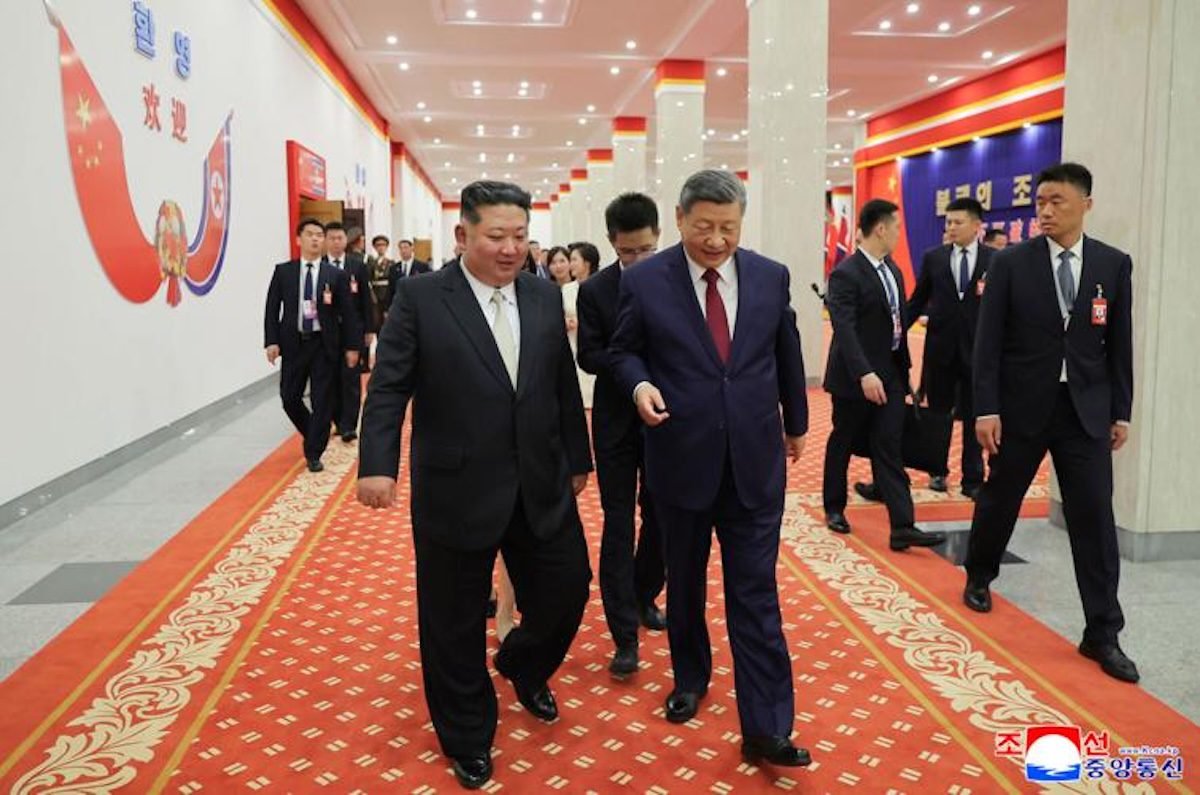
This makes what happened earlier this week worth our attention.Xi Jinping’s first foreign visit of 2026 — a year in which he has already hosted about a dozen world leaders including Donald Trump and Vladimir Putin — was not to Moscow or Washington.
The trip was to an erstwhile pariah: the heavily sanctioned and diplomatically isolated hermit kingdom of Kim Jong Un. That choice is a story and an alarm bell, and it has a name: the patron problem.
Kim’s audacious gambit
For decades, the China-North Korea relationship ran on a single, brutal logic: Pyongyang needed Beijing more than Beijing needed Pyongyang. Till recently, China accounted for over 95% of North Korea’s foreign trade. China supplied food, fuel, electronics, machinery, vehicles and textiles. This dependency was Beijing’s ultimate leverage — a leash elegantly disguised as fraternal socialism.
But Kim has spent the last four years systematically cutting that leash. The pivot began after Russia’s war with Ukraine created needs for ammunition, artillery shells and manpower. By late 2024, 11,000 North Korean soldiers were deployed to fight alongside Russian forces. In exchange, Pyongyang extracted a windfall that China could never imagine: it earned between $7.7 and $14.4 billion from its provision of equipment and manpower to Russia. This was way more than its total foreign trade of $3.2 billion for 2025.
North Korea was rewarded by President Putin paying a two-day visit to Pyongyang in June 2024, his first visit since July 2000 when he was hosted by Kim Jong Un’s father Kim Jong Il. Meanwhile, Kim Jong Un had met Putin in April 2019 (Vladivostok) and September 2023 (Vostochny Cosmodrome). Then two had met in Beijing during China’s Victory Day celebrations of September 2025.
Russia has since supplied North Korea with advanced drone technology, air defense equipment, space assistance, anti-aircraft missiles and electronic warfare systems. There are speculations that Pyongyang received a nuclear submarine reactor. But Kim was not merely seeking weapons; he aspired to independence.
Rocket Man to the rostrum
The culmination of this transformation arrived on September 3, 2025 in Beijing’s Victory Day parade commemorating 80th anniversary of the surrender of Japan during World War II. Kim Jong Un stood on the rostrum alongside Xi and Putin. He was accompanied by his teenaged daughter and possible successor Kim Ju Ae and they were welcomed at Beijing Railway Station by a member of the Standing Committee of the CCP Politburo, Cai Qi, and the foreign minister, Wang Yi.
This was the first time that Xi, Putin and Kim appeared together publicly; also the first instance since Chairman Mao hosted Kim Jong Un’s grandfather Kim Il-sung and Soviet leader Nikita Khrushchev at China’s National Day parade commemorating ten years of China’s liberation in 1959. Giving Kim Jong Un an equal billing alongside President Vladimir Putin, Xi Jinping had elevated the North Korean leader’s diplomatic standing.
The man once mocked by Donald Trump as “Rocket Man” and threatened with “fire and fury” was being accorded the same ceremonial standing as the leader of Russia. Among all 26 foreign leaders at the parade, only Putin and Kim were subsequently invited by Xi to tea and a banquet at the Great Hall of the People. At this event covered by global media, Kim had reaped the biggest “diplomatic windfall” of all.
President Trump has since publicly expressed readiness to revive his personal diplomacy, telling South Korea’s prime minister in March 2026 how he “has maintained a good relationship with Chairman Kim Jong Un” saying “he is wondering if Chairman Kim wants dialogue with the US and President Trump.”
Kim’s reply was self-assured: “If the US drops its hollow obsession with denuclearization and wants to pursue peaceful coexistence with North Korea based on the recognition of reality, there is no reason for us not to sit down.”
Beijing’s nightmare: the leash is gone
For Xi Jinping, this transformation of Kim Jong Un is no longer tactical. It presents a structural challenge. For the third time, China renewed their 1961 Treaty of Friendship, Cooperation and Mutual Assistance in 2021. Its Article 1 obligates immediate military assistance “by all means at its disposal” if either party is attacked. For seven decades, this made China North Korea’s sole guarantor. But with the 2024 Russia-North Korea Comprehensive Strategic Partnership, Kim has a second guarantor.
The diplomatic signals of Beijing’s discomfort have been too obvious. In early October 2024, Xi Jinping had pointedly omitted the traditional reference to North Korea as “friendly neighboring state” when replying to Kim’s congratulatory message on the 75th anniversary of the PRC. Experts described this as Beijing’s policy paralysis, saying that every option was a bad option as Beijing could not afford to lose its sway over Kim to Russia or to destabilize this nuclear power next door or, worse, to see Europe’s war imported into Asia.
But Kim continues to defy Beijing. In May 2024, with Premier Li Qiang in Seoul to attend the China-Japan-South Korea summit, North Korea’s launch of a military satellite showcasing its deepening military cooperation with Russia was a direct signal to China. The impact was visible in the readout from the Xi-Kim September 2025 meeting that conspicuously omitted any mention of “denuclearization,” which was in contrast to all their past five summits.
This marked the backdrop of Xi’s visit to Pyongyang, which also marked the 65th anniversary of the China-North Korea Treaty of 1961. Not only was Xi accompanied by senior leaders Cai Qi and Wang Yi, but the latter had even made a preparatory visit to Pyongyang two months earlier. Xi even penned an article for a North Korean newspaper describing bilateral relations as being at a “new historical starting point.”
On the eve of Xi’s visit, China resumed direct passenger train services and Air China flights to Pyongyang six years after they had sealed borders during the pandemic.
Xi optics vs Kim’s leverages
The optics of Xi’s visit therefore were less about friendship and more about leverage. According to experts, chances of Xi reviving his red line on denuclearization or on North Korea’s proximity to Putin were unlikely. Perhaps the visit was no more than Xi giving Kim a readout on his Trump summit and a signal that China, not Russia, remains Kim’s key ally. That Beijing feels compelled to make such an argument is itself the most eloquent measure of Kim’s growing leverages.
Kim has transformed this relationship from dependency to bargaining. North Korea’s growing nuclear arsenal, estimated at about 150 warheads, is projected to surpass 400 by 2040. The cumulative cryptocurrency theft by North Korea’s Lazarus Group hackers now exceeds USD 6 billion attributed to incidents since 2017; a sanctions-proof, borderless revenue stream funding his missile program. Kim has battle-tested troops and mutual defense pacts with China and Russia and aspirations to BRICS membership.
Kim is not a hermit anymore. He is a pivot point in a fracturing world order with great powers queuing up to prove it. This makes President Xi’s Pyongyang visit this week more reflective of Chinese anxieties. And for Kim, these anxieties are the greatest asset he has ever possessed.