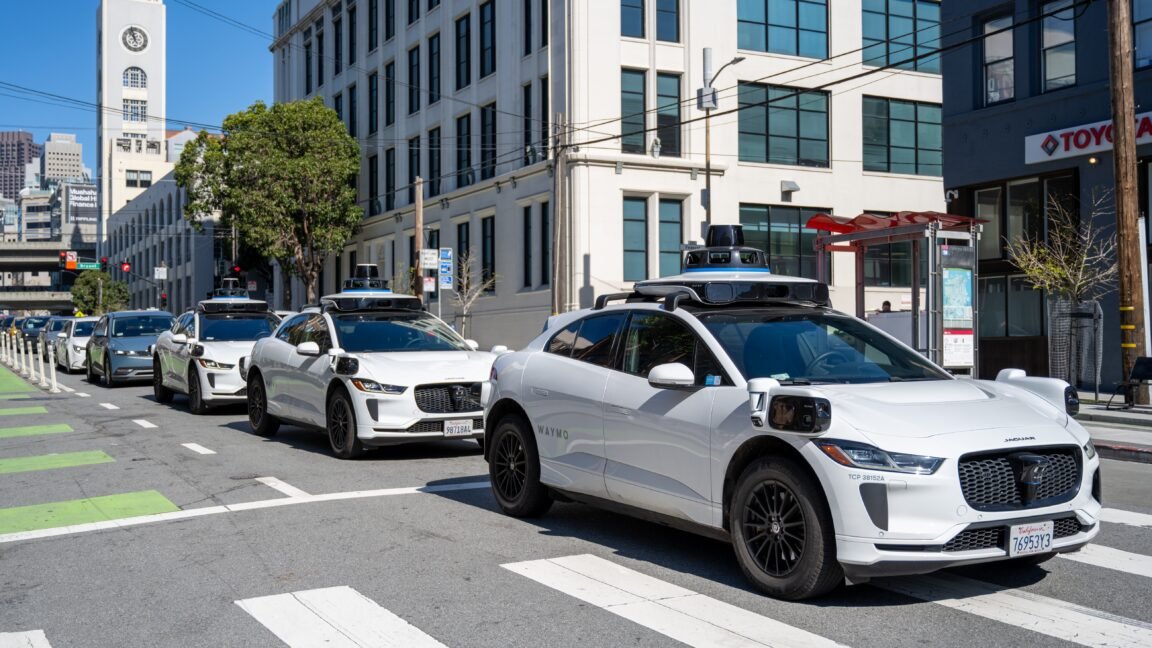
The age of robotaxis, long the preserve of science fiction, is now a reality, at least in a handful of American cities. It took just over a decade to get from the DARPA Grand Challenges to the start of Waymo’s commercial service in California, albeit initially with a safety driver on board.
Proponents of the technology, which has attracted at least $100 billion in investment, say robotaxis will be safer than human-driven vehicles. And last year, Waymo’s data showed its cars were involved in many fewer crashes than human drivers, with much lower insurance claims, although recent issues with school buses and flooded roads show the technology isn’t perfect.
But safety isn’t the only selling point: Autonomous vehicles are said to cut traffic. But data from Waymo’s reports to the California Public Utilities Commission shows that, at least in that regard, robotaxis are no better than ride-hailing services like Lyft and Uber.
Is there anyone in there?
The study, published in Transport Findings by MIT Transit Lab Assistant Director of Research Awad Abdelhalim analyzes data from August 2023 through December 2025, a roughly 1,000-day period. During that time, Waymo’s robotaxis completed 13.8 million trips for 19.3 million passengers over a total traveled distance of 86.3 million miles (138.8 million km), growing at a rate of around 15 percent a month. Abdelhalim wanted to see what proportion of those rides were made by empty robotaxis—known as “deadheading”—and how the number changed over time.
Initially, only 36 percent of Waymo’s miles were driven with a passenger onboard. But by the end of the study period, that had increased to around 56 percent and then plateaued, Abdelhalim found. So about 44 percent of Waymo’s driven miles are conducted with empty EVs.
I’m not entirely surprised; on each of my recent visits to San Francisco, the sensor-festooned Jaguar I-Paces have been thick on the ground, but rarely did I spot any humans riding in them.
In fact, there are two different kinds of deadheading: empty vehicles driving around waiting to be assigned a ride and empty vehicles driving to collect their passenger(s). And Waymo has been steadily reducing the number of miles driven empty en route to a pickup as it increases the size of its fleet. The number of deadhead miles per trip has also been declining, in part due to Waymo’s introduction of freeway service, the author suggests.
A similar analysis conducted late last year on Waymo’s CPUC data from January 2024 through September 2025 by Matthew Raifman, who studies policy and autonomous vehicles at UC Berkeley, also found that 44 percent of Waymo’s miles were driven with empty vehicles and that two-thirds of those empty miles were robotaxis driving around waiting to be assigned a customer.
No better, no worse than ride-hailing
Interestingly, similar arguments about reducing traffic were once made about ride-hailing. In 2014, other researchers at MIT published a study claiming that ride-hailing could reduce car ownership and cut traffic. Two of the authors later walked back their conclusions after evidence showed that ride-hailing actually increased traffic and CO2 emissions, partly because it was cheap enough to encourage trips people otherwise wouldn’t have taken. They noted that robotaxis would probably fall into the same trap. (A 2018 study found that almost half of the increase in vehicle miles traveled in San Francisco was attributable to ride-hailing services.)
In total, about 40 percent of the miles traveled by a Lyft or Uber driver are deadhead miles, suggesting there’s little difference in congestion whether there’s a human behind the wheel or not. Incidentally, this fact helps explain some of the statistical safety advantage of a robotaxi—if the average number of occupants of a robotaxi is always lower than the average number of occupants of a ride-hailing vehicle, the expected injury rate for the robotaxi should be correspondingly smaller.
Meanwhile, effective congestion reduction could be achieved through a robust expansion of public transport. The same number of people on a bus take up much less room on the road than if they were spread out in passenger cars, and the numbers get even better for trains and subways. But public transport doesn’t come cheap. Waymo might have raised $16 billion earlier this year for its robotaxis, and at least $100 billion has been invested in the sector since the 2010s. Meanwhile, the American Public Transport Association called for $268 billion in investment over five years, and a report by Transportation For America puts the price tag for a “world class” transit system at $4.6 trillion over the next 20 years.