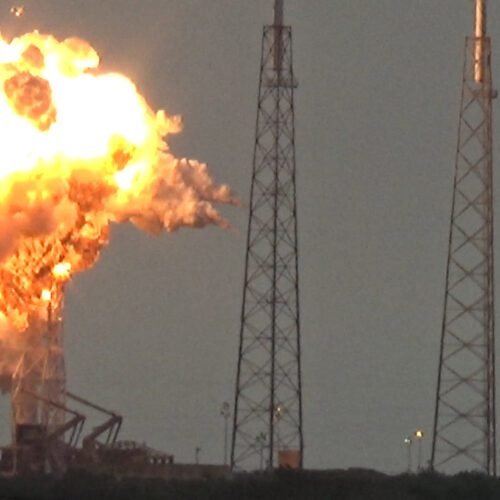
A former NASA engineer named John Muratore sat on console as launch director in early September 2016 as propellant flowed onto a Falcon 9 rocket in Florida. Ahead of a planned launch two days later, SpaceX was preparing for a static fire test of the vehicle.
Then, all of a sudden, the rocket exploded. “It came out of nowhere, and it was really violent,” Muratore said. This fireball resulted in the destruction of the rocket, much of its launch site, and the AMOS-6 satellite already attached to the vehicle.
Nearly a decade later, on May 28, Blue Origin conducted a static fire test of a new rocket, with its larger New Glenn vehicle a few miles down the Florida coast. The company had gotten further into its test, reaching engine ignition, before its rocket also exploded.
For longtime space coast observers, some of the parallels between these two spectacular explosions were uncanny. Both the Falcon 9 and New Glenn programs were on the cusp of taking off toward a higher launch cadence. At the time, NASA was counting on the Falcon 9 to return its capability to launch humans, and today, NASA is counting on New Glenn as a key element of its lunar ambitions. And both explosions catastrophically damaged their launch sites.
To better understand the challenges Blue Origin now faces, Ars spoke with several SpaceX veterans who experienced the AMOS-6 failure and worked the long days afterward to get the Falcon 9 rocket flying and rebuild the shattered facility at Space Launch Complex-40.
Difficult memories return
“My AMOS-6 scar started itching when I saw the video of New Glenn,” said Hans Koenigsmann, the SpaceX engineer who led the failure investigation in the fall of 2016. “It’s really terrible.”
Koenigsmann was SpaceX’s vice president of build and flight reliability at the time, and his team faced the challenge of identifying the failure in the upper stage of the Falcon 9 rocket that caused it to explode during a relatively benign part of the fueling process.
This involved a weekslong search of the wetlands surrounding the launch site at Cape Canaveral for pieces of the booster. The idea was that the components farthest from the pad were nearest the most energetic part of the explosion. Ultimately, the investigative team narrowed in on the complex failure of the lining of a pressure vessel in the upper stage.
For its investigation, Koenigsmann urges Blue Origin to be as transparent as possible with NASA and the Federal Aviation Administration and to study and take apart the physical evidence as soon as possible to identify the causes of failure. Every anomaly, he cautioned, is different.
Blue Origin has not publicly discussed the cause of the New Glenn failure, but speculation has focused on a possible anomaly in one of the seven main BE-4 engines. The Falcon 9 investigation was the primary obstacle to SpaceX returning to flight, but launch pad availability will be the bigger hurdle for Blue Origin.
Searching for wreckage
After the AMOS-6 failure, SpaceX was also without an active launch pad for the Falcon 9 rocket. Nearest to readiness was an existing pad at Vandenberg Air Force Base in California, which was undergoing upgrades to support the “Full Thrust” variant of the Falcon 9 rocket, which used densified propellant. This is where the Falcon 9 returned to flight, less than five months later, in January 2017.
SpaceX then focused on completing modifications to Launch Complex 39A at Kennedy Space Center, which it had leased from NASA. The Falcon 9 rocket launched from here in February 2017.
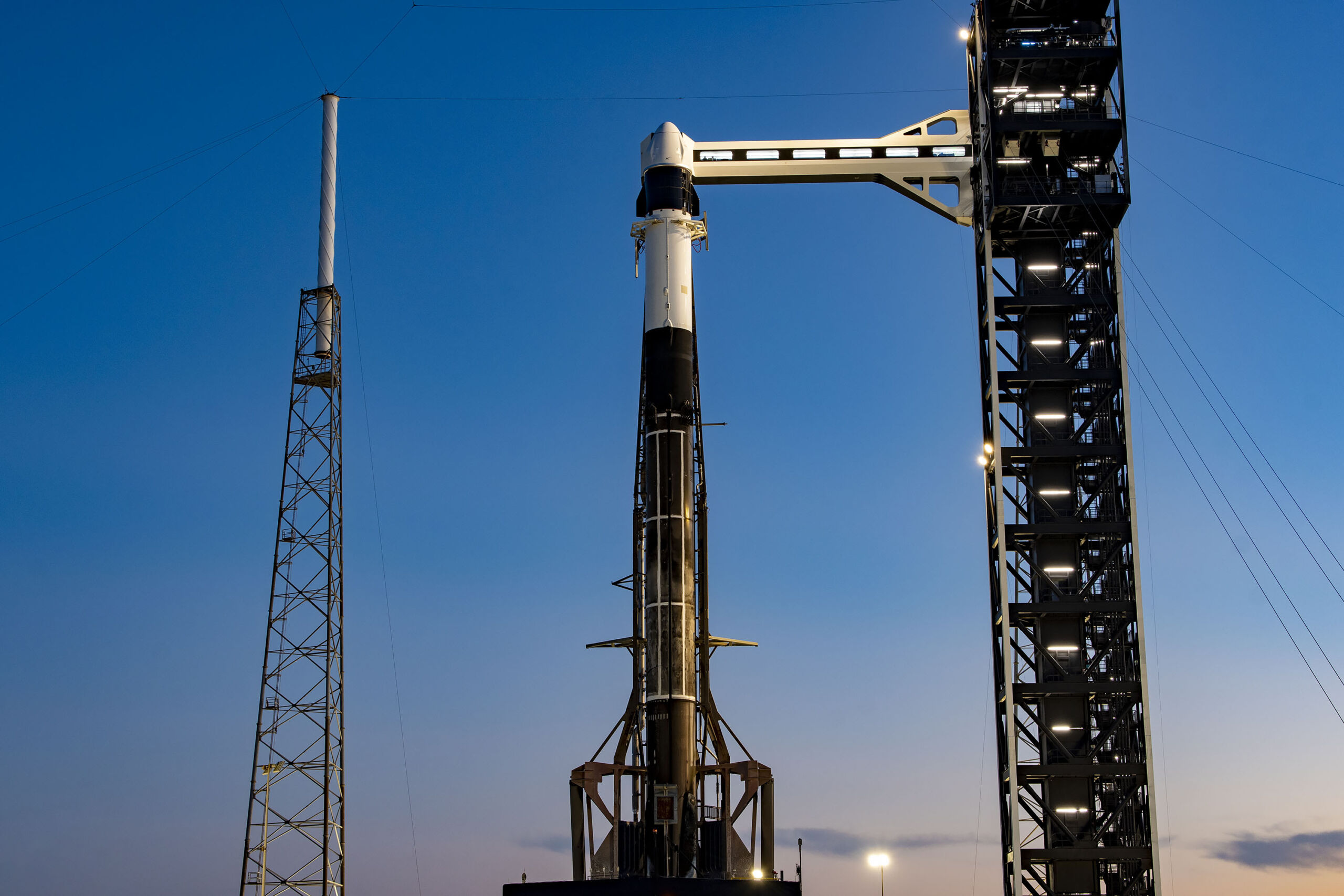
The closest analog to what Blue Origin is attempting to do, therefore, concerns the rebuild of Space Launch Complex-40, which was largely destroyed by the AMOS-6 failure.
According to Muratore, SpaceX was not allowed to begin reconstruction work at the launch pad until January 2017. The delay stemmed from the ongoing investigation, which included a grid-by-grid examination of debris, cataloging recovered materials, and launch site remediation. Muratore and other SpaceX engineers spent these four months redesigning the launch pad.
Trip Harriss, who managed the Falcon 9 fleet operations in 2016, said everyone at the company pitched in to support the investigation and then the reconstruction of the SLC-40 pad. The search for debris lasted from shortly after the explosion until early October, when efforts had to be abandoned due to the approach of the powerful Hurricane Matthew.
During this time, SpaceX pulled out all of the stops, deploying drones and aircraft with sensitive equipment. “At one point, I got a submersible to take into the flame trench, where there was an accumulation of water, to see if we could find any rocket debris,” Harriss said. “But it was just large chunks of concrete.”
Going fast
Launch pads are among the most complex pieces of infrastructure involved in sending a rocket into space. They require a lot of brawn, as evidenced by the need for tall and strong steel launch towers. Then there’s the large amount of concrete used for the foundation, flame trench, and surrounding areas.
Last Thursday, during the test failure, one of Blue Origin’s massive launch towers toppled, and the other appears to be seriously damaged. The concrete underneath the rocket also appears to have collapsed in some places. From a structural standpoint, there is likely a significant amount of work ahead.
But launch sites are about much more than concrete and steel. There is an incredible amount of electrical wiring that almost certainly got fried by the fireball. And then there is the intricate tubing that provides gas and liquids to fill not just the rocket’s propellant tanks but also smaller pressurized vessels throughout the vehicle for various purposes.
“I’m worried about the tubing,” Harriss said, noting that every launch site has bespoke plumbing and electrical elements, with lots of tasks that must be done by hand; pulling and splicing wire, delicate welding, and so much more. “It takes a lot of time and effort to put that into place.”
When it began rebuilding SLC-40, SpaceX had some advantages, Muratore said. The company had great teams coming from its pads at Kennedy Space Center and Vandenberg—not just the engineers, but also welders and other laborers who work directly on the infrastructure. This allowed SpaceX—a company already known for moving rapidly—to power through the SLC-40 rebuild.
Still, it took a while, with the first Falcon 9 rocket not launching from a rebuilt SLC-40 pad until December 2017. Including site remediation, SpaceX went from the AMOS-6 failure to a new launch in 15.5 months. The actual construction part, following remediation and design, required 11 months.
On Monday night, Blue Origin’s chief executive, Dave Limp, said the company would launch from its damaged pad before the end of this year, less than seven months from now.
None of the former SpaceX employees I spoke with for this article—some on the record, some off—believe this timeline is realistic. Twelve months was generally viewed as the best-case scenario. Eighteen months was seen as most likely.
Silver linings
Muratore said that, as demoralizing as it may be, the failure of the New Glenn rocket presents a golden opportunity to Blue Origin. He noted that the AMOS-6 launch failure allowed SpaceX to redesign the new pad to optimize for faster turnarounds between launches.
“It’s certainly a tremendous tragedy and a setback, but looking back on it rebuilding SLC-40 enabled us to make key improvements that we really needed to achieve high flight rates,” Muratore said. “When we built the pad initially, we had limited experience, and there were limitations that were in the pad because we could only model or speculate on how the pad was going to perform.”
One of the key changes was completely revamping the “strongback throwback” that supports the rocket at the launch site and falls away just before launch. SpaceX redesigned this massive structure to pull away more rapidly during liftoff to spare its myriad umbilicals and other connections to the rocket from serious damage.
SpaceX also improved the flame trench to reduce damage and upgraded the water-based sound suppression system. These updates were intended to support a higher cadence and reduce pad turnaround times from weeks to days. And it worked. By earlier this year, SpaceX was able to launch Falcon 9 rockets from SLC-40 within 45 hours of each other.
Blue Origin also designed its launch pad at LC-36A long before the final specs for the New Glenn rocket were complete. Muratore said Blue Origin started poaching SpaceX employees to work on its Florida pad even before SpaceX completed the SLC-40 rebuild nearly a decade ago. Now the Blue Origin engineers have reams of data from three New Glenn launches and will be able to optimize the rebuilt pad for a more efficient turnaround.
Harriss also sought to offer uplifting thoughts to a Blue Origin workforce struggling through a difficult period.
“Don’t give up,” he said. “This is hard. This is recoverable. You can come out on the other side, even if it doesn’t feel like that right now. It does not feel good. You feel bad for your customer, the engineers, and the operations team. Everyone is in a place where it’s no fun to be there. But take any thoughts of this is the end and replace them with this is an opportunity to start anew.”