Egisto Ott is no James Bond. But the stories the 63-year-old Austrian told a Viennese jury recently would make good plotlines. Ott worked as an intelligence officer in Austria’s now-defunct Federal Office for the Protection of the Constitution and Counterterrorism. He was also moonlighting for the Russians.
Prosecutors say Ott, who was sentenced to four years in prison on May 20, handed over information to fellow Austrian Jan Marsalek, the fugitive former executive of the collapsed payments firm Wirecard. Marsalek ran a cell of Bulgarians who were convicted in London in 2025 of spying for Russia. They called themselves the “minions”.
In 2023, the London Metropolitan police in cooperation with MI5 secured chat messages between Marsalek and the minions, which led to Ott. It turned out Ott had provided sensitive data on dissidents, investigative journalists and a Russian intelligence defector. The trial also revealed that Ott had obtained the infamous “canoe-trip-mobiles”.
In 2017, high-ranking Austrian civil servants went on a canoe trip in a tributary of the Danube River. They managed to fall into the water and had their phones sent in for repairs. Their mobile data was copied by Ott and subsequently ended up in Moscow, along with Marsalek’s favourite Viennese chocolate cake, a Sachertorte. According to the chat messages, the minions had a stressful time finding the correct one (there are rival Sachertorte recipes).

What sounds like a comic opera has a sinister backstory. Since the 1950s, Austria has hosted several international organisations that are regularly targeted by intelligence services. These include Opec (the Organization of Petroleum Exporting Countries), the International Atomic Energy Agency and the United Nations Office on Drugs and Crime.
However, Austria’s reputation as a spying hub dates back even longer. The Austrian capital, Vienna, was known for espionage before and after the second world war. Arnold Deutsch, the recruiter of the Cambridge Five spy ring that passed information to the Soviet Union, hailed from Vienna. Its leading light, Kim Philby, was also talent-spotted by Soviet intelligence in the city in 1933.
But Vienna was never just a playground for Soviet intelligence. After the war, when the city was divided into four sectors for allied occupation, the UK’s foreign intelligence service, MI6, started its most creative cold war operations. Peter Lunn, head of MI6’s Vienna station, built listening stations in the city to tap Soviet phone lines.
He hid his listening tunnels underneath ordinary shops in the British zone. The first tunnel was built beneath a police station. Later, MI6 built another tunnel under a jewellery shop and then installed intelligence officers posing as a young, rich couple in a Viennese villa. While they were partying upstairs, their colleagues listened in to Russian military traffic downstairs.
The only surviving witness of a listening station today is Sir Rodric Braithwaite, whom I first interviewed in 2024. As a 19-year-old conscript, Braithwaite worked with British Army Field Security in the Aspang listening station, next to the Aspang Bahnhof (a train station on the outskirts of Vienna).
It wasn’t an uplifting experience. He sat there for long shifts with earphones on, handling old equipment and pressing recording buttons. But his memories of the tunnel are valuable because to this day MI6 has not released any photos, let alone recordings, that were made during these operations.
The Third Man
They have also not revealed the details of another highly creative intelligence operation. In 1948, a British team arrived in Vienna to film The Third Man, a thriller set in the city. They were eager to shoot scenes in the Soviet sector.
Four key people involved in the making of the film were working for British intelligence: novelist Graham Greene, director Carol Reed, “Austria advisor” Elizabeth Montagu and, most importantly, producer Sir Alexander Korda. Korda’s film production company had been providing covers for British intelligence officers in Europe since the 1930s.
Whether the filming of The Third Man was connected to Lunn’s tapping operations, or whether MI6 had to smuggle something out of the Soviet sector, is a matter of conjecture. But “odd people” appeared on the set.
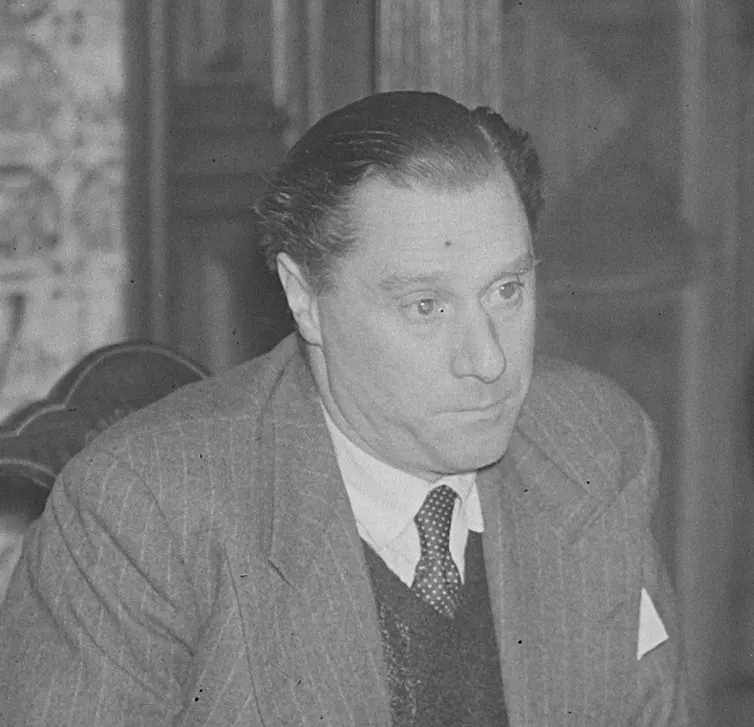
The film’s sound engineer, Jack Davies, remembered a British technician who turned up out of the blue. After filming, the technician vanished completely and Davies never came across him again – something rather unusual in the small world of British film technicians.
The script girl, Angela Allen, who I first interviewed for my book Das Haus am Gordon Place (Vienna ‘48) in 2024, also realised that something odd was going on. She noticed that Carol Reed was under enormous stress in Vienna and kept himself awake with Benzedrine. He stopped taking the drug once they were back in England, filming in London studios.
Allen, who is 97 now, wasn’t surprised to find out years later that Korda was working for the British intelligence services. She told me: “He had enormous charm. He could make his people do everything for him.”
Perhaps that is one reason why Ott and Marsalek failed. To succeed as a spy in Vienna, you need to be a great illusionist like Alexander Korda.