As geopolitical tensions rise and climate-related risks intensify, Europe is rethinking how it handles security on multiple fronts. One idea being developed relates to how nature and restoring landscapes can play a role in strengthening national resilience.
Our recent study explores how restoring biodiversity, such as wetlands and forests, can even complement military defence strategies. And he EU’s commissioner for the environment, Jessika Roswall, has said that rewilding border regions could make terrain harder for invading forces to cross.
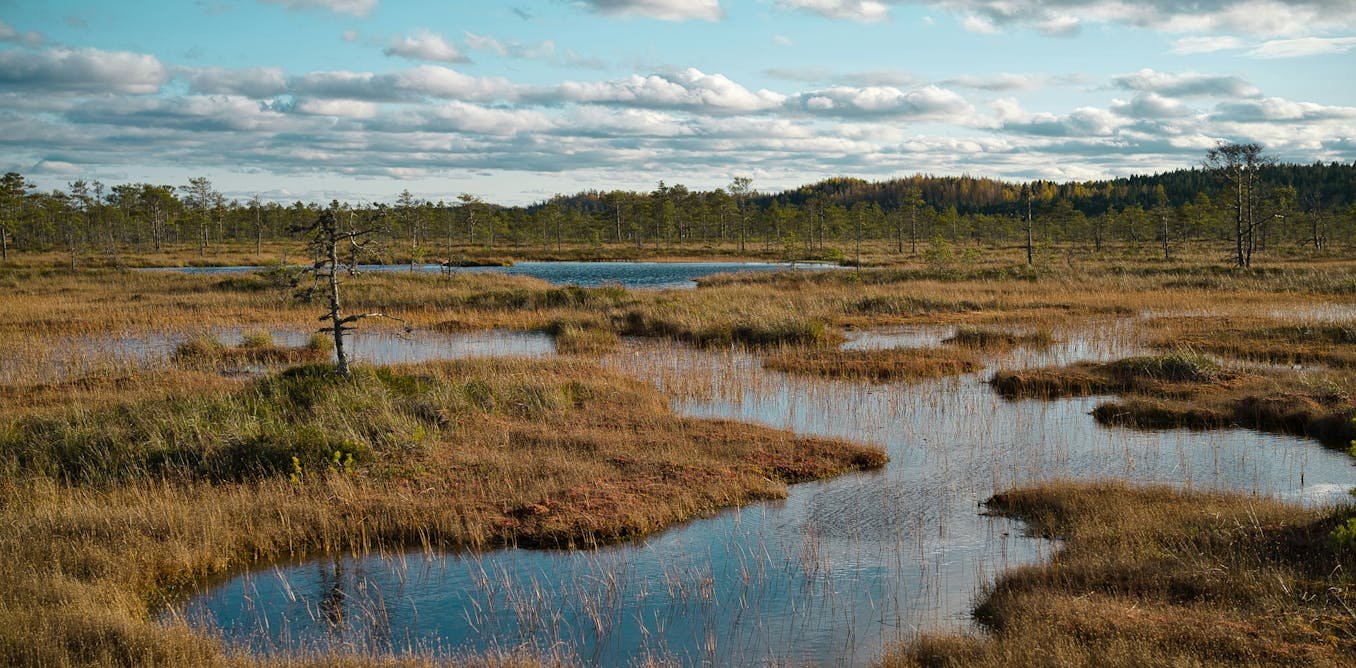
Finland and Poland are already restoring wetlands, forests and other natural systems, delivering vital carbon storage and biodiversity recovery. But these moves could also, in a combat situation, slow, channel or deter advancing forces.
Restoring nature can alter the geography of politically sensitive areas. Some rewilding – such as the restoration of wetlands which creates soft ground – makes terrain trickier for mechanised forces such as tanks or supporting ammunition trucks to navigate.
There are precedents. In 1941, the Pripet Marshes of southern Belarus played a key role in Operation Barbarossa, Nazi Germany’s invasion of the Soviet Union, which involved some 3 million soldiers. This vast wetland, since partially drained, acted as a geographic wedge that split the German frontline and created a huge gap in the advance. The winter weather made the landscape difficult to navigate. Forested areas surrounding Moscow further slowed the advance, allowing Russia to regroup and resist.
Read more: 40 years on from the disaster, why there are foxes, bears and bison again around Chernobyl
In 2022, during Russia’s full-scale invasion of Ukraine, the intentional flooding of the Irpin river’s floodplain created an impassable swampy ground that trapped Russian mechanised invaders on a few elevated road embankments north of Kyiv. This made them easy targets for light anti-tank teams, and proved critical in the defence of Ukraine’s capital.
Historically, a similar strategy was employed in 1914, when Belgian forces opened the sluice gates at Nieuwpoort to halt the German “race to the sea”.
Nature’s resilience
While a concrete anti-tank ditch is an expensive eyesore that requires constant maintenance, a rewilded landscape is a self-repairing, dynamic asset. Unlike industrialised forestry monocultures with uniform rows of trees, the structure of rewilded forests is messy.

In 1944, defending German forces used dense forest terrain as an ecological barrier during the Battle of Hürtgen Forest on the German-Belgian border. This turned a solid American advance into an 88-day war of attrition – the second-longest battle US soldiers have ever endured.
Restoring a river’s natural, sinuous path creates wet gaps that far exceed the 26-metre span of standard tactical bridges. Soft, marshy banks may prevent the use of amphibious rigs. For example, during the 1812 Berezina river crossing, soft river banks decimated Napoleon’s retreating army.
Restoring and rewetting drained or degraded peatlands creates the permanently wet conditions ideal for sphagnum moss to grow. This creates sponge-like landscapes capable of storing massive amounts of carbon and rainwater. On this terrain, even walkers sink up to their knees. Peatlands like these are impassable, even to light armoured vehicles.
On the coast, restoring mangroves and creating artificial coral reefs can have many benefits ecological benefits. And mangrove forests were virtually impenetrable to landing craft in Papua New Guinea and the Solomon Islands during the second world war. Natural reef structures can also ground vessels. This led to devastating casualties at the Battle of the Tarawa Atoll within the Pacific’s Gilbert Islands in 1943.
Trade-offs
Investment in resilience through nature restoration is supported by Nato’s new national resilience funds. These include a 1.5% GDP target for civil preparedness and resilience.
But restoring nature can lead to complex trade-offs, such as the cost of losing productive agricultural land. One possible solution is the wet soil cultivation of crops such as reeds or sphagnum moss which can be used to make insulation and composite boards used for low-carbon building construction.
There is an ethical risk that designating ecosystems as defensive assets makes them valid military targets under the laws of armed conflict, potentially inviting ecological destruction. However, modern warfare often decimates natural landscapes.
In the UK, coastline management is already changing. The country’ environment agency is retreating from maintaining sea defences and allowing saltmarshes and tidal incursions to re-establish natural habitats.
We believe protecting territory by letting it return to its most impenetrable, natural state is one of the best ways to ensure both ecological survival and national security.