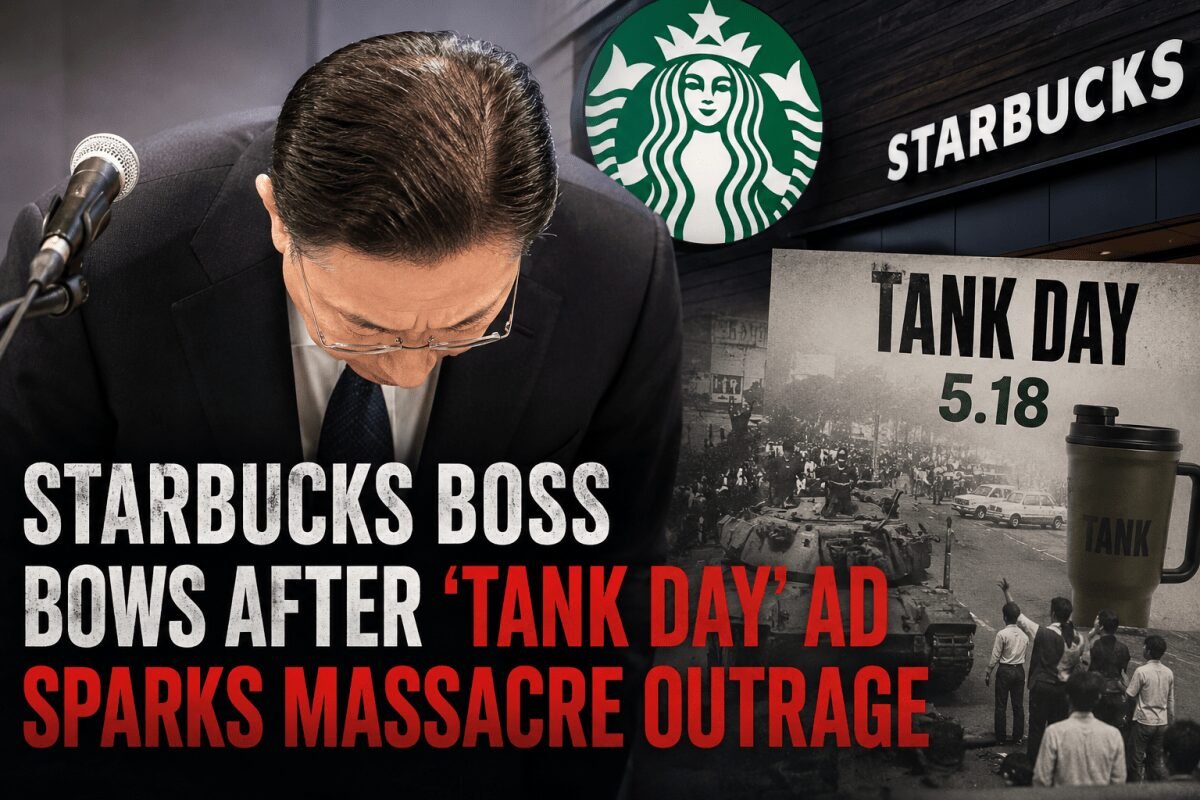
A Starbucks marketing stunt in South Korea has blown up into a full-blown national scandal after critics said the coffee chain appeared to mock one of the darkest chapters in the country’s history.
Now, one of South Korea’s most powerful retail bosses is publicly begging for forgiveness.
Chung Yong-jin, chairman of Shinsegae Group, which owns a controlling stake in Starbucks Korea, issued a dramatic apology Tuesday after a promotional campaign triggered outrage from families of pro-democracy activists killed during a brutal 1980 military crackdown.
During a televised statement in Seoul, Chung bowed three times and pleaded for forgiveness from victims’ families and the South Korean public.
“I take it very seriously the fact that many people felt deep pain and anger because of Starbucks Korea’s inappropriate marketing campaign,” Chung said.
The uproar began when Starbucks Korea tried to promote a large tumbler size it calls a “tank” by declaring May 18 to be “Tank Day.”
That date is not just any day in South Korea.
May 18 marks the anniversary of the Gwangju Democratic Uprising, when citizens in the southern city of Gwangju rose up against military rule in 1980. The protest was crushed by troops using tanks and helicopters. Hundreds were killed or injured.
So when Starbucks pushed a “Tank Day” promotion on that anniversary, many South Koreans saw it as a horrifying insult.
The campaign got even worse in the eyes of critics because it used the slogan, “Thwack it on the table!”
To many, that phrase appeared to echo a notorious 1987 police statement tied to the torture death of student activist Park Jong-chol. At the time, authorities tried to claim Park suddenly died after investigators “hit the desk with a thwack.”
The reaction was immediate and fierce.
Within hours, Shinsegae canceled the promotion and fired the chief executive of Starbucks Korea. Police also opened an investigation after complaints were filed by relatives of people killed in Gwangju.
Chung first apologized on May 19, saying the campaign caused “deep pain to the victims and bereaved families of the May 18 Democratization Movement as well as to the public.”
But the backlash did not go away.
On Tuesday, he returned with a second, more dramatic apology, this time bowing repeatedly on camera and asking the public not to take out their anger on workers at Starbucks shops.
The blame, he said, belongs with management.
So far, there have been no immediate reports of major incidents at stores.
A senior Shinsegae executive said the company has not found conclusive proof that Starbucks Korea marketing employees intentionally mocked the democracy movement. Employees have reportedly denied doing so.
However, the company said some workers refused to hand over their smartphones during an internal review. Executives said they will wait for the police inquiry and fire anyone found to have deliberately ridiculed the protesters.
The scandal has now reached the highest levels of South Korean politics.
Interior and Safety Minister Yoon Ho-jung said Starbucks products will no longer be used at government events, blasting what he called the chain’s “anti-historical behavior.”
President Lee Jae Myung also weighed in on X, accusing the campaign of showing “inhumane and disgraceful behavior” by people he described as “cheap profiteers” who deny democracy and basic human rights.
The Gwangju crackdown happened after General Chun Doo-hwan seized power in a 1979 coup. Official records say about 200 people died in the uprising, though activists have long claimed the real number was much higher.
Chun’s military government also imprisoned tens of thousands of people while claiming it was rooting out “social evils.”
Public outrage over his dictatorship eventually exploded into massive protests in 1987, forcing South Korea to adopt direct presidential elections. That moment is widely viewed as the beginning of the country’s transition to democracy.
For Starbucks Korea, what may have been intended as a simple tumbler promotion has turned into a disaster.
For many South Koreans, the words “tank” and “May 18” are not marketing gimmicks.
They are reminders of bloodshed, dictatorship and a fight for democracy that still cuts deep.