China’s expanding nuclear industry is becoming a new instrument of geopolitical influence across Southeast Asia.
From Vietnam to Indonesia, governments increasingly view nuclear energy as necessary to sustain industrial growth, AI infrastructure and rising electricity demand while reducing dependence on coal. The result is a regional nuclear reconsideration that would have seemed politically improbable only a decade ago.
Vietnam and Russia signed an agreement in March 2026 for the Ninh Thuan 1 nuclear power plant. The Philippines and Indonesia aim to operationalize reactors in the early 2030s, while Malaysia, Thailand and Singapore are studying small modular reactors as part of future energy planning.
At the center of this transformation stands China. While France, Russia, South Korea and the United States remain major exporters, Beijing has emerged as perhaps the most consequential long-term nuclear partner for Southeast Asia, combining financing, industrial scale and state-backed delivery capacity few rivals can match.
Nuclear partnerships are not ordinary infrastructure deals. They are strategic relationships that can last more than half a century and shape everything from fuel dependency and industrial standards to regulatory systems and geopolitical alignment.
China’s nuclear industrial rise
China’s emergence as a major nuclear exporter is the result of decades of sustained industrial policy and technological accumulation. As of 2026, China operates 61 nuclear reactors and has another 36 under construction, giving it the world’s third-largest reactor fleet while leading global nuclear construction.
Unlike many Western industries that stagnated after the Cold War, China sustained investment across reactor engineering, manufacturing and workforce development. This enabled Beijing to localize roughly 90% of reactor components domestically.
That localization reduces supply-chain vulnerabilities, lowers manufacturing costs and allows Chinese firms to offer comprehensive turnkey packages covering engineering, procurement, construction, financing, training and long-term fuel supply.
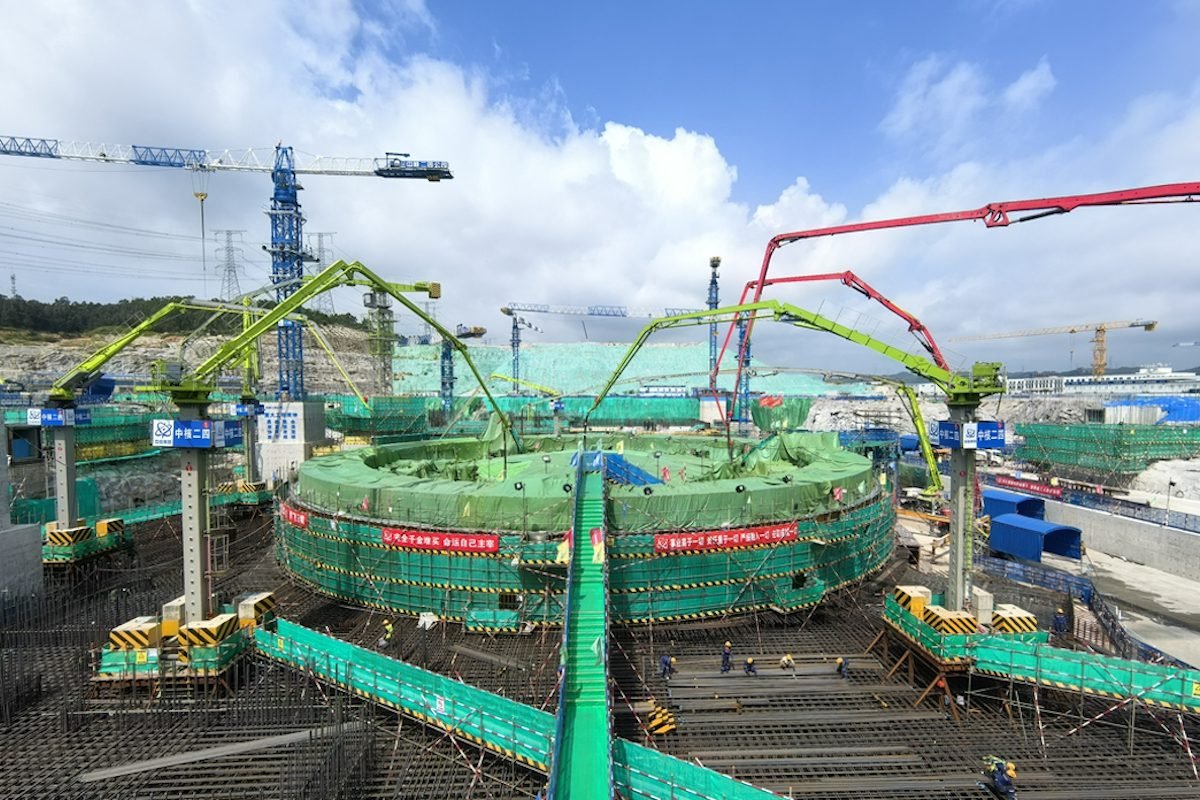
In effect, China is exporting entire nuclear ecosystems rather than standalone reactors. The centerpiece of this strategy is the Hualong One (HPR1000), a third-generation pressurized-water reactor jointly developed by China National Nuclear Corporation and China General Nuclear Power Group.
With more than 40 units operational or under construction, Hualong One has become one of the world’s most actively deployed reactor designs. It incorporates advanced safety systems and generates around 1,100 megawatts per unit – enough for roughly one million homes.
For developing economies facing mounting electricity deficits and industrial expansion pressures, these capabilities are highly attractive.
China’s nuclear appeal also lies in speed. Western nuclear projects frequently struggle with cost overruns and lengthy delays. Russia faces mounting geopolitical constraints, while South Korea lacks China’s scale of financing.
China, by contrast, offers financing, rapid deployment and integrated implementation simultaneously.
Beijing has reportedly set a target of exporting 30 reactors to Belt and Road Initiative countries by 2030, a push potentially worth 1 trillion yuan (US$145 billion). Projects and nuclear cooperation agreements already extend across Pakistan, Argentina, Kenya, Kazakhstan and Saudi Arabia.
For Southeast Asian governments operating under tight development timelines, this matters enormously.
Strategic risks behind the opportunity
Yet the attraction of Chinese nuclear technology comes with strategic consequences that regional governments cannot easily ignore.
Nuclear infrastructure creates an unusually deep, long-term dependency. Reactor lifespans often exceed 40 years, while fuel supply, technical upgrades and spent-fuel management remain tied to the original vendor for decades.
This is particularly significant because only a limited number of states possess industrial-scale uranium enrichment capability. Russia still dominates global low-enriched uranium supply, but China is rapidly expanding its own fuel-cycle infrastructure to support future reactor exports.
As a result, recipient states could become dependent on Beijing not only for reactor construction but also for long-term fuel access and operational continuity.
Technology lock-in may ultimately prove even more consequential than fuel dependency. Unlike ports or industrial parks, nuclear ecosystems are exceptionally difficult to unwind once institutional and technological dependence becomes embedded over decades.
Maintenance systems, engineering standards and regulatory adaptation usually remain linked to the original supplier, gradually shaping industrial priorities and strategic alignment over time.
China, therefore, exports more than power-generation infrastructure. It exports long-term strategic influence.
This does not necessarily imply malign intent, as all major nuclear exporters create similar dependencies. But China combines reactor exports with Belt and Road financing, industrial integration and broader geopolitical influence mechanisms, making the strategic implications especially significant.
For Southeast Asian states seeking to preserve strategic autonomy amid intensifying US-China rivalry, that matters. Washington increasingly views critical infrastructure competition in maritime Southeast Asia through a strategic lens as Chinese-backed energy, port and digital projects expand across the region.
Chinese reactor diplomacy could therefore become another dimension of Indo-Pacific competition over influence, standards and long-term regional alignment.
ASEAN governments are consequently likely to hedge rather than align exclusively with any single supplier. Maritime Southeast Asian states such as Indonesia and the Philippines may pursue more diversified technology partnerships, while mainland Southeast Asian economies could become more deeply integrated with Chinese industrial and financing ecosystems.
This divergence risks creating competing technological ecosystems whose infrastructure standards and fuel arrangements increasingly reflect broader geopolitical alignments, adding another layer of fragmentation to Indo-Pacific competition.
China is also investing heavily in next-generation nuclear systems, particularly thorium molten-salt reactors. In June 2024, China’s Wuwei Thorium Molten Salt Reactor reportedly reached full operational capacity, marking an important milestone in advanced reactor development.
While thorium technology is promoted as safer and more sustainable than conventional uranium cycles, its geopolitical significance may ultimately matter more than its technical characteristics.
If China becomes the first major exporter of commercially viable thorium reactors, Beijing could gain substantial influence over future nuclear technology standards across parts of the developing world.
Southeast Asia’s balancing strategy
Still, portraying Southeast Asian states merely as passive recipients of Chinese influence oversimplifies regional realities. Many governments are seeking external partnerships to accelerate domestic technological learning and industrial capacity building.
Thailand provides one example. In 2015, Ratchaburi Electricity Generating Holding acquired a 10% stake in two Hualong One reactors at Fangchenggang in Guangxi province, while Chinese firms simultaneously trained Thai nuclear professionals. This cooperation later helped underpin the 2025 China-Thailand memorandum on peaceful nuclear energy cooperation.
Importantly, China itself followed a similar developmental path. Beijing’s modern nuclear industry was built partly through technological absorption from Canadian, French, Russian and American systems before China eventually developed reactors with largely indigenous intellectual property rights.
Southeast Asian states may now attempt a comparable strategy by leveraging foreign partnerships initially while gradually building domestic expertise, regulatory capacity and industrial capability.
The challenge will be maintaining diversification. If regional governments become overly dependent on any single supplier – whether China, Russia or the West – strategic flexibility could narrow significantly over time.
Southeast Asia’s nuclear revival is no longer solely about decarbonization or electricity generation. It is increasingly tied to industrial competitiveness, technological sovereignty, AI infrastructure expansion and geopolitical positioning.
For China, reactor exports strengthen industrial reach, expand geopolitical influence and reinforce Beijing’s image as a provider of advanced technological solutions for the developing world.
For Southeast Asian governments, Chinese nuclear cooperation offers financing, rapid deployment and industrial learning opportunities that many competitors currently struggle to match.
The countries that dominate Southeast Asia’s future nuclear infrastructure may ultimately shape the Indo-Pacific balance of technological influence for the rest of the century.
Saima Afzal is a researcher specializing in South Asian security, counterterrorism, and broader geopolitical dynamics across the Middle East, Afghanistan, and the Indo-Pacific. Her work examines strategic affairs and evolving patterns of regional conflict. She is currently a Research Scholar at Justus Liebig University, Germany.