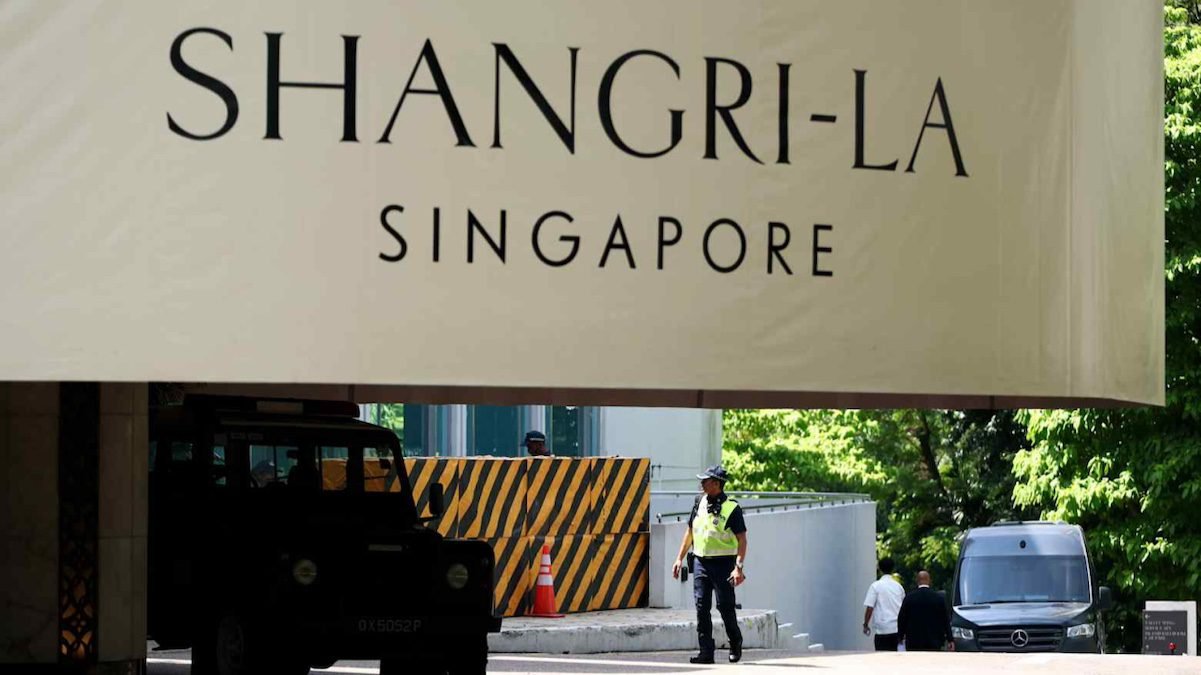
The Shangri-La Dialogue, held every year in Singapore, is one of the Indo-Pacific’s premier signaling platforms. A leader takes the keynote podium, and the room reads it for cues about where a country is heading: what partnerships it is prioritizing, what risks it is willing to name and how it sees the regional order.
The SLD draws defense ministers and military chiefs from over 40 countries, and much of its value has always rested less on the speeches than on the sideline bilateral meetings they facilitate across a wide range of relationships, from Japan-Australia defense coordination to India-ASEAN engagement.
In recent years, gauging great power rivalry has become a key purpose of the forum, and China’s level of participation has drawn particular scrutiny. Beijing has varied its delegation level over the years, sending PLA Academy vice-presidents rather than its defense minister in 2012, 2017 and 2018, before upgrading to ministerial attendance from 2019 to 2024.
Its downgrade in 2025, sending a one-star PLA National Defense University academic rather than Defense Minister Dong Jun, broke that recent run and drew pointed comment from Singapore’s own defense minister.
At the time, interpretations varied. While a US defense official suggested it signaled Beijing’s displeasure with Washington, others pointed to the political risk Chinese defense ministers face in a forum where questioning is unscripted. Still others read it as reciprocal after the West downgraded its own attendance at Beijing’s Xiangshan Forum.
Whatever the motive, the effect was felt across the forum: without senior Chinese participation, a significant set of bilateral meetings would lose their counterparts. Whether Beijing upgrades its delegation this year remains unconfirmed at the time of writing.
The stakes are sharpened by the 2026 SLD’s outline agenda, which runs from May 29 to 31: the fifth plenary is dedicated to “China’s Cooperative Partnerships in the Asia-Pacific.” In 2025, Beijing canceled a plenary on China’s security altogether. Whether this year’s China-focused session goes ahead, and at what level, will say more than whatever is said from the podium.
The keynote speeches, meanwhile, have a mixed record of their own. In 2022, Fumio Kishida pledged to “fundamentally reinforce” Japan’s defense capabilities, but the process had been underway incrementally since the Abe era.
Narendra Modi in 2018 presented India as central to Indo-Pacific security while offering few concrete commitments. In 2025, Emmanuel Macron called for “coalitions of action” between Europe and Asia, but France’s Indo-Pacific presence still rests on limited permanent deployments.
The plenaries have tended to follow a similar pattern: firm language on rules-based order with arguably little discernible shift in behavior once delegates leave Singapore. That track record is worth bearing in mind when assessing To Lam’s keynote address this Friday (May 29).
He will be the first Vietnamese leader to open the summit, a selection that itself signals Vietnam’s elevated standing in regional security conversations. It is also an opportunity to reassure partners that Hanoi’s strategic autonomy remains intact, even as its institutional ties with Beijing deepen.
To Lam had already been pursuing a sweeping restructuring of Vietnam’s administrative apparatus before his unprecedented consolidation of both party and state leadership at the 14th National Party Congress in January.
The diplomatic tempo since has been just as striking: a state visit to Cambodia in February, a meeting with Trump the same month, a state visit to Beijing in April, to India in May, and an official visit to Thailand on 27–29 May, landing in Singapore just ahead of the keynote.
Whether To Lam’s likely message of reassurance holds up to scrutiny is another matter. The inaugural “3+3” strategic dialogue with China in March has embedded security cooperation, including what Beijing has described as counter-“color revolution” coordination, into the institutional architecture of the relationship.
What To Lam says about maritime security, about ASEAN and about the terms of Vietnam’s partnerships will likely be read against that backdrop. The summit’s outline agenda suggests where the wider pressure points sit, and where To Lam’s reassurance of strategic autonomy will be tested by what others signal in return.
Pete Hegseth, now styled America’s secretary of war, speaks in the first plenary on Saturday (May 30) under the title “United States’ Strategy for Peace in the Indo-Pacific.” His 2025 SLD appearance surprised observers with its conventional reassurance of US regional commitment, a contrast with the Munich debacle months earlier.
It is unclear if that tone will hold this year. The USTR’s Section 301 investigations targeting Vietnam among 16 economies and the transshipment problem of rerouting tariff-dodging China-made goods remain unresolved.
Whether Washington folds economic grievances into its security framing could shape how the room reads American reliability, and how much room Vietnam has to present itself as a partner to both sides.
The third plenary, “Asia’s Maritime Security Disorder,” is likely to be the most charged session, and the one where Vietnam’s balancing act is most exposed. Vietnam is expected to complete its Spratly infrastructure program this year, populating features with civilians and naval infantry in ways that could provoke a Chinese response.
The Philippines, as the 2026 ASEAN chair, is pushing to conclude negotiations on the South China Sea Code of Conduct, which most analysts consider unlikely under its watch. Previous plenaries on the contested sea have tended to produce firm language without corresponding movement.
For To Lam, the session tests whether Vietnam can assert its sovereignty claims on the podium while preserving the institutional relationship with Beijing that the “3+3” mechanism represents. The intersection of Middle Eastern and Indo-Pacific security will run through several of the sessions.
The disruptions in the Strait of Hormuz following the US-Iran escalation have had tangible consequences for Southeast Asian states, with Vietnam turning to Japan and South Korea for crude oil assistance after China and Thailand banned refined fuel exports.
The fourth plenary on cross-regional security threats and the special sessions on strategic stability and defense-industrial resilience will be where these threads converge.
For all its prominence, the Shangri-La Dialogue remains a convening forum. It can surface tensions and offer a stage for signaling, but it does not bind anyone to anything. As ever, its value will depend more on who shows up and on what happens in the margins than what is and isn’t said on the podium.
Lam Duc Vu is a Vietnam-based risk analyst focused on regional trade and geopolitics