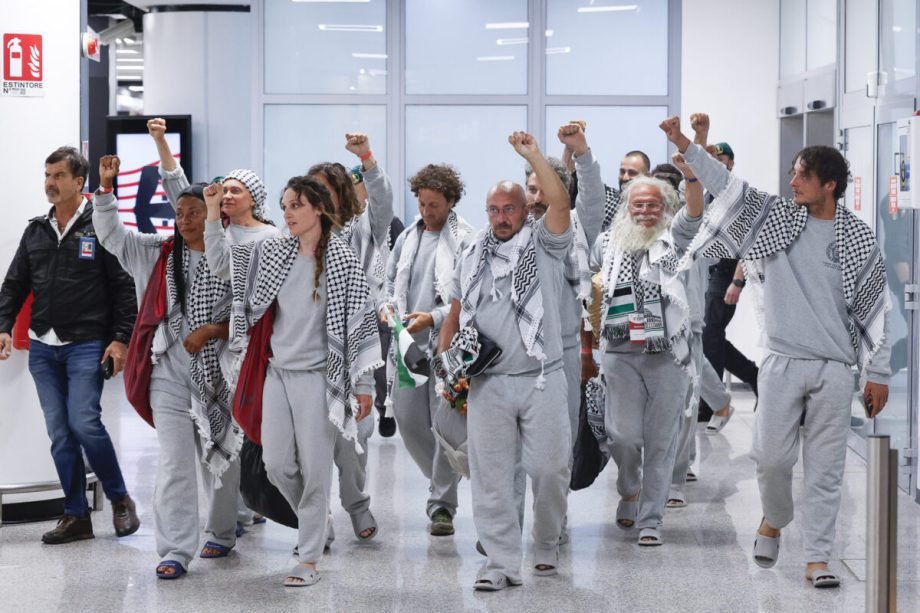
The image that ricocheted across the world was not a missile strike, nor another skyline collapsing into Gaza’s dust. It was far quieter than that. Dozens of civilians — aid workers, doctors, parliamentarians, students and activists from 44 countries — kneeling on the deck of a seized flotilla in the eastern Mediterranean, hands bound behind their backs, surrounded by armed Israeli personnel.
Then came the video posted by Israeli National Security Minister Itamar Ben-Gvir himself: taunting detainees, waving a flag, reducing human vulnerability into spectacle. For many watching from Canberra to Ottawa, something fundamental appeared to rupture.
The interception of the Global Sumud flotilla in May may ultimately be remembered not simply as another Gaza confrontation, but as a geopolitical inflection point — the moment the language of humanitarianism collided irreversibly with the realities of strategic impunity.
The flotilla carried approximately 400 activists and 128 tonnes of humanitarian supplies destined for Gaza, where more than two million Palestinians remain trapped inside what humanitarian agencies increasingly describe as a zone of engineered deprivation. According to WHO assessments, all of Gaza’s population now faces acute food insecurity, with more than one million people approaching famine conditions. Malnutrition rates among children have surged to levels unseen in the territory’s modern history.
Before the current war even began, over 80 per cent of Gazans already depended on humanitarian aid for survival. After nineteen years of blockade, repeated bombardment, and systematic destruction of civilian infrastructure, Gaza’s economy no longer resembles a functioning society so much as a permanently suspended emergency.
Yet it was not starvation statistics that triggered global diplomatic outrage. It was the humiliation of internationally recognisable bodies.
Italy summoned Israel’s ambassador within hours, condemning the treatment of detainees as a ‘violation of human dignity’. France, Spain, the Netherlands and Britain followed with formal protests. Even Washington, whose strategic protection of Israel has remained largely unshakeable throughout the Gaza war, publicly expressed concern and urged compliance with international law. Turkey denounced the ‘inhumane treatment’ of activists, while Indonesia and Pakistan condemned the abuse of their nationals as ‘totally unacceptable’.
This was more than diplomatic choreography. It exposed a deeply uncomfortable truth at the heart of the international system: the world often reacts not when suffering becomes intolerable, but when suffering becomes familiar.
For nearly two decades, Gaza’s civilians have endured conditions repeatedly condemned by human rights organisations as collective punishment. Amnesty International, Human Rights Watch, UN rapporteurs, and legal scholars have all argued that the blockade regime violates foundational principles of international humanitarian law. South Africa’s genocide case before the International Court of Justice — deemed ‘plausible’ by the ICJ in 2024 — intensified those allegations further.
Still, much of the liberal democratic world remained strategically cautious, unwilling to disrupt alliances, trade ties, intelligence cooperation, or domestic political calculations.
Then came the flotilla. Suddenly, the victims were Europeans, Australians, Canadians and Asians whose images pierced Western political consciousness in ways Palestinian suffering often had not. The uncomfortable implication is unavoidable. International empathy still operates through hierarchies of visibility.
This is no longer merely a Middle Eastern crisis. It is becoming a crisis of the Western liberal order itself.
For decades, liberal democracies positioned themselves as custodians of a rules-based international system built upon universal human rights, freedom of navigation, civilian protection and accountability under law. Those principles formed the moral architecture underpinning Western legitimacy after 1945. But Gaza has become the arena in which many in the Global South increasingly believe those principles are selectively applied.
When Russia bombed Ukrainian infrastructure, the West mobilised sanctions, legal mechanisms and moral outrage with extraordinary speed. When China was accused of abuses in Xinjiang, Western capitals invoked crimes against humanity. Yet in Gaza — despite mounting civilian casualties, widespread destruction, and starvation warnings from international agencies — many governments continued military cooperation and diplomatic shielding of Israel.
That inconsistency is no longer viewed merely as hypocrisy. Across much of Asia, Africa and Latin America, it is increasingly interpreted as evidence that international law itself remains subordinate to geopolitical hierarchy.
The Sumud flotilla intensified this perception because it transformed Gaza from an abstract humanitarian tragedy into a direct confrontation over international norms. Israel defended the interception as a necessary measure to enforce its naval blockade. Critics countered that intercepting civilian vessels in international waters while imposing starvation conditions on an occupied population cannot be reconciled with humanitarian law.
Strategically, Israel may have won the operation. Politically, it may have accelerated its isolation.
The comparisons now surfacing are historically significant. South African anti-apartheid veterans increasingly describe parallels between Gaza and the apartheid era’s architecture of segregation and control.
Civil society campaigns advocating boycotts and sanctions against Israel have gained momentum across European universities, labour movements and cultural institutions. Ireland, Norway, Belgium and Spain have all moved toward harder positions on settlements, trade restrictions or Palestinian recognition.
The symbolism matters because legitimacy matters. Modern conflicts are no longer won solely through military dominance. They are fought in legal forums, digital ecosystems, university campuses, corporate boardrooms and public narratives. Israel retains overwhelming military superiority, but reputational attrition is reshaping the strategic environment around it. Every viral image from Gaza erodes diplomatic capital accumulated over decades.
The greater danger lies beyond Israel itself. The Gaza crisis is accelerating fragmentation within the international order at precisely the moment global cooperation is already fraying under pressure from climate instability, great-power rivalry and economic insecurity. Trust in Western leadership has diminished sharply across the Global South. Younger generations, particularly in democratic societies, increasingly interpret foreign policy through moral coherence rather than Cold War loyalties.
This generational rupture is profound. Social media has dissolved traditional gatekeepers of wartime imagery.
Palestinians no longer depend exclusively on foreign correspondents to narrate their suffering. The visual immediacy of Gaza — hospitals collapsing, children starving, civilians kneeling on flotilla decks — now travels instantly into the political bloodstream of democracies.
Governments are struggling to adapt. Australia sits uncomfortably within this transformation. Canberra’s longstanding alignment with US strategic settings has often produced cautious language on Gaza, balancing support for Israel’s security with humanitarian concern. But middle powers face mounting pressure to demonstrate that commitment to international law applies universally, not selectively. The challenge is no longer rhetorical. It is essential for the credibility of rules-based diplomacy itself.
The word sumud in Arabic means steadfastness — the refusal to surrender dignity despite overwhelming force. That idea now extends beyond Gaza’s shores.
The flotilla was never militarily significant. Its true power was symbolic. It exposed the widening gap between the values the international community claims to defend and the realities it permits to endure. It forced uncomfortable questions into diplomatic chambers that have long preferred ambiguity.
How many civilians must starve before humanitarian law becomes enforceable? How many violations can the liberal order absorb before its moral authority collapses entirely? And what happens when entire generations conclude that international rules exist only for the weak?
Those questions now drift far beyond the Mediterranean. They are haunting the future of the international system itself.
The views expressed in this article belong to the author and do not necessarily reflect the editorial policy of Middle East Monitor.