After nearly a quarter of a century operating as a private company, with its financial accounts a closely guarded secret, SpaceX on Wednesday afternoon released a detailed accounting of its business in a nearly 400-page S-1 filing with the US Securities and Exchange Commission.
SpaceX, founded in 2002 and still led by Elon Musk, submitted the filing in anticipation of an initial public offering of its stock as soon as June 12.
The document revealed no major surprises about the company’s space operations, but there was a trove of details about its sprawling operations, which now encompass launch, spaceflight, space-based Internet, and, thanks to its recent acquisition of Musk’s xAI, social media and AI.
The company reported revenues of $18.67 billion in 2025, up significantly from $14.02 billion the year before. However, after turning a small profit in 2024, the company lost $4.94 billion in 2025 largely due to spending on artificial intelligence development.
That’s a big market you’ve got there
SpaceX projects a “total addressable market,” or TAM, of $28.5 trillion across its present and future offerings in space, data, and AI services. However, of this amount, only about $2 trillion is directly related to space or the company’s Starlink network. The remaining $26.5 trillion is believed to come from AI, largely from enterprise applications.
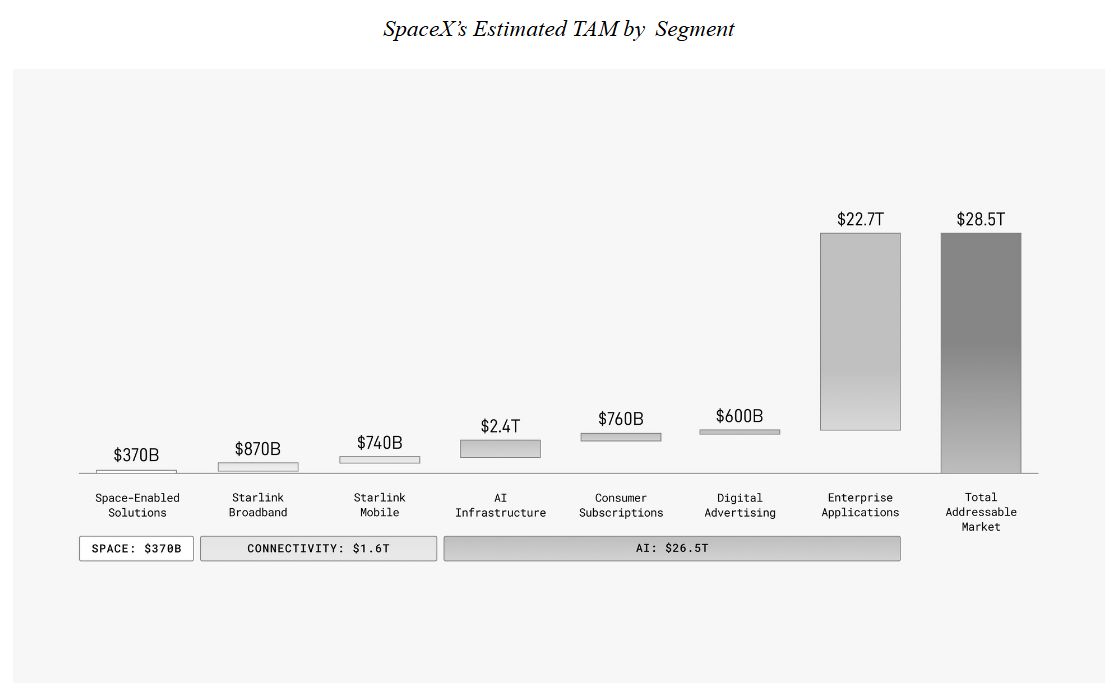
“We believe we have identified the largest TAM in human history,” the company states on page 171 of the filing. “We believe our next trillion-dollar market is AI compute, which we contemplate will leverage our rockets and satellites for massive orbital deployment.”
The company said its estimates for this large market were based on a number of sources.
“Our AI market estimates are based in part on projections of global data center compute demand from third-party sources, including estimates published by RAND Corporation, together with internal assumptions regarding the portion of global compute capacity that may be utilized for AI workloads and other operational assumptions such as power usage, utilization rates and pricing,” the filing states.
Compensation details
The document includes some interesting details about the company’s leadership. After the IPO concludes and SpaceX becomes a public company, Musk will retain 85.1 percent of the “combined voting power” in leading SpaceX. He will serve as the company’s chief executive officer and chairman of the board of directors. It will be very difficult to remove him from this position.
Musk’s salary in 2025 was $54,080, a value tied to California’s minimum salary for exempt employees. Gwynne Shotwell, president and chief operating officer of the company, received a salary of $1.08 million in 2025, but including stock awards, her total compensation was valued at $85.8 million.
The S-1 filing notes that Musk has served as an advisor to President Trump and alludes to the possibility that changes in politics might materially affect the company’s future.
“The current political environment in the United States is highly polarized, and shifts in the composition of the US Congress or changes in the presidential administration can result in significant changes in government spending priorities, regulatory posture, and the allocation of contracts and resources across industries and programs,” the filing states. “Our relationships with US government agencies and the favorability of the regulatory and procurement environment in which we operate may be affected by which political party controls the presidency or one or both chambers of the US Congress.”
The space business
There is relatively little new information in this document about the company’s launch business. For example, there is no breakdown of the Falcon 9’s internal launch cost (believed to be about $15 million per launch) relative to the base public price of $74 million.
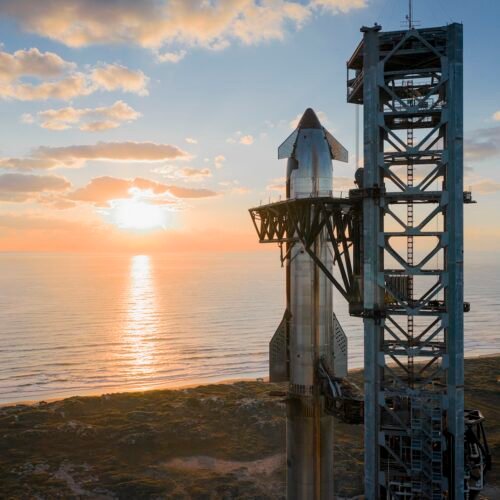
As for the larger Starship vehicle, the filing states that SpaceX aims to reduce the price per kilogram to orbit to at least $185. SpaceX intends to begin launching V3 Starlink satellites during the second half of this year on the super-heavy rocket, but this is predicated on a series of test flights that will resume as early as Thursday from Starbase in South Texas.
The filing also acknowledges the significant work that SpaceX has yet to complete with Starship to make it a fully reusable rocket capable of delivering large payloads to the Moon and Mars.
“These systems involve significant technological, engineering, and operational challenges, including the need to develop habitable transportation and surface environments, and perform complex in-orbit operations,” the document states. “Solving these challenges will require developing solutions that are novel or untested and will require substantial capital investment.”
The AI business
By staking its future on AI, SpaceX makes the case that it is the best-placed company to build a massive constellation of orbital data centers.
“We believe we are the only company with a commercially viable path to building orbital AI compute at scale,” the filing states. “This is underpinned by our unique ability to launch substantial mass into orbit cost efficiently through reusable rockets and manufacture secure, reliable, and high performance satellites at low cost and high volume. Our goal over time is to launch 100 gigawatts of compute to space each year.”
SpaceX said it expects to begin deploying its orbital AI compute satellites as early as 2028.
This company, founded with an initial goal of launching a small rocket known as the Falcon 1, has come a long way since its humble beginnings. It has become the world’s most accomplished launch company and annually puts about 80 percent of all mass into orbit. It operates more satellites than the rest of the world combined.
And yet, to reach its stratospheric valuation and addressable market, SpaceX must evolve from a space company into an AI company and continue growing rapidly. These are huge bets. It will be up to investors to decide in the coming months and years whether these are also good bets.