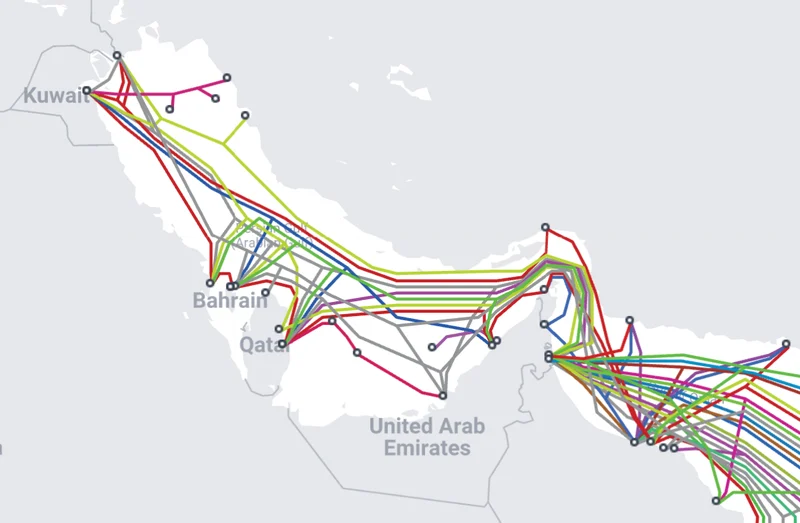
Iran claims it will charge US tech companies fees for using undersea Internet cables that run beneath the contested Strait of Hormuz shipping lanes. The war has already halted multiple projects and led to the suspension of cable repairs in the region—and the latest Iranian threats may accelerate efforts by Big Tech and Gulf countries to find alternative routes for bypassing the Strait of Hormuz’s digital chokepoint.
The latest assertions of Iranian authority over the Strait of Hormuz were announced in a brief statement by Ebrahim Zolfaghari, a spokesperson for Iran’s military and the Islamic Revolutionary Guard Corps. “We will impose fees on internet cables” Zolfaghari wrote in a May 9 post. It was not immediately clear how Iran might implement such fees or impose its rules on cable projects, given that the majority of routes pass through Oman-controlled waters.
But Tasnim and Fars, both Iranian state-linked media channels, laid out more detailed proposals on how Iran could charge license fees to US tech giants for the use and maintenance of undersea cables carrying regional Internet traffic, according to The Guardian. For example, the Tasnim plan described charging tech companies—specifically naming Meta, Google, Amazon, and Microsoft—license fees for cable usage while also claiming that Iran alone has the right to repair and maintain the subsea cables.
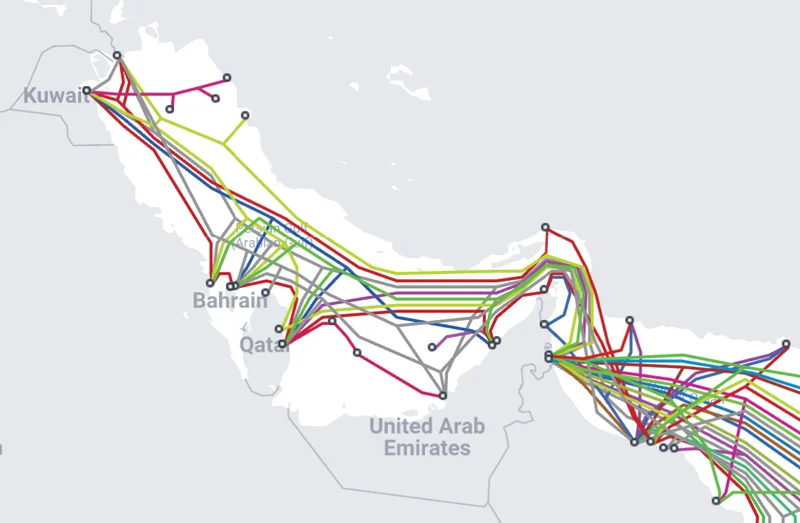
More than 99 percent of international Internet traffic runs through the global network of undersea cables that crisscross various oceans, connecting continents and islands. The major active cables running through the Strait of Hormuz primarily serve the Gulf countries in the region. They include the Asia Africa Europe-1, FALCON, and the Gulf Bridge International Cable System, according to TeleGeography, a telecommunications research organization.
The FALCON and Gulf Bridge cables run through Iranian territorial waters at certain points, Alan Mauldin, a research director for TeleGeography, said in a CNN interview. CNN also reported that Iranian state media outlets have “issued veiled threats warning of damage to cables.”
By comparison, there is “not much risk to Europe-Asia data traffic from hostilities in the Strait of Hormuz” because such Internet traffic primarily travels through cables in the Red Sea, TeleGeography wrote in a blog post. But undersea cables in the Red Sea have already seen a spate of damage in recent years, exacerbated by lengthy repair times and attacks by Houthi rebels allied with Iran.
The biggest threat to the digital chokepoint
Iran’s capability to threaten undersea cables as a way of imposing its will is uncertain at this point. Since the US and Israel started the war by attacking Iran on February 28, the US military claims to have destroyed 161 vessels of the Iranian navy, according to Admiral Brad Cooper, commander of US Central Command, in testimony given to the Senate Armed Services Committee on May 14. The US military has also sunk some of the small fast boats operated by Iran’s paramilitary Islamic Revolutionary Guard Corps when the latter threatened civilian shipping in and around the Strait of Hormuz.
The vast majority of damage to undersea cables comes from commercial ships accidentally dragging their anchors or fishing trawlers dragging weighted nets along the seafloor. So it’s not out of the realm of possibility for a more innocuous-looking Iranian ship to sneakily perform some subsea cable sabotage if it’s willing to run the gauntlet of US military surveillance and patrols in the strait.
Even a damaged commercial ship abandoned in the strait could end up dragging its anchor across some cables, as was the case with a drifting ship that damaged three cables following an attack by Houthi rebels in the Red Sea in 2024.
However, the greatest threat to subsea cable infrastructure in the Strait of Hormuz may simply come from delays in any necessary cable repairs in the region. Such jobs require specialized ships to find the damaged area and lower grappling hooks to lift up the cable for inspection and repair, according to BBC News. That repair process can require days or sometimes weeks, which would leave the ship vulnerable to Iranian missiles, drones, or fast boats that have continued to attack commercial shipping in and around the strait.
“Operators face a choice: pay protection fees and accept Iranian licensing over Middle East Gulf seabed activity, or accept that future faults may go unrepaired indefinitely,” said Windward, a maritime intelligence company, in a blog post. “A single transoceanic cable system costs between $300 million and $1 billion to deploy. The expected value of an Iranian protection fee, from Tehran’s perspective, is structured to sit well below that.”
The Strait of Hormuz has already been a no-go region for repair ships since the conflict began early this year—and new cable projects have also been halted. In March, the French state-owned company Alcatel Submarine Networks notified customers that it could not fulfill ongoing contracts due to one of its main cable-laying ships being stranded near Saudi Arabia, according to Bloomberg. That led to the suspension of a Meta-backed undersea cable project aimed at expanding internet service across Africa.
Going by land
All this has spurred efforts by US tech companies and Gulf countries to develop overland routes for Internet cables that bypass the Strait of Hormuz, according to Rest of World. But the independent projects originated by Saudi Arabia, Qatar and the United Arab Emirates represent competing efforts rather than regional coordination—and overland cable projects can face their own geopolitical complications with planned routes through countries such as Syria, Iraq, Sudan and Ethiopia.
Most major US tech companies involved in the AI data center buildout have bought into a scheme to channel data through fiber-optic cables that run along protected oil and gas pipeline routes, from the southern end of Iraq to the Turkish border and beyond to Europe, the Rest of World reported. Once completed, the overland project by IQ Networks, an Iraqi telecom company, would provide a direct overland fiber link between the Gulf and Europe.
The need to seek alternative Internet fiber routes comes on top of Big Tech’s other headaches from the war and Strait of Hormuz crisis. As the US and Israel launched airstrikes on Iran in the early weeks of the war, Iran retaliated by attacking shipping near the strait along with targeting a wide range of infrastructure across the Gulf region. Iranian drone attacks on data centers disrupted Amazon Web Services in the region and stuck Amazon with months of repairs while forcing another data center developer to pause Middle East projects.