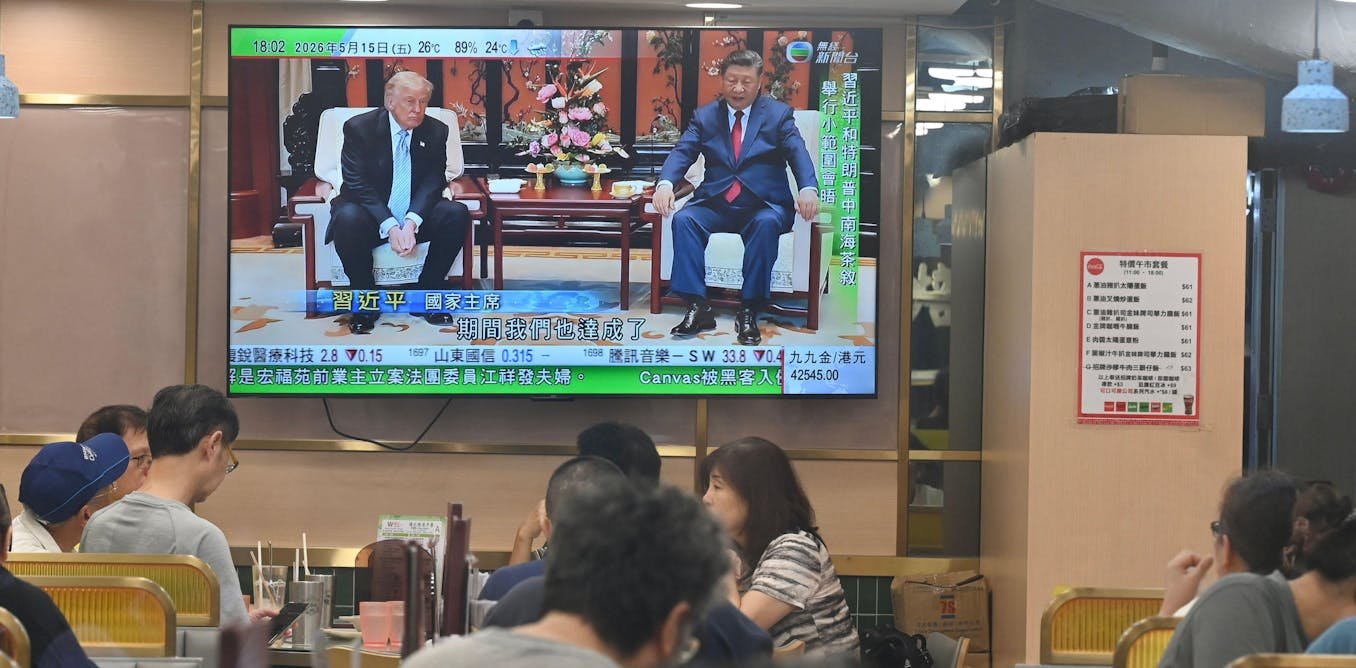
Donald Trump’s appraisal of his recent state visit to China was, typically, positive and self-regarding. At the end of the trip, the US president told reporters that it had achieved “a lot of good” and “fantastic trade deals” had been signed. He concluded that a lot of different problems were settled “that other people wouldn’t have been able to solve”.
As usual, the US president appeared to enjoy the pageantry of a state visit. He likes meeting other “great” leaders – strongmen who lead powerful countries.
At face value, the trip appeared largely successful. The Trump-Xi relationship appeared cordial. There were no undiplomatic comments by Trump. Xi described it as “a milestone visit” of “historic” proportions. Trump said that his relationship with Xi is “a very strong one”. China pledged to buy 200 Boeing aircraft and also committed to buying billions of dollars of soybeans and other agricultural goods. These are all things Trump can present as wins, even if their significance is disputed.
The cordiality of the visit was a contrast to the Biden years, when “extreme competition” with China – in Biden’s words – was the central organising principle of US foreign policy. The Biden administration viewed China as a once-in-a-generation challenger to US power: politically, economically, militarily and ideologically. It believed Beijing was aggressively trying to displace the US as the world’s dominant power and actively sought to prevent this.
Over the past year, the second Trump administration has shifted attention away from great power conflict with China and focused on other things. These have included regime change in Venezuela (and, all the signs suggest, Cuba is now in his sights). He has changed America’s relationship with Europe, introduced an at-times erratic regime of tariffs in an attempt to address US trade deficits. And, above all, he has started a war with Iran.
Ely Ratner, a China hawk from the Biden administration has accused Trump of “strategic deference” towards Beijing. And there can be little doubt that the Trump administration has dialled down the Cold War-style ideological rhetoric about China.
Its 2025 national security strategy stresses that: “We seek good relations and peaceful commercial relations with the nations of the world without imposing on them democratic or other social change that differs widely from their traditions or histories.” This much was evident from Trump’s visit. Unlike Biden, Trump did not publicly raises human rights issues on his trip to China. This removed a persistent irritant in the relationship.
That said, the US Congress – and many of those around the president – still see the relationship with China as fundamentally competitive and adversarial. They want the US to remain the world’s primary power, militarily, economically and technologically. The desire to out-compete China is likely to drive policy in the longer-term.
The 2026 national defense strategy, published in January, states that Washington will be “clear-eyed and realistic about the speed, scale, and quality of China’s historic military buildup” and will “prevent anyone, including China, from being able to dominate us or our allies”. The strategy commits the US to deterring a Chinese invasion of Taiwan by keeping “a strong denial defense along the First Island Chain” north and south of Taiwan. The US secretary of state, Marco Rubio, who accompanied Trump to Beijing, confirmed that US policy on Taiwan has not changed as a result of the leaders’ meeting.
The Trump administration’s approach is driven primarily by economic interests. This is because it believes that “the Indo-Pacific will soon make up more than half of the global economy” and, according to the defense strategy: “Were China… to dominate this broad and crucial region, it would be able to effectively veto Americans’ access to the world’s economic center of gravity.”

This means the Trump administration will try to preserve the giant US military presence in Asia Pacific that the Chinese see as encirclement.
‘Conscious de-coupling’
The US president remains a mercurial character who can make unpredictable decisions. He likes to tout his prowess as a dealmaker and it is always possible that he could undermine the consensus view within his own government. But the US Congress is also firmly behind the drive to out-compete China and to “decouple” in advanced technology.
In July 2025, the bipartisan “One Big Beautiful Bill” Act (OBBBA) included US$58 billion (£43.5 billion) of federal investments in, and tax incentives for, AI production inside the US. These measures barred “prohibited foreign entities” from US supply chains. In 2018, Congress passed strict new export controls and investment restrictions into law to try to decouple from China in emerging new technologies. The House Select Committee on China is pushing for more of this.
Over the past year, the Trump administration launched a new strategy for rare earth metals. China’s dominance of the mining and processing of these metals is a huge advantage – they are critical to modern weapons systems and widely used in electronics, from smartphones to EVs.
In April 2025, Beijing began to impose export controls on rare earths in response to US tariffs. Since then, the US has launched a US$7.3 billion global effort to secure supplies of rare earths outside China and invest in domestic mining and processing capabilities. While this will take years to come to fruition, the goal is to speed up decoupling from China in rare earths – hardly a sign of trust.
Finally, Trump reportedly refused to extend the trade truce signed in October 2025 until the end of his administration as he believed he would lose leverage over China in future. It’s a clear sign that even he expects tension in future.
The Trump administration says that, unlike its predecessors, it is not looking for conflict with China. But its insistence on US dominance of Asia Pacific is likely to drive competition with China in the long-term.