Diplomacy involves the art of telling lies with a straight face or even a reassuring smile.
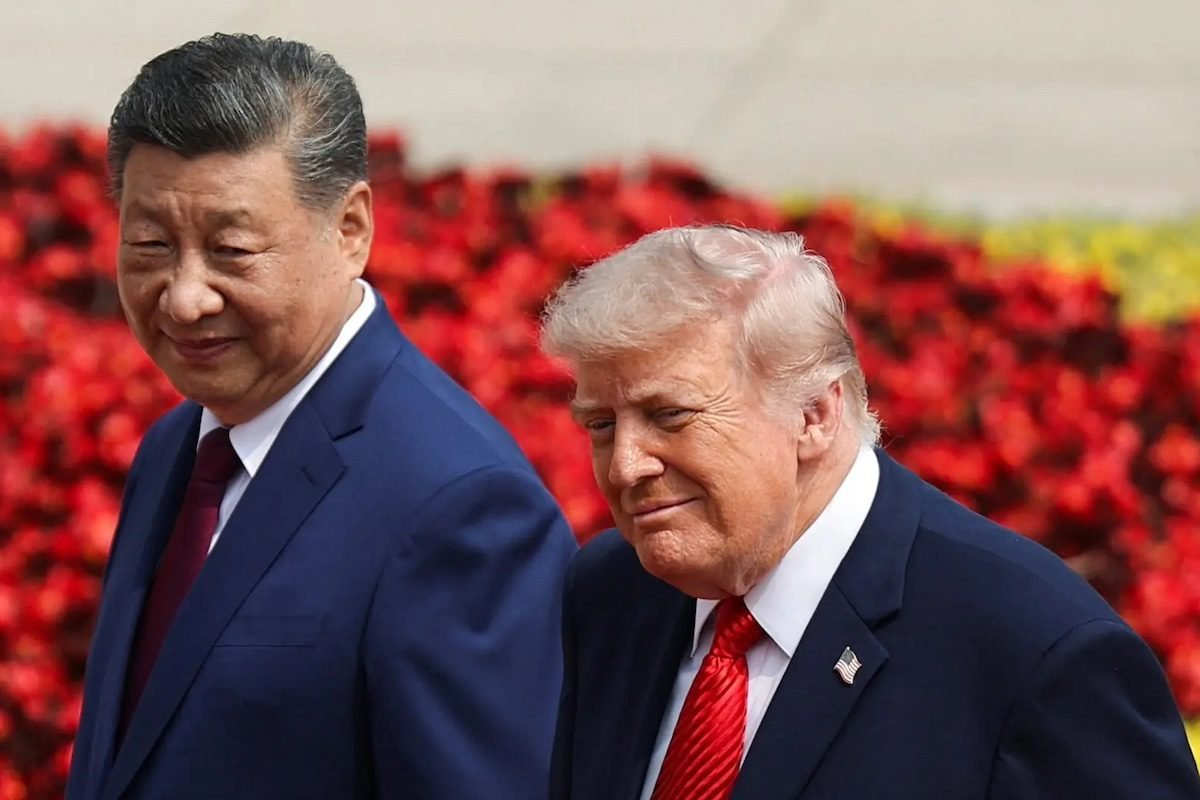
On day one of Donald Trump’s China visit, political correctness and diplomatic finesse were in ample display from the US leader, while Chinese sources reported that Xi Jinping issued a stern warning to “properly” handle Taiwan, “the most important issue in China-US relations.”
Otherwise, Xi continued, “the two countries will have clashes and even conflicts, putting the entire relationship in great jeopardy.” That was typical Chinese bluster, clearly uttered for domestic consumption. The issue has been “properly” handled by the US since 1949, otherwise it would have blown up into a war by now.
Much has been written and said about China’s position of relative strength in this summit, with the US bogged down in the Iran war. This may be the reflection of the alleged antipathy of much of the mainstream media towards anything Republican Party in general and towards Trump in particular. True or not, polls show that a majority of Republicans have no trust in the US mass media.
But US and Chinese actions may be a better guide about who is actually speaking from a position of strength at the summit. We could start with trivia. China allowed a sanctioned American to travel with Trump, land in Beijing and shake hands with none less than Xi Jinping.
US Secretary of State Marco Rubio is renowned for China-bashing, rooted in part in his antipathy toward all things communist, hailing from an immigrant family from Cuba who was deeply influenced by the exiled, anti-communist Cuban community in Miami.
Rubio has repeatedly touched a raw nerve with Xi through his criticism of China’s atrocities against ethnic Uighurs in Xinjiang and was sanctioned by Beijing in 2020. Rubio’s inclusion in Trump’s delegation and warm welcome in Beijing speaks to China’s desire to bend over backward to facilitate the summit.
While Beijing was preparing a red-carpet welcome for Trump and company, it was likely no coincidence that a jury found Lu Jianwang guilty of opening and operating a secret police station in Manhattan’s Chinatown neighborhood on behalf of the Chinese government.
Moreover, just two days earlier, Eileen Wang, the mayor of Arcadia in southern California, had resigned after she was charged by the US Department of Justice with being a Chinese government agent. Wang faces charges of sharing pre-written articles by Chinese government officials on the US News Centre website and spreading Chinese Communist Party disinformation, including denial of atrocities against Uighurs.
The First Assistant US Attorney had called it the latest success in America’s “determination to defend the homeland against China’s efforts to corrupt our institutions.” This calling out of China’s grey-zone war against the world’s democracies, just a couple of days before the Trump-Xi summit, would surely not have been music to Xi’s ears.
Widespread labeling of China as a totalitarian, repressive state had begun much earlier but notably intensified as the summit came closer. The US National Security Strategy 2025 re-emphasized US dominance in the Western Hemisphere, amid China’s rapid inroads.
A reassertion of the Monroe Doctrine, the portmanteau “Donroe Doctrine” stressed securing critical supply chains and materials and the “reindustrialization” of the US, measures clearly aimed at China without naming it.
Later in the document, it directly refers to China, accusing American elites of both political parties of being “either willing enablers of China’s strategy or in denial.”
There has been a slew of federal agency actions in recent weeks directed at China. On May 6, 2026, the US Trade Representative issued a notice that it has started a second, statutory four-year review of the actions taken in the “investigations of China’s Acts, Policies, and practices Related to Technology Transfer, Intellectual Property, and Innovation.” Apparently, a routine exercise, but the timing sends a signal.
On April 14, 2026, the US Federal Trade Commission announced a “Made in USA” sweep and took action against companies for selling products made in China as if they were produced in America.
On April 16, 2026, the US State Department, headed by Rubio, issued a report on conditions in Hong Kong which said that, “Beijing and Hong Kong authorities have systematically degraded Hong Kong’s political autonomy and civilians’ rights and freedoms.”
It added that US citizens who live in Hong Kong or go there for business or tourism and “publicly criticize the Chinese Communist Party or its policies are at a heightened risk of arrest, detention, expulsion or prosecution.” The report did note there were no national security-related arrests in 2025; its appearance so close to the summit nonetheless raises eyebrows.
On 23 April 2026, the US Scam Center Strike Force brought “criminal charges against two Chinese nationals who managed a cryptocurrency investment fund compound” in Myanmar, where “trafficked workers were beaten and forced to steal from Americans.”
So why would the Trump administration initiate so many actions against China and the Chinese shortly before an important summit meeting if Trump is the summit’s underdog?
It does not stand to reason that the “stronger” party would roll out the red carpet and do legal calisthenics to facilitate sanctioned Rubio’s participation at the summit, while the “weaker” US would paint its welcome carpet black through numerous actions aimed at antagonizing China.
Trump, buoyant from his recent achievements against China in Venezuela, Panama and elsewhere, is talking in Beijing about it being an “honor” to meet and call Xi his friend.
Xi, facing an economic slowdown, falling consumption, an entrenched real estate crisis and high youth unemployment, on the other hand, issued a warning. This is what diplomacy is all about – flexing while weak and showing grace while strong – but the realpolitik reality in Beijing is that the US, not China, is deciding the relationship’s direction and tone.