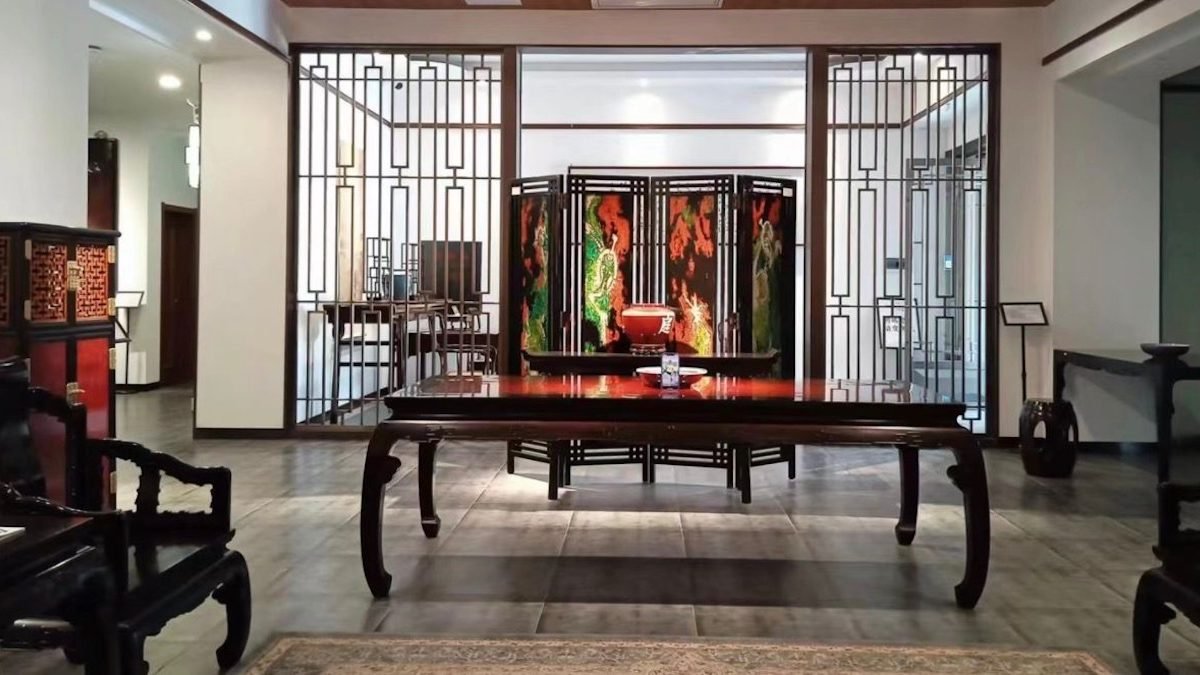
The first time one truly stands before a Ming-style horseshoe-back armchair, a quiet misperception arises. It does not feel like an antique. It feels like a piece of modern design completed several centuries too early.
There is no heavy imperial pomp, no crowded carving, none of the mother-of-pearl inlay so often associated with later Qing taste, no need for gold, jewels, heraldry or sheer mass to announce value. Four legs touch the ground. The arms open outward. The back curves with restraint. Under the light, the grain begins to move. The object is silent, yet its structure, proportion and hierarchy are unmistakable.
The value of Chinese classical furniture does not lie in the vague label of “Eastern style.” It lies in the way timber, craftsmanship, bodily scale, spatial etiquette and collecting history enter a daily object and turn it into a form of civilization.
The first element is wood.
According to Shi Hao, founder and director of the Donghu Rosewood Museum in Wuhan, the three great tribute woods of antiquity refer to the precious hardwoods selected for imperial use during the Ming and Qing periods and offered by local authorities or tributary regions. They were known as “first yellow, second purple, third red”: huanghuali, zitan and dahong suanzhi. The classification offers a direct entrance into the material hierarchy of Chinese furniture. Huanghuali is prized for warmth and grain; zitan for density, darkness and gravity; dahong suanzhi for its deep red tone, hardness and stability.

Among Ming-style furniture, huanghuali occupies a special place. The finest Hainan huanghuali can glow in tones of amber, honey and reddish brown. Its grain may resemble mountains, running water or drifting clouds.
Most distinctive are the so-called guilian or limian patterns — “ghost faces” or “lynx faces,” also known as ghost eyes or coin patterns. These dark brown clusters can look like theatrical masks, leopard markings or stacks of ancient coins. On a table surface or a chair back, one may see many such images: half-face, half-eye, half-apparition. Craftsmen and collectors describe the wood as alive because these images are not carved into it. They grow from within.
This is one reason Ming furniture often prefers plain surfaces. It was not a lack of decorative ability. It was respect for the material. Huanghuali already contains landscapes, clouds, ghost faces and coin patterns. Excessive carving would interrupt the wood’s own painting.
From the middle and late Ming period onward, fine hardwoods entered elite furniture through southern trade, maritime commerce and the consumer culture of Jiangnan. As large pieces became scarce and slow-growing timber more difficult to obtain, huanghuali came to be regarded as “gold among woods.” The literati liked it unadorned because the grain itself was the event.
Today, museums and traditional craft institutions are again reorganizing this material knowledge. The Donghu Rosewood Museum occupies about 2,000 square meters and houses more than 400 pieces of precious classical rosewood furniture. Through research and development with expert teams from the Palace Museum and the Shanghai Museum, it uses Suzhou-style craftsmanship to revive the elegance of Ming furniture.
This matters beyond one institution. It shows that Ming-style furniture is no longer only an antique category in the collecting market. It has returned to the fields of material study, craft history, museum research and contemporary aesthetic education.
After material comes structure.
The most refined part of Chinese classical furniture is often hidden at the joints. Mortise-and-tenon construction is not merely the romantic idea of “using no nails.” It is a structural system for dealing with force, expansion, contraction, weight and stability. Wood moves with humidity. Metal nails can injure its nature. Mortise and tenon allow furniture to breathe within limits, which is one reason so many pieces have survived for centuries.
To understand a horseshoe-back armchair, one cannot stop at the outline. One must see how the arms extend from the back, how the back splat receives the human body, whether the legs splay just enough, how the stretchers distribute force and how aprons and openings balance support with visual rhythm. Luoguo stretchers, ba wang stretchers, mitered frames with floating panels, waisted construction, foot supports and soft seats are not a list of antique terms. They are the grammar of structure.
If the proportion is wrong, the spirit of the object collapses. If the arm is too high, the body resists. If the back is too straight, one does not wish to remain seated. If the legs are too thick, lightness disappears. Fine Ming furniture is not simply “simple.” It is accuracy after compression. Minimal appearance is only the surface. Precision is the essence.
In the traditional craft system, measurement was never casual. Ming carpenters, especially in Jiangnan, often used the Luban ruler, also called the menguang ruler or bazi ruler, to determine the dimensions of doors, beds, tables and other objects. Luban, whose personal name was Gongshu Ban, was a celebrated craftsman of the state of Lu during China’s Spring and Autumn period, roughly 770 to 476 BCE.
This period overlaps broadly with archaic Greece and the Roman kingdom. At a time when the foundations of Eastern and Western civilizations were both being laid, Chinese craft culture was already linking technique, measurement and symbolic order.

The Luban ruler divided measurement into auspicious and inauspicious positions. Common favorable characters included wealth, righteousness, office and good fortune; unfavorable ones included illness, separation, calamity and harm.
A saying from Luban’s handbook on architecture, the Luban Jing Jiangjia Jing states: “Beds do not leave seven, tables do not leave nine, stools do not leave three, doors do not leave five, coffins do not leave eight.” The phrase reflects a belief that the final dimensions of beds, tables, stools and doors should not only serve use, but also fall within auspicious measurements.
Seen from a modern perspective, this belongs to feng shui and symbolic belief. Seen within traditional society, it shows that furniture making was not merely technical labor. It joined bodily scale, domestic peace and psychological order into one craft discipline.
Imperial architecture and court objects took measurement even more seriously. The Qing dynasty Gongbu Gongcheng Zuofa Zeli, the official building standards of the Board of Works, listed numerous door dimensions aligned with auspicious Luban positions, including categories such as “wealth-increasing doors,” “righteousness and harmony doors,” “official rank and emolument doors” and “fortune and virtue doors.”
A bed, a table or a door was therefore not simply processed timber. It carried ideas of household stability, continuing fortune and maintained order. The proportion of Chinese classical furniture came from eye and hand, but also from a long inheritance of measurement culture.
This design logic explains why Ming furniture speaks so naturally to modern design.

Modernism values structural honesty, material honesty, functional clarity and formal restraint. Ming furniture had already achieved these principles centuries earlier. It lacks the coldness of industrial design, but it possesses the modern spirit at its core: It does not conceal structure, it does not abuse decoration and it does not substitute mass for authority.
A Ming-style chair can stand in a modern house, a gallery or a private study beside stone, concrete, abstract painting and contemporary lighting without appearing theatrical. Its outline is clear, its scale controlled, its material legible, its structure self-evident.
Yet furniture is never only design.
In late Ming literati life, furniture formed a spatial order. A painting table was not an ordinary table. It was the center for reading, writing, viewing paintings, burning incense and receiving guests. A horseshoe-back armchair determined posture, line of sight, ritual distance and the bearing of the host. An incense stand might hold only a burner, a vase or a scholar’s rock, yet it gave the room breath. A luohan bed stood between bed, couch and seat. One could recline, converse, drink tea, read or rest upon it. It belonged to the zone between private life and social space.
Hall furniture emphasized order and ritual. Study furniture emphasized solitude and cultivation. Beds and couches joined the daily body to the life of the mind. The placement, scale and grouping of furniture formed a social language. Ming furniture gave particular importance to empty space. Emptiness here was not absence. It was control. It allowed distance between objects, room for light, air and movement. A sophisticated room is not one packed with valuable things. It is one in which each object knows its position.
Collecting value must also be judged from within this system.
The price of a piece of Chinese classical furniture is not determined by wood alone. Wood is only the threshold. What gives a piece scholarly and market value is age, form, proportion, workmanship, condition, provenance, publication history, exhibition record and collecting pedigree.
The international market has already shown what truly top-level Chinese classical furniture can command. Christie’s has cited important results: a 16th- to 17th-century huanghuali circular incense stand sold for US$5,847,500, while an 18th-century zitan luohan bed sold for US$3,607,500. Such prices make clear that top Chinese classical furniture is no longer treated internationally as decorative antiquity. It is a high-level art asset combining material rarity, technical refinement, aesthetic rank and collecting history.
To judge a huanghuali piece, one must ask several questions. Is the timber old material? Does the form correspond to the period? Are the mortise-and-tenon joints original? Are panels, legs, aprons or openings later replacements? Is the patina natural? Has the surface been over-polished, waxed or recolored? Has the structure undergone major repair? Have dimensions been altered? Is the provenance clear? Has the piece entered significant collections, exhibitions, catalogues or auction records?
Provenance is especially important at the high end of the market. Without a clear history, even beautiful material remains limited in value. With a documented collecting record, publication history and scholarly background, a piece is no longer merely an old object. It becomes a cultural asset tested by time, connoisseurship and the market.
Authenticity demands the most experience.
Chinese classical furniture cannot be judged simply by whether it looks old. Old wood can be used to make new furniture. New furniture can be aged artificially. Old components can be recombined. Partial restoration can change the value of the whole. The real judgment lies in whether wood, structure, proportion, tool marks, patina, wear and use logic agree with one another.
Naturally used furniture ages with direction. The arms become smoother where hands often rested. The seat shows subtle wear where the body made contact. The lower legs carry traces of long contact with the floor. Drawer edges grow rounded from repeated opening and closing. Real traces of life are never evenly distributed. If a piece is uniformly old from top to bottom, caution is required.

Patina is not a layer of shine. It is the surface condition formed by hands, air, light, dust, use and time. Good patina is calm, warm and layered. Over-polishing erases time. Artificial aging invents it. Old furniture fears two things most: being restored too new, or being made too old. One destroys evidence; the other fabricates history.
Late Ming furniture history also contains an emperor who cannot be avoided: the Tianqi Emperor, Zhu Youxiao, who reigned from 1620 to 1627. He was so devoted to woodworking that he may be called the most “hands-on” emperor in Chinese history. Later generations remembered him as the “carpenter emperor.” The title is not a casual anecdote. It places the precision and prosperity of late Ming woodwork beside the decay of imperial politics, creating one of the strangest and most tragic images in Chinese dynastic history.
According to the Ming Shi, the official History of the Ming dynasty, and Liu Ruoyu’s Zhuozhong zhi, a detailed insider account of the late Ming court, Zhu Youxiao loved carpentry intensely. He is said to have made miniature palace models, folding beds, small screens, lacquer objects and mechanical wooden pieces with his own hands. When working with wood, he could forget meals, sleep, heat and cold.
Even skilled craftsmen in the palace acknowledged the refinement of his work. Later accounts even record that he had eunuchs take some of his pieces outside the palace to sell, giving his hobby an oddly worldly quality: An emperor not only admired woodwork, but personally sawed, planed, carved and shaped timber into objects.
The story darkens quickly. The emperor’s absorption in carpentry coincided with the rise of Wei Zhongxian. Wei held major positions, including writing eunuch of the Directorate of Ceremonial and head of the Eastern Depot. The Ming Shi, Britannica and historians in China and abroad commonly regard him as one of the most powerful eunuchs in Chinese history. Britannica states: “He is usually considered by historians to have been the most powerful eunuch in Chinese history.”
In accounts such as Liu Ruoyu’s, Wei would present important memorials while the emperor was absorbed in his tools. Tianqi would often respond with a phrase to the effect of: “I have understood. You handle it well.” Affairs of state then passed into the hands of the eunuch faction.
On one side were sawdust, shavings, mortise and tenon, lacquer and ingenious furniture. On the other were court corruption, eunuch domination, unpaid military funds, worsening frontier pressures and spreading unrest.
Tianqi did not create Ming-style furniture. His significance is different. He became the most extraordinary imperial footnote to late Ming wood culture. That an emperor could work wood so well that craftsmen admired him shows how mature the craft system had become. That the same emperor abandoned government to his obsession gives this furniture history an unavoidable political shadow.
The maturity of Ming furniture did not come from Tianqi alone. It arose from Jiangnan wealth, maritime hardwoods, literati taste, court demand and a developed craft system. Zhu Youxiao’s meaning lies in the contradiction he embodies: Woodwork could become refined enough to enter the emperor’s hands, while the dynasty itself had become fragile enough to be undone by failed authority. Behind a folding bed, a miniature palace or a lacquered mechanism stood not only skill, but the imbalance of an age.
Chinese classical furniture deserves to be seen from this breadth.
It is not a single category of object. It is a complete civilizational cross-section. Its materials come from nature and trade. Its structure comes from craft experience. Its proportion comes from bodily scale and the Luban ruler. Its space comes from literati life. Its value comes from collecting history. Its authenticity comes from trained judgment. It belongs to technical history and aesthetic history, to market value and to the shadow of dynastic rise and decline.
True Chinese classical furniture does not rely on massive scale to intimidate, nor on gold and jewels to seduce. It hides civilization in structure, status in proportion and time in wood grain. It gives a daily object practical, aesthetic, ritual and spiritual weight.
Beauty need not shout.
Power need not always sit on a golden throne.
Sometimes a piece of wood, shaped by exacting eyes, precise hands, auspicious measure and long time, is enough to preserve a civilization’s judgment.
Jeffrey Sze is chairman of Habsburg Asia (partially owned by the Habsburg Family) and GP of both Archduke United LFP and Asia Empower LPF. He specializes in high-end art transactions and RWA-T operations. In 2017, he secured a cryptocurrency exchange license in Switzerland.