Few things enrage Donald Trump more than being upstaged, particularly when he is on the biggest stage of both his stints as US president — in Beijing. Though Trump World will deny that Nvidia CEO Jensen Huang did just that this week, he did. And global markets know it.
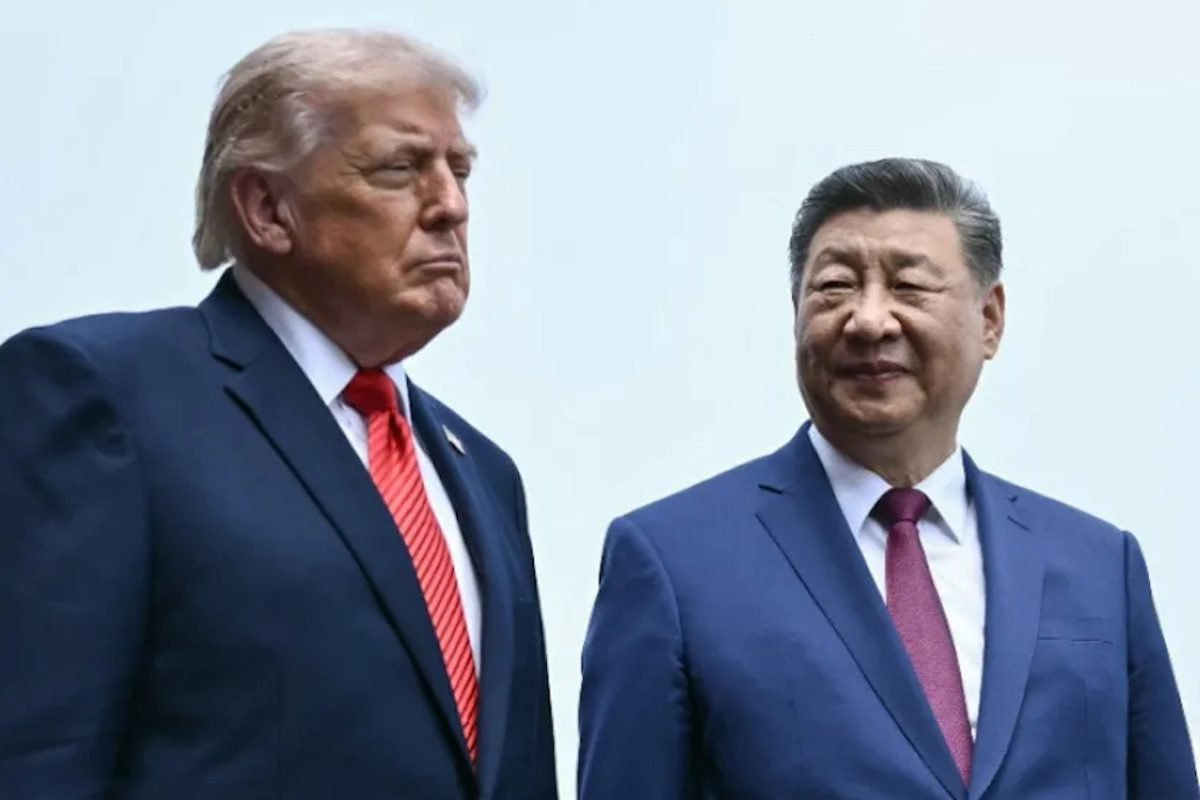
Just as expected, the first visit by a US leader to the Chinese capital in eight years was huge on pomp and circumstance, light on diplomatic breakthroughs. President Xi Jinping threw Trump enough of a bone so that he can argue back in Washington that the US and China will cooperate to tamp down trade tensions and, most importantly, end the war in Iran.
But the real action – and global fascination – was Trump’s US$20 trillion entourage of CEOs seeking greater access to Asia’s biggest economy. That delegation, representing a market value equivalent to China’s annual gross domestic product, stole the spotlight from the camera-hungry Trump.
Especially Huang, who was a late-breaking addition to the CEO army that fortified Trump’s China trip strategy. So late, in fact, that Huang had to catch up with Air Force One at a refueling stop in Alaska. Huang’s inclusion signaled to many that Trump is bending over backward to curry favor with Beijing.
It means that, “contrary to our expectations, the announcement of Chinese purchases of a first batch of H200s appears increasingly likely, following Huang’s last-minute participation,” notes Eurasia Group analyst Amanda Hsiao.
This is huge news for the artificial intelligence boom that’s driving global stock markets to all-time highs. And it could be the most lasting win from Trump’s Beijing trip – Huang’s win. And a win for the AI trade, with chipmaking behemoth Nvidia approaching an unprecedented $6 trillion market capitalization.
Sure, there’s talk of some Boeing plane orders, soybean purchases and a reciprocal Xi visit to Washington later this year. But the truly big issues – unfettered access to rare earths, AI coordination or reopening the Strait of Hormuz – were left on the table for another time.
As former US Congressman Adam Kinzinger put it on his YouTube channel: Xi treated Trump “like a salesman that he’s going to politely entertain, and this particular salesman appears to be flying home with very little in his bag.”
Now, the waiting game begins. We’re several months away from knowing if Trump’s jamboree of tech, finance and defense executives – including Tesla’s Elon Musk, Apple’s Tim Cook and the heads of Boeing, Citi, Goldman Sachs will bear fruit.
One wildcard, of course, is that Trump is deal-hunting with far less juice or leverage than he expected at the start of 2026. It depends largely on whether an increasingly erratic Trump White House goes off the rails with new tariffs, an intensified war in the Middle East or wherever else this White House might decide to shake things up.
Xi told Trump’s CEO parade that China will open its economy further. Trump emerged from his meeting with Xi, calling it “great” while striking an optimistic tone. The warm, welcoming optics will clearly cheer global markets.
Below the surface, though, uncertainty abounds. Xi’s stern warning of a potential conflict if the Taiwan issue is mismanaged — including talk of “collision or even clashes” — was an obvious wake-up call for geopolitical risk experts. It was hardly a great look for Trump, who, while standing at Xi’s side, refused even to acknowledge reporters’ questions on Taiwan.
Economists, meanwhile, have plenty to chew over following Xi’s raising the risk of a “Thucydides trap” involving two economies worth a combined $53 trillion of GDP. The reference here is to the risk of military conflict when a rising power threatens to displace an established one. Though framing the scenario in historic terms, Xi proposed a “constructive, strategic and stable relationship” between the Group of Two.
Of course, the very fact that Trump and Xi were able to clink glasses and take a deep breath this week is an unambiguous positive for the global economy. That in itself is an economic victory.
But lost in the shuffle this week is the top goal of Trump’s two presidencies: bringing China to heel with a “grand bargain” trade deal that browbeats Xi’s Communist Party into deep economic concessions. Amid the photo ops and niceties in Beijing, that goal looked more fleeting than ever.
In the medium-term, a notable diplomatic breakthrough “remains improbable,” notes Carlos Casanova, economist at Union Bancaire Privee. “More plausible are modest gestures, including calibrated moves toward a tariff truce in select categories and assurances on critical‑materials access.”
As US-China talks resume in the weeks ahead, rare earths are a “prime candidate,” Casanova says. China’s rare‑earth exports surged 197% year-on-year in April (up from 3.3% in March), underscoring both Washington’s dependence and Beijing’s display of “goodwill.”
A “mutual understanding to maintain a stable supply in exchange for restraint on punitive measures would be a logical, market‑friendly outcome, especially given vast investments in artificial intelligence that have fueled the stellar performance of equity markets in the United States,” he adds.
Yet, as with Iran and the Strait of Hormuz, global markets can unsee the events of 2025. China retains the capacity at any moment to switch off the flow of rare-earth minerals vital to the production of electric vehicles, LED TVs, lithium-ion batteries, military radar systems, semiconductors and smartphones.
China could also deepen its relationship with Iran, including increased oil purchases from Tehran, military equipment aid and intelligence sharing. China could, at any moment, cancel Boeing’s 200-plane order or pivot back to Brazilian soybeans.
As Trump returns home to a White House in disarray, his MAGA base can’t be impressed. From 2017 until now, across two presidencies, Trump promised to show China who’s boss. How has that worked out? China’s GDP is now $8 trillion higher than in 2017.
That’s despite more tariff announcements and trade curbs than researchers could ever count. Despite US tariffs as high as 145% on China in 2025, Xi’s economy ended the year with a record trade surplus of US$1.2 trillion.
The problem for Trump is that only a splashy victory over China on trade, and the last 15 months of tariff turmoil and inflation, might convince the MAGA faithful that it was all worth it.
The Iran war that Trump launched with Israel on Feb. 28 complicated things for Trump World. The resulting surge in oil prices, on top of tariff fallout, has Trump’s approval ratings at historic lows.
Now he returns to Washington with, essentially, a deal to continue talking about a potential framework for a deal sometime down the road. In the interim, Trump World probably won’t like the headlines from Beijing highlighting just how little Trump achieved versus his big talk of just a few months ago.
Also, Trump’s Republicans approaching mid-term Congressional elections in November, might have to fend off too-easy-on-China chatter, considering the deference the administration showed Xi’s inner circle. Not to mention the risk that Trump leaves himself hemmed in by China’s diplomatic language.
As Bill Bishop, a longtime China watcher who writes the Sinocism newsletter, noted, Xi’s inner circle “wants a period of strategic detente and this concept could realize that on terms favorable to them for the rest of Trump’s second term.”
Bishop adds that “any future US moves to address PRC industrial overcapacity, tighten technology controls, etc. could then be cast by Beijing as violations of the new ‘constructive China-US relationship of strategic stability’ to which the two leaders personally agreed.”
Though China is plagued by many domestic challenges, including a giant property crisis, Xi has used the Trump era to position China as the more stable economic partner that’s open for business. Only time will tell if this week in Beijing marked the latest soft-power win for Xiconomics.
But Xi will have to find a new gear to convince inflation-traumatized Americans that China didn’t just eat the US’s lunch.
Follow William Pesek on X at @WilliamPesek