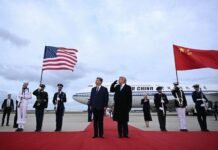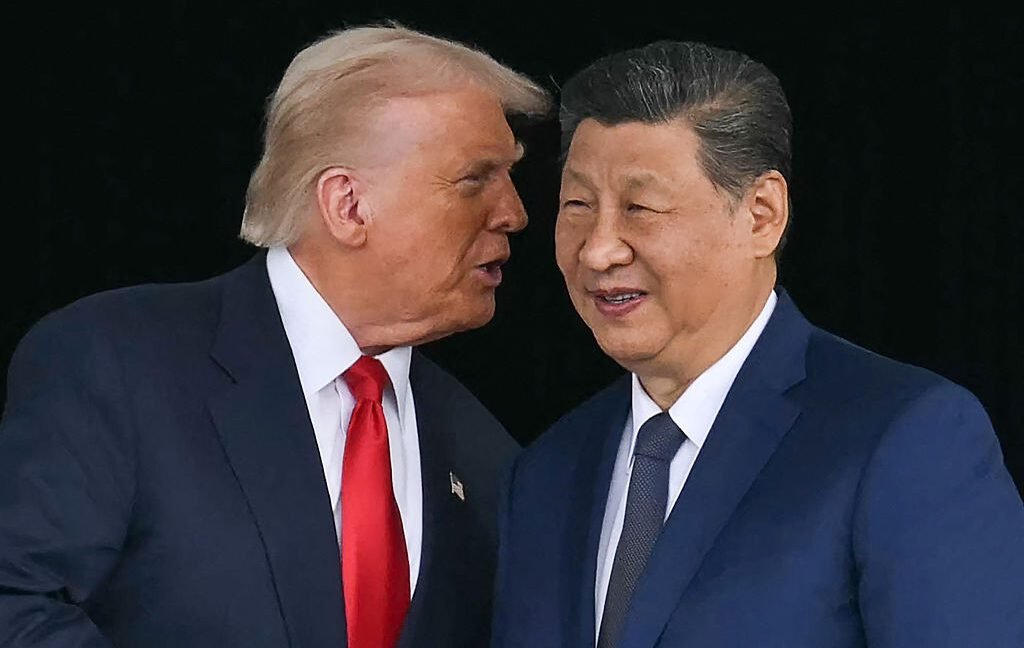
Donald Trump has very little leverage heading into two days of meetings with China’s leader, Xi Jinping, in Beijing this week, experts say.
The thinking goes that Trump came into office with a plan that has since largely failed. He hoped to resolve the conflict in Ukraine, settle things down with Israel and Gaza, launch his Liberation Day tariffs, and quickly diversify US supply chains, all of which would have given him substantial leverage over China.
But none of that happened, and instead, Trump’s escalations in Iran have only handed China even more leverage heading into talks, and Xi knows it.
Unwilling to appear weak when negotiating with one of America’s most critical trading partners and fiercest adversaries, Trump invited executives of some of the biggest US tech firms to tag along.
Among tech leaders joining Trump is Tim Cook, who Trump fondly calls “Tim Apple.” The Beijing trip will likely be Cook’s “final major diplomatic effort” as Apple’s departing CEO, EuroNews noted. Elon Musk will also be there, suggesting that Trump still values the SpaceX CEO’s input on foreign policy. And at the last minute, Trump confirmed that Nvidia CEO Jensen Huang will also be attending, which Reuters noted could help Nvidia finally convince China to start buying the high-end chips that Huang convinced the US would be safe to sell to China earlier this year.
Scott Kennedy, a senior adviser at the Center for Strategic and International Studies (CSIS), a bipartisan think tank, recently spent two weeks in Beijing discussing US-China relations with Chinese officials and businesses. At a recent press briefing, he provided insights that could help explain why Trump may have hastily formed this tech gaggle ahead of the summit.
Kennedy suggested that even though China has more leverage, both countries rely on each other at this pivotal moment in the AI race. Nvidia’s chips are peerless, Reuters reported, and access to China’s rare-earth exports is critical to leading US tech firms.
In the week before the summit, the topic of AI was suddenly added to the agenda, Kennedy noted, with both countries interested in discussing how to manage AI risks after China blocked Meta’s acquisition of a Chinese company called Manus.
On Truth Social, Trump said it was an “honor” for tech executives to stand by his side in Beijing, while indicating that his hope was to convince Xi to “open up” China “so that these brilliant people can work their magic and help bring the People’s Republic to an even higher level!”
Possibly, Trump invited the executives to remind China that it depends on US tech firms and can’t afford to push Trump too far.
But that doesn’t guarantee China will be intimidated by Trump’s tech industry pals. Importantly, China has so far resisted buying Nvidia chips while prioritizing advancing chip tech at domestic firms in a bid to be less reliant on the US.
Trump’s social media comments caused “deep concerns among China hawks in Washington,” Reuters reported. They’re worried that Trump will trade away too much, giving China a chance to beef up its military and catch up on AI.
Chris McGuire, a senior fellow for China and emerging technologies at the Council on Foreign Relations and a former official in the Biden administration, told Reuters that Huang’s invitation alone should raise eyebrows.
“Any deal that allows Nvidia to sell more chips to China means fewer Nvidia chips for US firms, and a smaller US lead in AI over China,” McGuire said. “It is remarkable that President Trump keeps getting convinced to put Nvidia’s interest ahead of America’s.”
China wants Trump to pivot on Taiwan
China’s top priority at the summit is clear: Xi wants to finally force Trump to discuss Taiwan.
Historically, China has maintained that Taiwan is part of its territory. And the US has treaded lightly, helping Taiwan maintain its self-defense, while cautiously avoiding upsetting China by officially recognizing Taiwan’s independence.
In the recent past, China has pressured the US to change the language it uses from “does not support” Taiwan independence to “opposes,” and it’s possible that Xi sees an opportunity to push Trump to make that symbolic change during the summit, experts suggest.
For Taiwan, the language the US uses matters, as China might be more willing to take military action if Trump’s resolve to shield Taiwan remains uncertain.
In an article criticizing Trump’s inconsistent stance on Taiwan during his second term, a senior fellow at a progressive think tank called the Center for American Progress, Michael Schiffer, warned that “the administration’s signals on Taiwan have grown so contradictory that neither Beijing nor Taipei can reliably discern American policy.”
For example, Trump has accused Taiwan of stealing the US semiconductor industry, but he also authorized the largest arms package the US has ever set aside to aid Taiwan’s defense. Rather than align with past administrations’ commitments to Taiwan’s security, Trump has used the arms package as a bargaining chip to try to force Taiwan to move 50 percent of its semiconductor manufacturing into the US. Perhaps even more frustrating for Taiwan, Trump recently told reporters that whether Xi decides to invade Taiwan is “up to him,” Schiffer’s piece noted.
“This pattern of strategic flip-flopping broadcasts a dangerous signal to Beijing: For the right price, Taiwan’s security is an expendable line item,” Schiffer’s piece said. “But this transactionalism is a double-edged sword. Xi likely views any Trump administration commitment with the same skepticism one affords a month-to-month lease, knowing it is liable to reverse course on a whim.”
It’s important for Trump to clarify his strategic stance on Taiwan, Schiffer said, urging in his article that “strategic instability serves no one’s interests and significantly increases the risk of catastrophic miscalculation. The time to choose a coherent strategy is now, before contradictory signals generate the very crisis they purport to prevent.”
In the US, the original strategy was to protect Taiwan to maintain access to its semiconductor industry, which produces over 90 percent of the world’s most advanced semiconductor chips.
Trump’s trade tactics have set Taiwan on edge. A deputy minister at Taiwan’s China-policy-making Mainland Affairs Council, Shen Yu-chung, has confirmed that Taiwan has attempted to “intensify” talks with the US ahead of the meeting, Reuters reported. “We will be watching whether the US makes any changes to its position on Taiwan Strait issues as a result of that meeting,” the official said.
Schiffer told Ars that the US shifting its position on Taiwan may not be the worst outcome for Taiwan. Since the COVID-19 pandemic made it clear that supply chains must be diversified, it’s no longer practical for Taiwan to expect to maintain overwhelming dominance in the semiconductor industry, he suggested.
Likely, officials in Taiwan are having “complex conversations” about “how to placate Trump,” Schiffer said, while coming to terms with the “new world” in which the US can’t afford to defend Taiwan’s “Silicon Shield” forever.
“Obviously Taipei wants to maintain market share,” Schiffer said. “But Taiwan is a single point of failure for the chip market,” and it’s getting “harder and harder, no matter how well inclined you are towards Taiwan” to argue that the US and “most of the world should depend to that degree on Taiwan as the chip forge for the world.”
Most likely, Taiwan will face pressure to move a certain amount of its semiconductor business elsewhere, but the “magic number” that would make that sustainable in the face of a Chinese military threat can’t be predicted yet, Schiffer said.
Don’t expect a big win for Trump
Experts agree that the US and China will likely extend the temporary trade truce established during Trump’s last meeting with Xi, as both sides would benefit from that stability. But it remains unclear how much Trump might be willing to trade as China uses its leverage to push for its biggest asks. Those will likely include the shift on the US position on Taiwan, easing of export restrictions to give China access to more high-end tech, and possibly the removal of Chinese firms from US sanctions lists.
Notably, Trump no longer has emergency tariffs or even his global tariffs to intimidate China, so Xi may get more out of the bargain than Trump likes.
However, China doesn’t even need to get any of its biggest asks to emerge as winners from the summit, Kennedy said. “As long as there’s not a blow up in the meeting and President Trump doesn’t go away and look to re-escalate, China basically comes out stronger,” Kennedy said.
The best outcome for Trump might be coming out of Beijing with “some pomp and pageantry, but nothing of substance that harms the United States or harms our allies and partners,” Schiffer told Ars.
“This may be sort of dialing expectations down, but I would consider that a win at this point,” Schiffer said.
At the very least, Trump needs to secure symbolic wins coming out of Beijing, experts agreed, if he wants Republicans to have something to campaign on ahead of the midterm elections.
But if he’s really invested in US dominance in AI, he can’t actually afford to be short-sighted at the summit, especially after making “massive” cuts to US science funding and research, which drove China to start recruiting top US scientists last year, Kennedy suggested.
“That’s really where the competition is going to be won or lost,” Kennedy said.