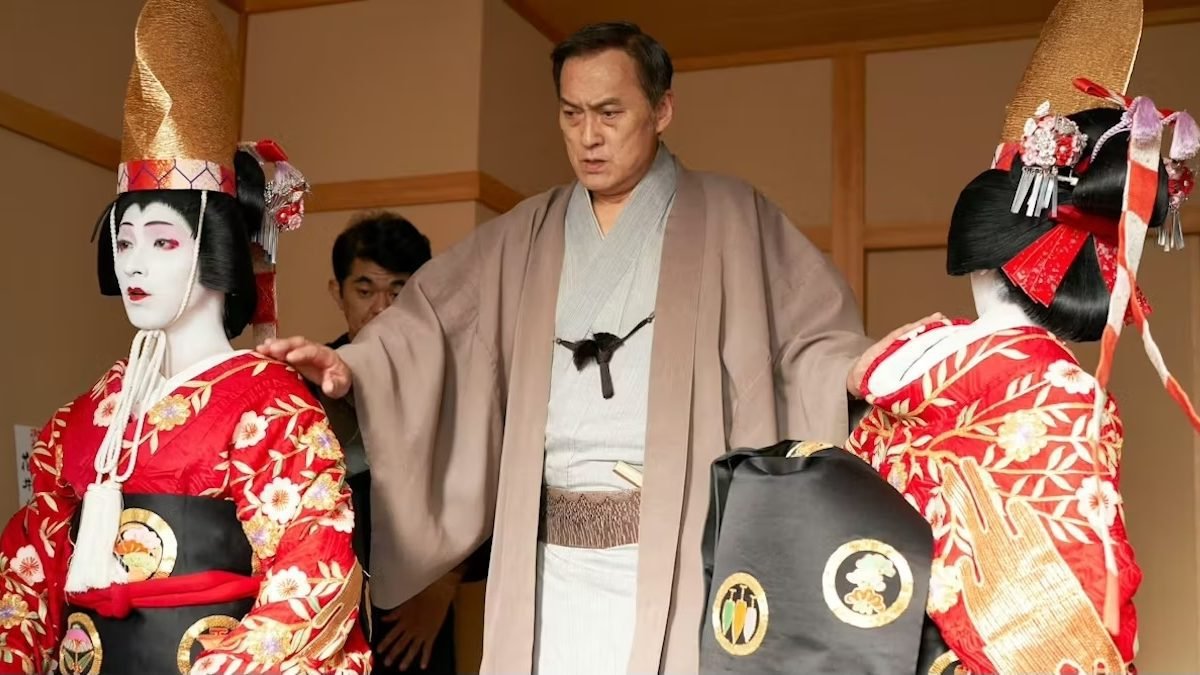
Kokuho is a colourful, lengthy epic, spanning five decades and running almost three hours, set in the world of kabuki – Japan’s most popular traditional performing art. It has been a huge hit in Japan, becoming the country’s highest-grossing live-action film ever.
The film’s title translates as “national treasure.” But that does not refer to tangible treasures like Buddhist temples, tea bowls, or imperial calligraphy. Instead, it refers to ningen kokuho – “living national treasures.” It’s the popular term for people recognized by the Japanese state as embodying a traditional art or craft.
Honorees run the gamut from potters, dyers and swordsmiths to lacquerware makers. But it is the kokuho from the traditional theatrical genres, especially kabuki, who most strongly capture the public’s imagination. Only a handful of kabuki actors in each generation ever make it to this rarefied height of official recognition. In Japan today there are just six of them.
The film traces the career of Kikuo (played as an adult by Ryo Yoshizawa), the orphaned son of a Hiroshima gangster. We follow Kikuo as he first enters the world of kabuki in the late 1940s, trains as an onnagata (a male actor who specializes in female roles) under the uncompromising guidance of a famous Osaka actor, Hanjiro (Ken Watanabe), wins and then loses the friendship of Hanjiro’s son Shunsuke (Ryusei Yokohama) and finally ascends to the rank of kokuho in the 1980s.
Professional kabuki is a tight-knit and all-male world of family connections. Actors pass down their hereditary stage names to their sons (the professional world has been male-only since the early 1600s) and successful outsiders are vanishingly rare. So Kokuho’s central question is far more culturally specific than other A Star is Born-esque narratives. Specifically, what makes a star kabuki actor – hard work or blood?

Where the film truly shines is in its understanding and rich evocation of kabuki’s offstage and backstage life.
Training is strict and fearsome. This is captured convincingly in scenes of the teenage Kikuo and Shunsuke stripped to the waist, sweating buckets in the summer practice room. They repeat sequences of dance movements over and over until they can internalize them to Hanjiro’s satisfaction.
Real kabuki actors are trained by their families and appear on stage regularly from five or six years of age, slowly moving up through minor to starring roles. They truly grow up on stage, under the initially tolerant then later increasingly expectant eyes of audiences who grow old with them.
Kabuki has survived as commercial theater for over 400 years and its impresarios remain in constant need of handsome actors whose image can be fanned and manipulated to attract a new generation of fans into the theaters. Kabuki, therefore, frequently forces promising young actors into roles and new hereditary names before they are quite ready for them.
It’s a reality that Kokuho neatly captures. Shunsuke finds Kikuo backstage, about to play a starring female dramatic role for the first time and trembling with anxiety, unable to do his own makeup. Kikuo begs Shunsuke for a cup of his blood to drink, terrified that his years of hard training may not be enough.
The film does an excellent job of convincing us that Kikuo has indeed become a great actor. The onstage scenes, shot in a variety of lights by Tunisian cinematographer Sofian El Fani (Blue is the Warmest Color, Timbuktu) look ravishing, drawing upon the vibrant colors of costume and set that are kabuki’s trademarks.
The plays chosen for these scenes have been carefully selected from the historical repertoire. With the one notable exception of a love suicide play, they are spectacular dance pieces that permit an emphasis on kabuki’s vivid visual and aural palettes, and on the stunning onstage hikinuki costume changes in which the threads on an outer kimono are cut and it is suddenly whipped away by stage assistants to reveal a contrasting garment beneath.
These choices also allow for lots of rapid cuts that go a long way to disguise the fact that Yoshizawa had only 18 months of kabuki training, instead of 25 years, before filming began.
The film’s attempt to answer its central question of blood or art is nuanced. Interestingly, for a film about an onnagata, it steers coyly clear of any problematic questions about sexual or gender identity. The only hint of that comes in the brief but memorabl scenes with the older onnagata, Mangiku (played by butoh dancer Min Tanaka).
Tanaka brings an acidic taste of threat to his role, speaking directly to the “fearsome, negative narcissism” that Yukio Mishima saw in Utaemon Nakamura VI, the greatest onnagata of the mid 20th century. What we are given instead is the deeply ambivalent sense of self that Yoshizawa brings to Kikuo, untouched by lost loves, abandoned children, ailing friends and even the bloody death of his yakuza father.
The conclusion we are guided to is that his traumatized blankness is the true source of his art. This suggestion reaches its culmination in the film’s final dance sequence in which the spirit of a heron, embodied first as a young then later an older woman, whirls alone at night amid thickly falling theatrical paper snow.
For Kikuo, the creation of identity through a concentrated evocation of beauty in performance is abundantly clear. Quite what message Japan’s film-goers have taken from it is much harder to parse.
Alan Cummings is a senior lecturer in Japanese Studies, SOAS, University of London.
This article is republished from The Conversation under a Creative Commons license. Read the original article.