
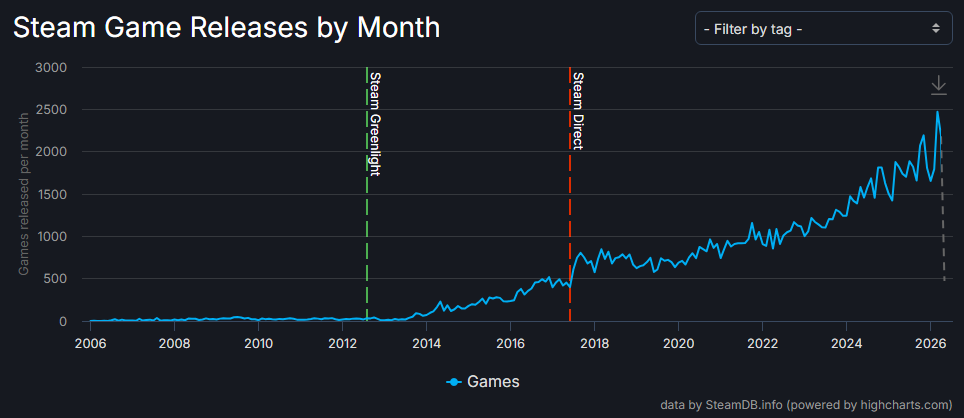
Anyone following the modern game industry knows that easy-to-use game engines and the accelerating shift to digital distribution have helped enable a massive increase in the quantity of commercial games released each year, both on console storefronts and especially on Steam. Now, Sony Interactive Entertainment President and CEO Hideaki Nishino says we should expect the rate of new game releases to accelerate even faster as new AI development tools make it easier for developers big and small to pursue new projects efficiently.
In a presentation to investors on Friday, Nishino noted that Sony “expect[s] to see a meaningful increase in the volume and diversity of content available to players” in the near future. That increase is the inevitable result of AI development tools that are “lowering barriers to creation, accelerating development cycles, and enabling more creators to enter the market,” he said.
By way of evidence, Nishino cited Sony’s first-party game development efforts. Gamemakers inside Sony are already using AI tools to “automat[e] repetitive workflows” in areas like quality assurance, 3D modeling, and animation, he said.
That includes a 3D animation tool called Mockingbird that Nishino said allows Sony artists to convert raw motion capture data into in-game animation much faster. While this tool can’t replace the motion-capture actors themselves, it means that “animation work that would have taken hours can now be completed in a fraction of a second,” Nishino said.
Machine learning tools have also been able to take in “videos of real hairstyles” and apply them to automated animation models that can realistically model “hundreds of strands,” replacing the “labor-intensive process” of animators placing those strands individually, Nishino said.
Elsewhere in the presentation, Sony Group President and CEO Hiroki Totoki praised the increased “efficiency” enabled by AI tools, saying it would, in turn, lead to “more innovative and ambitious projects—projects that were previously difficult to pursue due to constraints of cost and time.”
Totoki also highlighted a pilot partnership with publisher Bandai Namco that “identified massive gains in speed and productivity per person” in video production. While the team has needed to fine-tune generic AI models to prevent problems of “consistency and controllability,” Totoki added that these models can, in some cases, help enable “highly sophisticated and realistic outputs which were not feasible before due to production time constraints.”
Even as AI enables a flood of new game releases, Sony said it believes AI will help players navigate that glut. AI models can already “outperform manual curation” when it comes to suggesting new games players might enjoy, Nishino said, and could soon also suggest “the next gameplay moment, subscription, accessory, or merchandise that best reflects their passion.”
The human equation
Despite Sony’s predictions, there isn’t necessarily a direct relationship between developer efficiency and the raw number of game releases over a given period. Gains in efficiency could reduce the total number of human developers working on a project, rather than the total time spent on it, for instance. On the other side of things, more efficient development tools could increase the baseline quality expectations for high-end game development, meaning more time is needed to meet that baseline.
Despite Sony’s bullishness on AI’s game development potential, the company stopped well short of suggesting that AI could replace game designers wholesale or make entire games from scratch. Nishino said directly that “AI is meant to augment [developers’] capabilities, not to replace them,” and that humans will always be responsible for “the vision, the design, and the emotional impact of our games.”
Speaking more broadly, Totoki said Sony maintains a “core principle” that “human creativity must remain at the center” of the company’s creative efforts. Totoki called AI “an amplifier of human imagination” while saying in practically the same breath that “great content comes from deep personal experiences, unique perspectives, and a strong inner motivation to express something meaningful.”
At the same time, though, Nishino suggested that Sony’s development teams have created “prototypes where NPCs with their own personalities can create a living, dynamic world for the player to explore.” It’s unclear what role human artists would have in a world where NPCs can have their own AI-generated “personalities,” but it would definitely be a far cry from the role they play in game development today.