When we look at the military landscape today we cannot help but be impressed by the significance of drones on the battlefield. Drones represent an unexpected revolution in military affairs that has dramatically changed the balance of forces on the battlefield and beyond.
The rise of the drone as a potent technology for warfare is not the first time that technology emerged to shake up great and small powers alike. Here are two examples from the ancient Near East that were revolutionary.
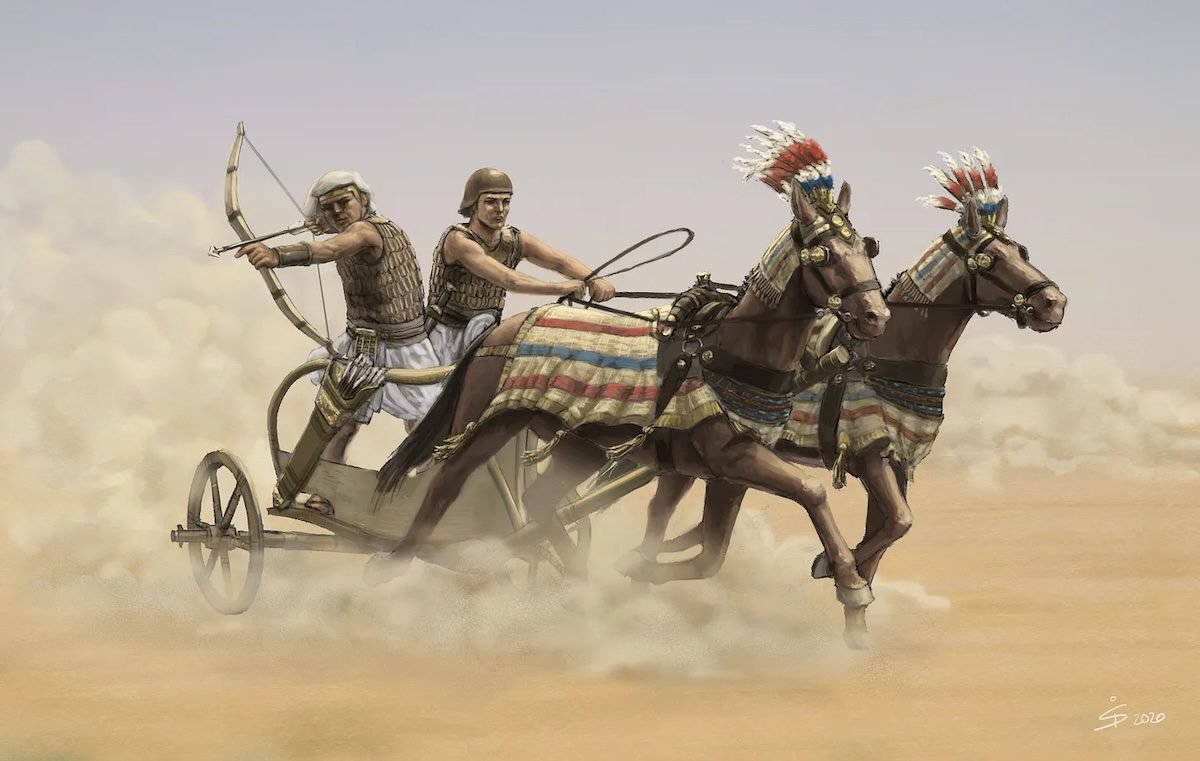
The chariot dramatically changed warfare, particularly as chariot design improved to make its cabin more secure and stable. Because of its war fighting utility, the chariot remained a factor in warfare for a thousand years or more. It enabled war fighters to flank their enemy, disrupting their foot soldier formations, forcing them to turn their ground divisions to face the mobile attackers. Later, as the chariot itself was hardened and became an assault weapon, chariots could spearhead charges against infantry, breaking up lines and paving the way for ground assaults.
A chariot typically had a crew of two or three warriors. One was responsible for driving the chariot. Another carried a heavy axe, a spear or both; the third was armed with a bow and arrow.
The bow and arrow is a very ancient weapon, known for more than 10,000 years. It was essential for hunting as well as for war. But, as archers surely knew, there were problems that plagued this weapon.
The bow was subject to breakage, either snapping or cracking – which made it worthless. So too was the bow string, made of animal gut, likely to fail at the most inopportune moment.
Fighting range was limited and accuracy was poor because of the shock to the structure when the bow string was pulled back hard and released. The “snap” was moderated by transversal forces on the string, creating twist in the released arrow that would throw it off course unless compensated by an experienced archer.
The composite bow
The invention of the composite bow improved archery and was a key to giving the chariot archers greater range, better accuracy, and more killing power since an arrow launched from a composite bow at a target could penetrate a hard target up to three inches.
There is debate about the origin of the composite bow; whether it initially was a Sumerian or Akkadian invention, or whether it was Canaanite. It was surely a vital weapon for the Hyksos which, along with their chariots, overpowered Egypt’s military forces.
The composite bow is made from wood, horn sinew and fish bladder. The secret is the fish bladder which, when prepared and cooked down, forms durable glue, the epoxy of the ancient war fighter.
The fish bladder is how a fish raises and lowers himself in water, by holding or releasing water. The bladder itself is primarily a collagen material, and the best fish bladders for the collagen glue are found in carp, sturgeon, catfish and cod.
Today fish bladders are processed into isinglass (essentially the concentrated collagen of the bladder), which is used for clarifying beer and wine.
Isinglass also was used during the Renaissance in “Court Plaster” which was a sticky material that could be used on walls and ceilings.
More recently, isinglass is used to treat wounds without the need for additional dressing. Thus an ancient material is playing a new role in the rapid treatment of wounded soldiers.
The advantage of glue based on the fish bladder is that it is stronger and can stand more torsion effects than glue made from beef sinew scrapings either from an animal’s gut or from the surface of leather. We don’t know whether bow makers in the Middle East produced their own isinglass, or if it was imported.
Certainly many of the woods needed to manufacture the bow had to be imported. The production of a composite bow was a slow process.
Wealthy property owners paid by tribal chiefs managed bow and arrow production and used slave labor to do the manufacturing. Some believe that the production of a good composite bow could take a year’s work. This suggests there were many hands involved in bow and arrow making and that production was a vital part of a well organized and disciplined community that was hierarchically organized.
Iron for weapons
The period that historians call the Bronze Age began around 3,300 BCE and ended with the collapse and disintegration of trading networks and some of the major powers of the time around 1200 BCE.

Bronze is a durable alloy made from copper and – during much of the Bronze Age – arsenic.
It was revolutionary because it turned copper, a soft material, into a metal that could be used for spear tips, arrow heads, swords, axes, pikes and armor (helmets and body armor).
In the ancient Near East, the most significant source of copper was Cyprus, although copper was also extracted elsewhere, especially in the Arabah Valley (Timna/Faynan), and in the Sinai Peninsula.
Alloying copper with arsenic had two major drawbacks: it was not effective for longer weapons, especially swords, and arsenic fumes were poisonous, resulting in the death or impairment of workers making bronze and shaping bronze weapons. The full transition to copper-and-tin bronze came about roughly in 1500 BCE thanks to an overland and overseas trade network that could import tin from Kazakhstan and Afghanistan or (later) from Britain (Cardiff).
Bronze military hardware and agricultural tools were affordable by rich nations and helped define great power relations especially in the late Bronze period.
But between 1200 and 1000 BCE the trade system that supplied copper and tin fell apart, although not all the reasons for the collapse are known. With that collapse, other forces emerged. Among the great challengers were the Sea Peoples who raided many of the trading centers and eventually controlled what today is modern Israel. Among the Sea People were the Philistines.
The Philistine coalition was made up of five city states: Ashkelon, Ashdod, Gaza, Ekron and Gath, situated on the southern coastal plain of ancient Canaan (modern-day Israel/Gaza), from about 1200 BCE to 700 BCE.
There were dozens of other settlements in ancient Canaan, including the Hebrew tribes that were mainly concentrated in the hilly areas of the region. (The hills inhibited the use of chariots by the Philistines.) The Biblical story of Samuel, Saul and David takes place at this time and it centers on Philistine control of bronze and iron making.
Book 1 of Samuel (the Hebrew Torah does not separate Samuel into two books) Chapter 13 says:
“There were no blacksmiths in the land of Israel in those days. The Philistines wouldn’t allow them for fear they would make swords and spears for the Hebrews. So whenever the Israelites needed to sharpen their plowshares, picks, axes, or sickles, they had to take them to a Philistine blacksmith. The charges were as follows: a quarter of an ounce of silver for sharpening a plowshare or a pick, and an eighth of an ounce for sharpening an ax or making the point of an ox goad. So on the day of the battle none of the people of Israel had a sword or spear, except for Saul and Jonathan.”
In a nutshell the Philistines controlled the Hebrew tribes by denying them weapons. This forced the tribes to rely on a thriving black market that was trading mostly bronze and copper weapons in exchange for agricultural products and slaves. But Philistine arms makers were also smelting and forging iron, a metal that was far cheaper than bronze that did not need external trade networks. It was the renegade David from the tribe of Judah who allied with the Philistine King Achish in Gath, giving him access to the secrets of iron making.
While David’s access to Philistine iron making is still debated by experts, archeology tends to confirm that once he was king of Israel, perhaps even during the five-year period when he was king only of Judah, iron making nearby was likely under David’s control. This is found in the site known as Khirbet Qeiyafa.

Khirbet Qeiyafa, a fortified 10th-century BCE city in the Elah Valley, provides significant evidence of early iron technology, with 47% of its metal assemblage being iron alongside bronze. The excavators of the site identified Khirbet Qeiyafa as a Judahite settlement built on the border of the Kingdom of Judah. The excavators of the site suggest that Khirbet Qeiyafa manufactured “typical Judean curved swords.”
Like drones today, Iron making know-how made it possible for David, as the head of the Hebrew tribes, to challenge Philistine control, eventually leading to a political settlement between the Israelites and Philistines. One element of this settlement was that the elite palace guard protecting David consisted of 600 Gittites from Gath.
Iron for armaments was a revolution in military affairs. Without iron for weapons, David might well have lost his struggle with Saul and failed to build a consolidated monarchy based in Jerusalem.
These ancient revolutions in military affairs suggest that massive changes can be brought about by new and innovative technology, just as the drone today appears to be changing the nature of modern warfare.
Stephen Bryen is a former US deputy under secretary of defense. This article and many others can be found on his Substack newsletter Weapons and Strategy.