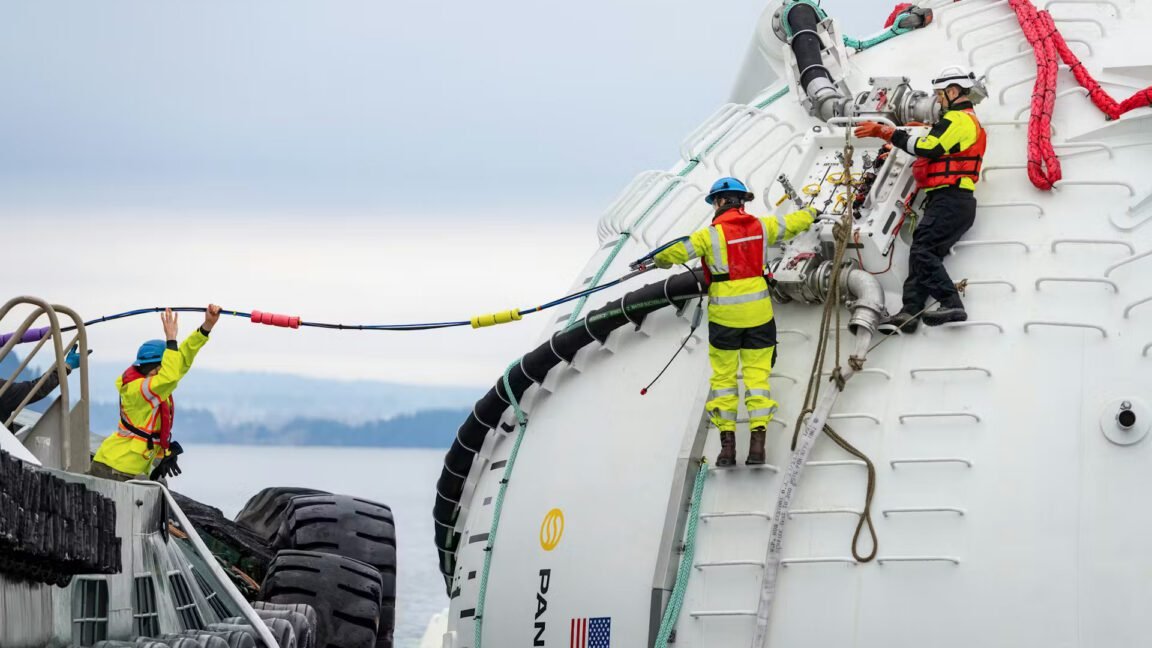
Silicon Valley investors such as Palantir co-founder Peter Thiel have bet hundreds of millions of dollars on deploying AI data centers powered by waves in the middle of the world’s oceans—a move that coincides with tech companies facing mounting challenges in building AI data center projects on land.
The latest investment round of $140 million is intended to help the company Panthalassa complete a pilot manufacturing facility near Portland, Oregon, and speed up deployments of wave-riding “nodes” designed to generate electrical power, according to a May 4 press release. Instead of sending renewable energy to a land-based data center, the floating nodes would directly power onboard AI chips and transmit inference tokens representing the AI models’ outputs to customers worldwide via satellite link.
“Panthalassa’s idea transforms an energy transmission problem into a data transmission problem,” Benjamin Lee, a computer architect and engineer at the University of Pennsylvania, told Ars. “Performing AI computation on the ocean would require transferring models to the ocean-based nodes and then responding to prompts and queries.”
Each node resembles a huge steel sphere bobbing on the water with a tube-like structure extending vertically down beneath the surface. The wave motions drive water upward through the tube into a pressurized reservoir, where it can be released to spin a turbine generator that produces renewable energy for the AI chips on board.
Panthalassa claims the node’s AI chips would also get cooled using the surrounding water, which could offer another advantage over traditional data centers. “Ocean-based compute might offer a massive cooling advantage because the ambient temperature is so low,” Lee said. “Land-based data centers use a lot of electricity and fresh water for cooling.”
The newest node prototype, called Ocean-3, is scheduled for testing in the northern Pacific Ocean later in 2026. The latest version reaches about 85 meters in length and would stand nearly as tall as London’s Big Ben or New York City’s Flatiron Building, according to the Financial Times.
Panthalassa has already tested several earlier prototypes of the wave energy converter technology, including the Ocean-1 in 2021 and the Ocean-2 that underwent a three-week sea trial off the coast of Washington state in February 2024. The company’s CEO and co-founder, Garth Sheldon-Coulson, said in a CBS interview that he hopes to eventually deploy thousands of the nodes.
Challenges ahoy
But there are plenty of challenges to overcome before Panthalassa can attempt to transform the world’s oceans into AI computing resources. Relying on satellite links to transmit data between the nodes and customers means dealing with limited bandwidth and signal delays—there is a reason why data centers still use fiber-optic cables to transmit large amounts of data quickly while reserving satellite links as backups.
The limitations on satellite data transfers could also create complications if multiple nodes must coordinate to handle larger AI workloads. So it seems highly unlikely that such a scheme could replace traditional data centers, even if it might prove useful in some cases.
“Satellites could communicate perhaps hundreds of megabits per second per terminal, which is feasible for real-time responses to prompts and queries,” Lee told Ars. “But frequent communication and coordination between nodes may be challenging. And transferring larger volumes may require more time and physically transporting storage disks to the data center nodes by ship, but this should be done only periodically.”
Maintenance and replacement issues could also prove complex for nodes scattered across the world’s oceans, Lee pointed out. Panthalassa wants to ensure the nodes are capable of “surviving for more than a decade in the harshest ocean conditions” while lasting “without human maintenance or intervention,” according to recent company job listings that describe the node technology. The nodes are also supposed to be autonomous and self-propelled, although initial deployment would likely occur by ship.
The idea of placing computing resources and data centers in the ocean has surfaced before in other projects. The most well-known example comes from Microsoft’s Project Natick, which experimented with putting data center servers underwater in 2015 and 2018. Such underwater trials “showed that sealed, seawater-cooled systems could achieve lower failure rates than land-based systems,” Lee said.
Microsoft eventually decided against commercializing that vision, for now. But Chinese companies have gone ahead with deploying underwater data centers near Hainan Island and off the coast of Shanghai. There have also been several attempts to build floating data centers, with one of the most recent being the company Keppel starting construction of a floating data center for Singapore.
The Panthalassa plan is more audacious than previous ocean-based efforts in many respects. But Silicon Valley’s willingness to invest $210 million so far in such a vision is less surprising when considering how major US tech companies have committed to spending $765 billion on building AI data centers in 2026—and they are facing growing resistance from local communities along with construction delays associated with power supply constraints and labor shortages.
Whatever the engineering and business challenges, floating AI computing nodes at least appear more feasible than Silicon Valley’s other big bet on orbital data centers.