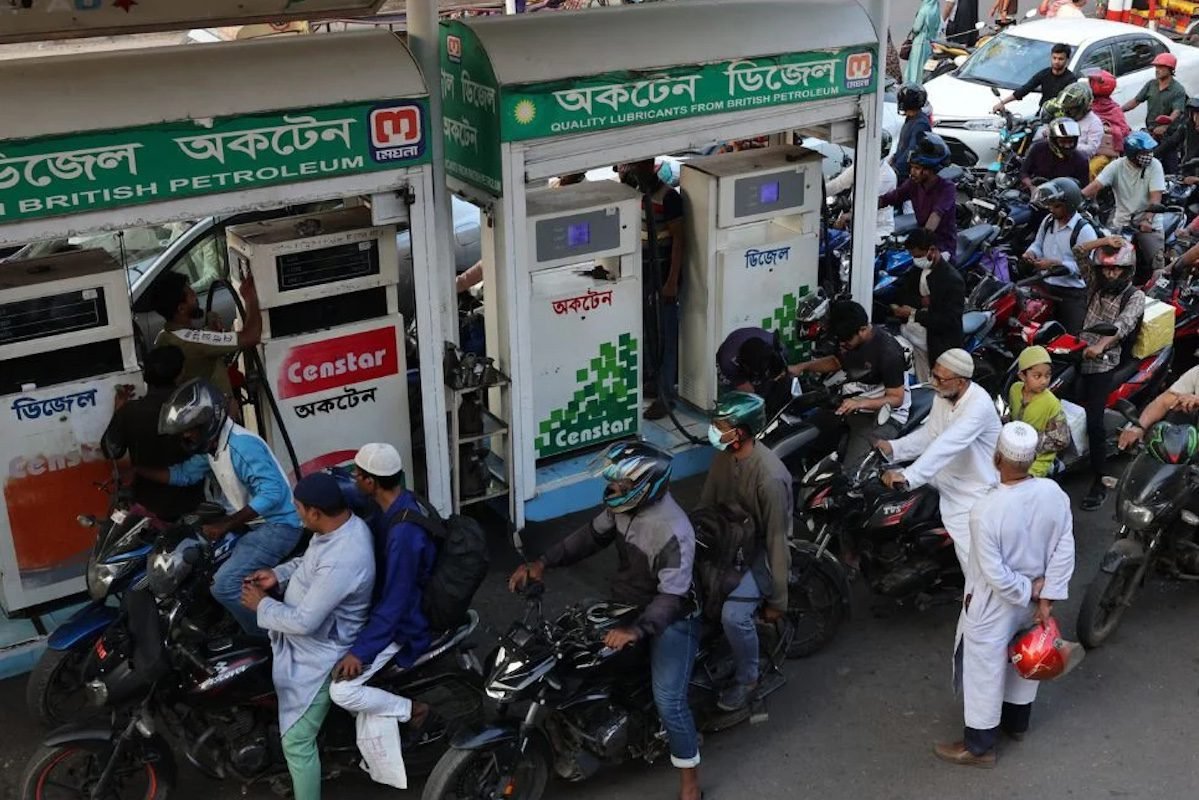
The US-Iran war is exposing a hard truth: Asia is a tiered system of energy access, where wealth determines resilience.
Investors have for years treated Asia as a single growth engine. Capital flowed into the region on the assumption that, despite the clear, well-known differences between nations, many fundamentals held: stable trade routes, manageable energy costs and export-driven expansion.
But this assumption is now under strain. Roughly a fifth of global oil supply typically passes through the Strait of Hormuz, but disruption there doesn’t hit Asia evenly, though. It sorts winners from losers.
Japan, South Korea and Singapore sit at the top of this hierarchy. They import most of their energy, but they also have the financial capacity to secure it.
Japan holds more than US$1 trillion in foreign exchange reserves. South Korea has over $400 billion. These countries can defend currencies, subsidize fuel, and outbid competitors when supply tightens.
Lower down the scale, the picture becomes far more fragile. Bangladesh is running inflation above 8%, with officials warning that fuel costs are draining public finances.
Thailand, with one of Asia’s highest ratios of oil imports to GDP, has already cut its economic growth forecast to 1.5%. South Korea’s import prices surged 16.1% year-on-year in March, highlighting how quickly external shocks feed through into domestic costs.
The Asian Development Bank has cut regional growth forecasts to 4.7% from 5.1%, while raising inflation projections to 5.2%. These numbers matter, but, arguably, the pattern matters more.
Asia is splitting into tiers defined by energy security, fiscal strength and access to capital. In a tight market, of course, oil does not flow equally. It flows to those who can pay. And this creates a hierarchy of economic resilience.
For global investors, this changes how Asia should be understood. The old framework, of broad regional exposure capturing growth, is no longer sufficient.
Energy access is becoming a primary filter for capital allocation. Countries with strong reserves, credible policy and diversified supply will attract investment. Those without will see rising risk premiums.
Currency markets are already reflecting this divide, too. Japan has spent around $35 billion supporting the yen as energy costs push the currency lower. Other Asian economies don’t have the same firepower. As import bills rise, currencies will weaken, feeding further inflation and tightening financial conditions.
Bond markets will follow, as they always do. Those nations with weaker external balances and higher import dependence will face higher borrowing costs. Fiscal space will shrink precisely when governments are forced to spend more on subsidies.
Subsidies, in fact, are part of the problem. They buy time, but they don’t solve the underlying issue.
Japan can afford to cushion the impact of fuel prices. The Philippines can support public transport drivers. Vietnam can draw on emergency funds.
These measures soften the immediate impact, but they widen deficits and increase long-term vulnerability, particularly in economies with limited fiscal capacity.
The deeper shift is significantly more structural. Asia’s growth model has relied on cheap, reliable energy flowing from the Middle East, and that model, clearly, now faces sustained uncertainty.
Even if supply returns to normal, the risk premium will remain as shipping costs, insurance costs, and delivery times rise, and planning becomes harder.
Supply chains start to reflect this. The disruption in Hormuz has already contributed to a backlog of around 1,000 vessels, delaying cargo across energy and industrial inputs.
For manufacturing economies operating on tight margins and precise timelines, delays matter as much as prices. Production schedules slip, inventory costs rise and export competitiveness weakens.
All this, then, feeds directly into corporate earnings. Energy-intensive sectors, such as chemicals, transport and heavy industry, face margin compression. Companies in weaker economies struggle to pass on costs without hitting demand, and those with pricing power or exposure to energy supply gain a relative advantage.
Against this backdrop, savvy investors will need to adjust quickly.
Country selection becomes more important than regional allocation. Metrics such as foreign exchange reserves, current account balance and energy import dependence move to the center of analysis. Exposure to “Asia” as a single theme carries more risk than it once did.
China and India sit in complex positions within this hierarchy. China has scale and state control, but remains heavily dependent on imported energy. India continues to post strong growth, yet imports roughly 85% of its oil, leaving it exposed to price shocks.
Neither is insulated. Central banks across the region are, as such, facing difficult choices. Raising rates supports currencies but slows growth; yet holding rates risks deeper inflation and further currency weakness.
Singapore has already tightened policy, Australia is weighing further increases and others face similar trade-offs with less room to maneuver. The result is a region that is increasingly out of sync.
Nigel Green is CEO and founder of deVere Group